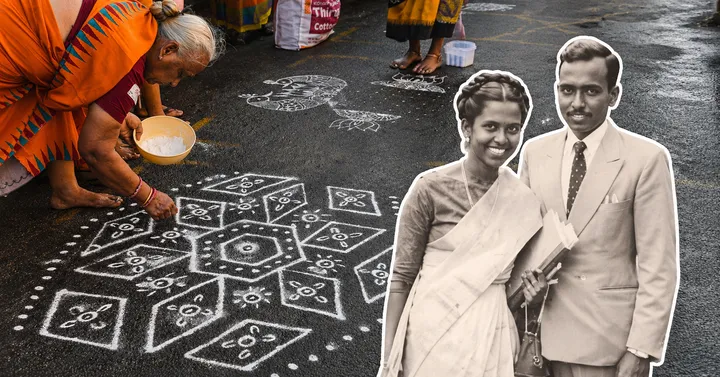
Early each morning in the month of Margazhi, a statistics professor would set out on his motorbike to watch women at work on their doorsteps. Gift Siromoney admired the kolams, but he was chasing a different question.
How did women, many of them nonliterate, loop a line around a grid of dots, close it without error and repeat the feat from memory the next day?
Working with his wife and fellow academic Rani Siromoney at Madras Christian College in Tambaram during the early 1970s, he concluded that the drawing follows rules precise enough to be written down as a formal grammar that a computer can run.
A tradition older than the textbooks
Every morning, women across Tamil Nadu sweep their thresholds, sprinkle them with water and cow dung, and trickle powder between their fingers to build symmetrical patterns, as the mathematician Marcia Ascher described in American Scientist in 2002.
A kolambegins with a grid of dots called pulli, and tradition holds that the rice flour feeds ants and insects, so the day opens with an act of kindness.
Siromoney traced the earliest mentions of kolam in Tamil literature to the 16th-century Madurai Meenakshiammai Kuram, followed by the 17th-century Thiru Kutraala Kuravanji. He also noted that older Tamil word lists, ancient paintings and travellers’ accounts say nothing about the art, so its documented literary history begins only in the 16th century.
A red pen and seven sheets of carbon paper
To see how a kolam grows, Siromoney devised a trick. He stacked seven sheets of paper, interleaved them with carbon paper, and asked practitioners to draw with a red ballpoint pen, removing the top sheet and its carbon at the end of each stage. Every sheet then showed earlier strokes in black and the newest stage in red, which gave him a frame-by-frame record of the drawing.
Skilled practitioners always drew the pulli first and then built the pattern stage by stage in its natural segments, which suggested that they remembered kolams as chains of smaller units rather than as whole pictures. Practitioners and novices differed in how well they copied unfamiliar kolam patterns, so Siromoney treated kolam drawing as a learned skill.
T Robinson of the college’s mathematics department adds that the women drew almost like the turtle moves of a programming language, with instructions such as go forward, turn left, and make a loop.
How a folk art became a picture language
With the computer scientist Kamala Krithivasan, the Siromoneys published ‘Picture languages with array rewriting rules’ in 1973 and ‘Array grammars and kolam’ in 1974.

Their idea treated each kolam as a sentence in a pictorial language, where rules rewrite a small array of symbols into a larger one, much as grammar rules grow a sentence. Computer programs could then generate kolam patterns of a given type mechanically. Later researchers use these models, which they call Siromoney array grammars.
The team also asked whether a pattern is made of one strand or several. For interlaced sikku kolam, Siromoney introduced operations called cut and join, which turn a single-strand pattern into a multi-strand one and back.
Rani Siromoney and colleagues later noted that the same operations appear in the theory of circular DNA splicing.
Why the discovery still matters
For computer scientists, kolams supplied ready-made examples of existing picture languages and inspired new types, so a doorstep craft helped shape how machines draw and recognise images. None of this required the women to know any grammar.
R Narasimhan, who worked alongside Siromoney, observed that a large share of practitioners were nonliterate and unaware that their designs have grammatical properties. The couple’s school of formal language theory at Madras Christian College, he wrote, became one of the best and most active in the field.
The research continues. A 2018 paper by K G Subramanian, T Robinson and colleagues generated kolams using membrane computing, a model inspired by living cells, and showed that it can produce designs that earlier array grammars could not handle. Subramanian did that work in the college’s Department of Mathematics, so the research still runs from Tambaram.
Kolams were one strand of a restless career. Siromoney also used computing to date medieval Tamil inscriptions, applied cluster analysis to sculptures at Mamallapuram and built what South First describes as the first teleprinter keyboard for Tamil.
He died on 21 March, 1988, aged 56. Yet every Margazhi morning, the women whose hands inspired his grammar keep drawing, and the rules he glimpsed keep running quietly beneath their fingers.
Sources
‘Gift Siromoney, polymath who used AI concepts in the 80s to solve historical mysteries’: by Poorani Balendra for South First, Published on 21 March, 2023
‘KOLAM’: by T. Robinson for Chennai Mathematical Institute (Gift Siromoney memorial pages)
‘The Kolam Tradition’: by Marcia Ascher for American Scientist, Published in January-February 2002 (Volume 90, Number 1)
‘Generation of Kolam-Designs Based on Contextual Array P Systems’: by Ibrahim Venkat, T. Robinson, K. G. Subramanian and Philippe de Wilde for Springer (Diagrams 2018), Published in 2018
Disclaimer : This story is auto aggregated by a computer programme and has not been created or edited by DOWNTHENEWS. Publisher: thebetterindia.com