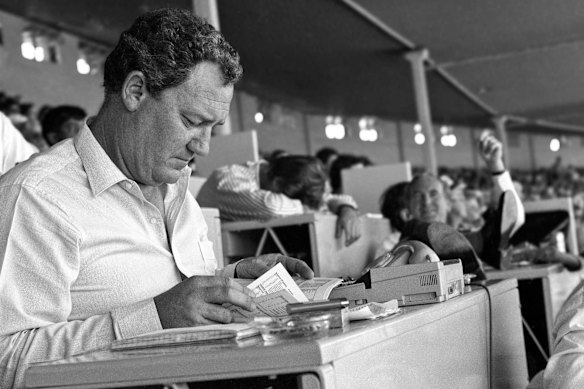

Alan Shiell was a cricketer gifted enough to make 202 for South Australia against the touring Englishmen at Adelaide Oval in 1965.
He was a journalist trusted enough to break perhaps the biggest of all cricket news stories – Kerry Packer’s World Series Cricket breakaway in 1977.
And he was a man beloved enough to ensure there has been widespread grief and reflection at the news of his death from pneumonia in Adelaide this week at the age of 81.
Adelaide Oval’s flags were at half-mast and South Australia’s players wore black armbands on Tuesday, in gestures of respect for Shiell’s contribution to sport and to journalism.
In his early days, it appeared more likely that Shiell – widely known as “Shef” – would make his biggest mark by scoring runs rather than writing about them. Slender but powerful, Shiell was rated highly enough by teammates that they felt he was capable of playing Test cricket.
Certainly, the MCC team of 1965-66 were left wondering during his double century whether the 22-year-old would ever get out – he also made 81 against them in another tour game earlier in the season.
Talent was not the issue when Shiell gave cricket away at the age of 24; rather, in an era when professionalism was still more than a decade away, the dilemma was around committing to a “real job” and not missing large swathes of the working year to play the game.
Journalism, first with the News, then the Advertiser and for many years as The Age’s Adelaide-based sports writer, offered Shiell an opportunity to put his cricket knowledge and relationships to work.
He worked in the manner of the old school, writing with economy and dry wit, getting stories through copious phone calls and much pavement pounding, and enjoying the smells and sounds of the newsroom, the cricket and footy press boxes and the bar after (and occasionally during) play.
It was in a pub – the Overway Hotel in Hindley Street – where Shiell found Ian Chappell in February 1971, to tell his former teammate that he had been handed the job of Australian Test captain after the summary sacking of Bill Lawry. Shiell had called Chappell’s employer, W.D. & H.O. Wills, to be told he had gone to lunch – from there, he called the pub he knew to be Chappell’s favoured spot for a counter meal, and history was made.
Six years later and Shiell was a new father nervously contemplating the task of covering his first Ashes tour for News Limited (the group newspapers plus The Australian) when the bright young thing David Hookes, fresh off his Centenary Test heroics, confided a secret to die for over another pub lunch.
Packer had signed a bunch of the world’s best cricketers for a breakaway competition to go head-to-head with the Australian Cricket Board the following summer.
It wasn’t clear whether Hookes was tipping a story or simply conveying worries about his own future to a friend, but as was often the case with Shiell, it was possible for such conversations to be both. “He was worried about his future and whether he’d be able to play Test cricket again,” Shiell told me in 2017.
“He would have been speaking to me as a friend too, chatting all about it knowing I wasn’t going to write it the next day, but once it all broke he never had a go at me about it in England and was always comfortable about it there.”
Shiell always had a certain humility about him that was occasionally reflected in underestimation of his own ability. That was shown in how, fearing his rival’s ACB contacts, he shared the story with Peter McFarline at The Age, meaning they would jointly break it to the world a month or so into the tour.
From there, Shiell was swept up in a story that not only changed cricket forever, but also had a considerable relationship cost. One of his more sobering exchanges about the story was with Len Maddocks and Norm McMahon, the ACB representatives on the tour.
“They didn’t believe it and didn’t want to believe it, but they soon had to believe it!” he said. “Things were never the same, on the tour or after it.”
Nothing underlined the human toll quite like the tear-stained resignation of Kim Hughes from the Test captaincy in Brisbane in November 1984, as his team was being hammered by the West Indies while being riven by old WSC wounds within. Shiell was at the press conference where Hughes quit, and kept the resignation statement.
The following year Shiell covered the third and last of his Ashes tours, after 1977 and 1981. These trips had kept him away from covering the SANFL in Adelaide, where he was a reliable source of news from across the league while always maintaining his love of the Norwood Football Club and making many lasting friendships there.
Shiell continued covering summer and winter sports for The Advertiser into the early 1990s, also ghostwriting a spiky Hookes autobiography, and penning some memorable words about the Adelaide Crows’ stunning entry to the AFL with an 86-point hiding of Hawthorn at a heaving Football Park in 1991.
A couple of years later, he was at Adelaide Oval to chronicle the West Indies’ heart-stopping defeat of Allan Border’s Australians by what he termed “one measly run”. He was also an unabashed advocate for Adelaide Oval to acquire floodlights, leading the grand old ground into the 21st century and a world-class redevelopment.
After leaving The Advertiser, Shiell wrote for The Age from 1994 to 2007 and also contributed to a selection of Adelaide-based publications, remaining a fixture at major sporting events and being unfailingly generous in his offers of advice, phone numbers and fellowship.
He wrote on the Tony Modra phenomenon in Adelaide, in 1997 penned a neat interview with Norm Smith medallist Andrew McLeod, and two years later led a hard-nosed investigative piece about the centre bounce disc on which Shaun Rehn wrecked his knee.
The stairwell in the old Sir Donald Bradman stand was a favourite haunt for smoke breaks, while phrases like “who took strike?” or “just a few pars” were uttered often.
Much of Shiell’s work is confined to the microfilm archives of our libraries or the digital resource of Newsbank, but some remains online. His 2011 tribute to Shane Warne’s mentor Terry Jenner is terrific, full of sharp observations and real feeling.
He was never happier than when he had the opportunity to sit down and talk through the sports he loved so much with the likes of the Chappell brothers, Ken “KG” Cunningham or, in footy, Norwood chums such as Neil Craig and Neil Balme.
In later years, Shiell struggled with ill health, battling cancer and the debilitating loss of power and mobility in the legs that had carried him all the way through the aforementioned innings of 202. But he enjoyed the chances to spend time reminiscing and celebrating life with family, friends and former colleagues, including a lively 80th birthday celebration last year.
Shiell is survived by his son Brad and his grandson, Luke. His death came suddenly on Monday, after a brief bout of pneumonia.
But it has been remarked more than once in subsequent conversations among his many friends that considering the number of shots “Shef” played, it had been a long and rewarding innings.
 Daniel Brettig is The Age’s chief cricket writer and the author of several books on cricket.Connect via X.
From our partners
Disclaimer : This story is auto aggregated by a computer programme and has not been created or edited by DOWNTHENEWS. Publisher: www.smh.com.au