
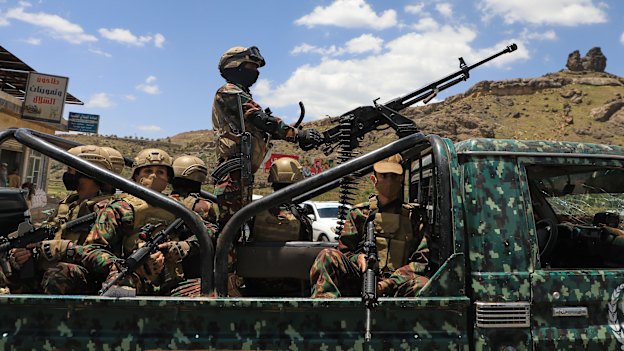
In a matter of hours, an Iran-allied militia trounced Saudi-backed forces to take control of Yemen’s Red Sea coast. No one was able – or willing – to stop them.
Riyadh, Saudi Arabia: In the weeks before the Iran-backed Houthi militia fanned out along Yemen’s Red Sea coast, sending their foes into a frenzied retreat, a Yemeni government commander called for help.
It was obvious to the commander, Lieutenant General Tariq Saleh, that the Houthis wanted to seize his territory to reach the Bab el-Mandeb Strait, one of the most important waterways in the world.
According to three Yemeni officials, he tried to warn his powerful allies in Saudi Arabia and the United States. About 10 per cent of global trade goes through the strait. Amid the US-Israeli war with Iran, both countries had an interest in preventing an Iran-linked militia from winning a perch beside it.
Yet last month – when the Houthis did just that – no one was able, or willing, to stop them.
The militia’s stunning triumph over the Bab el-Mandeb, which unfolded in a single night of chaos and panic, set off a cascade of events that plunged Yemen back into a war with global reverberations.
This month, Saudi Arabia began a bombing campaign to help the Yemeni government reclaim the territory it lost, with intelligence and targeting assistance from the US military. Government-allied forces claimed to have since made significant gains, besieging the Houthi fighters who held the strait.
It is unclear whether the Houthis’ advance will hold, or where they will stop if it does. The Saudi government has pledged to help the Yemeni government “eliminate” the Houthis. The last time they took up that mantle, a decade ago, it devolved into a bloody quagmire.
This is the inside story of the battle that reignited Yemen’s war and the dark lessons it imparts for the next phase of fighting. The Houthi victory on September 10 showed how a ragtag militia transformed into a formidable force with advanced technology. It was a major defeat for the Yemeni government and its Saudi patrons, demonstrating that they were unable to fight cohesively and plagued by internal strife.
This article is based on interviews with more than 15 people who participated in the fighting or were briefed on what happened, including soldiers, Yemeni military officers, officials with Yemen’s internationally recognised government, US officials and Houthi officials. Almost all of them spoke on condition of anonymity, either because they feared retribution from the Houthis or Saudi Arabia, or because they were not authorised to discuss what happened.
Their accounts make it clear that while the Houthis’ victory last month surprised many, it was foreseeable.
For months, the US military and intelligence agencies had warned Saudi Arabia about a resurgent threat from the Houthis and urged Saudi officials to unify the fractious forces of the Yemeni government, according to two senior US officials and one former senior US official.
In the lead-up to his defeat, Saleh had reached out to Saudi and US officials, seeking greater support in holding back the Houthis, according to a Yemeni government official and two senior Yemeni military officers. The officers said he had asked the Saudis for air cover and the Americans for electronic jamming of Houthi communications. Saleh received little from either country, the three officials said. Even some in his own government seemed disinclined to intervene.
US officials offered assistance with planning and intelligence – including on Houthi troop movements – but emphasised that their aid was limited and would not include airstrikes, the current and former US officials said.
It is unclear why Saudi Arabia, equipped with US fighter jets and bombs, did not step in more intensively on its own. The Saudi government did not respond to a request for comment, nor did the White House.
The Houthis, who survived a US bombing campaign last year, gained international attention during the war in the Gaza Strip by launching missiles and drones at Israel and vessels in the Red Sea. Holding territory along the Red Sea would make it even easier for the group to disrupt shipping, analysts say.
Whether any foreign military campaign could have held back the militia remains an open question. Mohammed al-Bukhaiti, a Houthi political official, attributed their victory to progress they had made in developing their military capabilities throughout years of war. The Houthis are fighting “to liberate Yemen from occupation”, he said, dismissing their foes as Saudi “mercenaries”.
Two Yemeni government soldiers interviewed by The New York Times said they ultimately blamed their own feckless leaders for their defeat.
It was just after sundown on September 9 when everything crumbled, according to one of their comrades, who spoke on condition of anonymity, fearing retribution.
He recalled how he had been stationed with other soldiers outside Mokha, a historic port city near the Bab el-Mandeb, when they received reports of Houthi fighters advancing from multiple directions. Suddenly, their communications went dark, he said, severing contact with other units. They heard shouting.
“Retreat! Retreat! Retreat!” he remembered his comrades yelling. “The Houthis are already here!”
They turned and fled for their lives.
Rebels on the rise
The Houthis’ recent conquest belies their simpler origins. The group began in the 1990s as a religious movement focused on Zaydism, an offshoot of Shiite Islam. Its leaders later mounted an armed rebellion against Yemen’s government, saying that they were battling corruption and foreign influence.
Scholars debate when Iran began supporting them, but the Houthis eventually became a key Iranian ally.
In 2014, they took over Yemen’s capital, Sanaa, routing the government and starting a civil war. Saudi Arabia and the United Arab Emirates began a disastrous military campaign to restore the government. Hundreds of thousands of people died from violence, hunger and disease. The Houthis survived, cementing their rule over northern Yemen.
After a truce in 2022, the Houthis used the lull in fighting to become stronger and more self-sufficient, expanding their arsenal, analysts say.
The Yemeni government did not. During the war, it had become increasingly fragmented and weak, beholden to its Saudi and UAE patrons – which were often at odds with each other.
“The Yemeni government is basically a fiction at this point,” said Gregory Johnsen, a non-resident fellow at the Arab Gulf States Institute in Washington. “They spend more time fighting one another than they do the Houthis.”
One of the key players in this government was Saleh. The nephew of Yemen’s former authoritarian leader, he had made plentiful enemies over the years as he seesawed from one alliance to another – siding with the Houthis, then joining the government.
In Mokha, with UAE backing, he formed his own armed faction. His soldiers, numbering about 50,000, served as a bulwark against the Houthis pushing south towards the Bab el-Mandeb. Then, in January, the UAE withdrew from Yemen amid a feud with Saudi Arabia. Saudi officials consolidated their control over the government’s many factions. Once again, Saleh found himself with a new sponsor: Saudi Arabia.
The offensive begins
When the US and Israel attacked Iran in February, the Houthis appeared willing at first to sit out the war. But behind the scenes, Yemen’s truce had become a brittle stalemate.
Talks aimed at a long-term peace deal – from which the Houthis hoped to gain greater authority and access to oil revenue – had stalled. Poverty in Houthi territory was dire, putting pressure on the group. They blamed Saudi Arabia and bristled at Saudi restrictions on Yemeni airspace.
The tensions came to a head in July. The Houthis accused Saudi Arabia of bombing Sanaa’s airport to prevent an Iranian aircraft from landing. They declared a blockade on Saudi shipping in the Red Sea, now a crucial route for oil exports during the Iran war. They launched missiles and drones into Saudi Arabia, and the kingdom launched airstrikes on Yemen.
This escalation dovetailed with the interests of Iran, where officials were pushing to widen the war with the US, raising its costs for President Donald Trump.
As the Houthis put pressure on oil markets, some Yemeni government officials sensed an opportunity to solicit foreign support to fight the Houthis.
Clashes reignited inside Yemen, and Houthi officials accused Saudi Arabia and their Yemeni allies of preparing a new offensive against them. Quietly, the militia readied its own plans.
On August 9, the Houthis began to shower Mokha with missiles and drones, damaging the port and seeking to cut off the city’s supply line from the sea, according to two Yemeni military officers. Then, on September 3, the Houthis began a huge ground offensive.
A push towards the coast
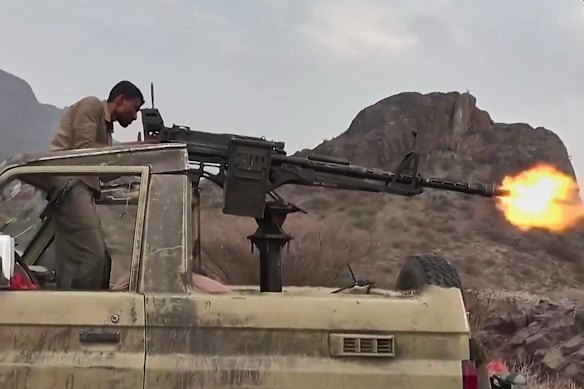
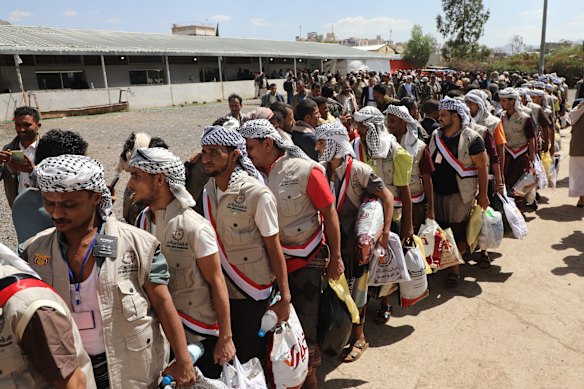
A 39-minute video released by the Houthis, which they said was filmed during fighting for control of the Red Sea coast, shows their militiamen scaling rugged mountains on foot and waving guns in jubilation.
The video, which the Times was unable to independently verify, also shows the bodies of what appear to be Yemeni government fighters slumped inside vehicles. At the end, a toothless Houthi fighter vows to “pursue the enemy into their very lairs”.
For more than five days, the government force held off the militia, battling in the mountains above Mokha. Eventually, the Houthis were able to push forward, with an onslaught of missiles, drones and shelling. Saudi Arabia carried out only minimal airstrikes to assist its Yemeni allies, according to the two Yemeni military officers.
On the evening of September 9 and into the next morning, the government forces collapsed. In a flurry of confusion, they beat a rapid and disorganised retreat. The Houthis seized a major military camp in the foothills east of Mokha – leaving their enemies on the coastal plain exposed and vulnerable.
Instead of reorganising, the government’s soldiers withdrew all the way to the southern city of Aden, handing the entire Red Sea coast, including an island inside the Bab el-Mandeb Strait, to the Houthis.
Overnight, Yemen’s government had lost more than 4500 square kilometres of territory. At least 500 of Saleh’s fighters were killed and more than 1500 wounded, according to a statement by his group. The Houthi death toll is unknown.
Scattered and wounded
Soon after Mokha fell, Saleh and several of his comrades flew to the Saudi capital of Riyadh, according to one of the Yemeni government officials and two of the military officers. There, they decamped to a five-star hotel, where easy listening music echoed through a cavernous lobby and servers brought tea with madeleines.
One of the military officers, who is close to Saleh, told a Times reporter that he was now focused on regrouping his forces and treating the wounded. Eventually, there will be an investigation into what went wrong, he said.
In Yemen, Saleh’s soldiers have scattered. Some were left stranded outside Aden after fighters from other factions – ostensibly their allies – barred them from the city, according to the officer close to Saleh and another soldier. Speaking by phone from their makeshift encampment, that soldier said that they had gone days without food.
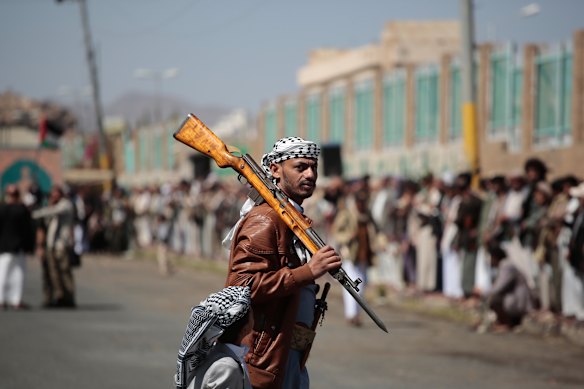
In public statements, the Houthis sought to reassure the international community that they posed no threat to maritime security – only to Saudi Arabia, one of the world’s largest exporters of oil.
As oil prices surged above $US100 a barrel, the Houthis began pushing to expand their territory further, promising to “liberate” all of Yemen.
Last weekend, the Yemeni government’s leader, Rashad al-Alimi, declared a full-blown war against the militia. The government’s goal, he said, was to reclaim all the territory lost to the Houthis over the past 12 years.
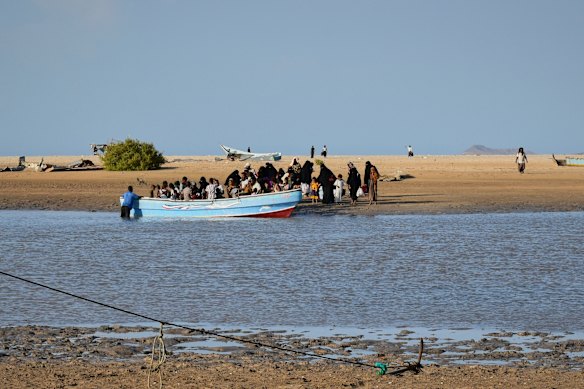
For Yemeni civilians, already facing dire poverty and hunger, the war’s return portends deeper suffering. More than 180,000 people have been displaced in recent weeks, often piling onto pick-up trucks and motorcycles as they rushed to escape.
“The moment felt like doomsday, with everyone looking out for themselves,” said Hassan Sughair, a civilian who fled from a town near Mokha. “We did not even say goodbye to our neighbours, and we do not know what happened to them.”
This article originally appeared in The New York Times.
Get a note directly from our foreign correspondents on what’s making headlines around the world. Sign up for our weekly What in the World newsletter.
Disclaimer : This story is auto aggregated by a computer programme and has not been created or edited by DOWNTHENEWS. Publisher: www.smh.com.au



