
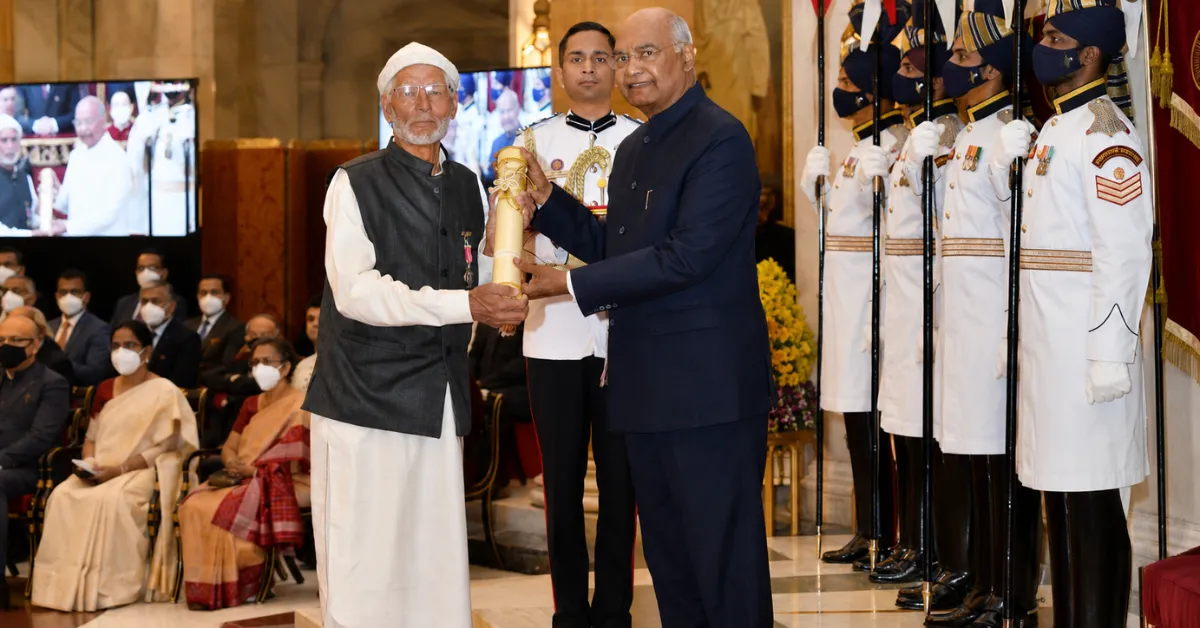
In the village of Karkitchoo, about 13 kilometres from Kargil town in Ladakh, lives a man who has never sat in a classroom, and yet holds an honorary doctorate.
Akhone Asgar Ali Basharat, now in his seventies, is a writer and poet of Balti, a language spoken in Ladakh and the Baltistan region of Pakistan-occupied Kashmir.
What began as a love for verse in his father’s home has grown into a five-decade mission to document, preserve, and breathe life into a language that the census data show is steadily losing speakers.
His early education came from a madrassa (educational institution) his father established at their home in 1972, where students were taught Balti, Persian, and Arabic.
That beginning gave Basharat fluency across scripts and traditions, making him uniquely suited to compile and author literary works in a language with no known dominant institutional backing.
He became interested in writing poetry around 1980, with his early works being Naat — poetry in praise of the Prophet Muhammad — and Manqabat, a Sufi devotional form.
From those beginnings, his writing expanded into the full cultural landscape of Balti life: its geography, oral histories, and the community divided by the Line of Control.
Five books and a shrinking language
Over more than 50 years of writing, Basharat has compiled three books and authored two more.
As a compiler, his works include Guldasta-e-Najaat, a collection of Balti Masnavi and Behra Taweel; Muhzinul Bukaa, a collection of Balti Marsia and Noha; and Raah-e-Behasht, an anthology of poetry by old Balti poets, including some works by Persian poets.
As an author, he has written two poetry collections, Guldastae Basharat and Bazme Basharat.
The urgency behind that body of work is not sentimental; it is statistical. The Balti language faced a speaker decline of 31.31% between the 2001 and 2011 censuses, and UNESCO classifies Balti as a vulnerable language spoken in both India and Pakistan.
India is home to hundreds of indigenous languages under threat, but Balti’s situation is particularly fraught because the community it belongs to is split across an international border that prevents the kind of free cultural exchange that might otherwise sustain it.
Taking Balti into classrooms
Basharat’s literary journey received a significant boost when All India Radio’s Kargil station launched in 1999; he was a regular at its poetry recitation programmes from the very first day.
As a presenter and writer of radio programmes like Mehfil-e-Mushaira, he helped bring Balti poetry into homes across Jammu and Kashmir, much as other remarkable people of Kargil’s AIR station have shaped the region’s cultural life.
/filters:format(webp)/english-betterindia/media/media_files/2026/06/22/3-2026-06-22-12-49-26.png)
Beyond the airwaves, his work entered formal education: between 2016 and 2017, he served on a committee that prepared the Balti language syllabus for Jammu and Kashmir Board of School Education (JKBOSE), and under his supervision, the basic Balti language textbook for NCERT was compiled.
In July 2024, the University of Ladakh conferred an honorary doctorate on Basharat at its inaugural convocation, in recognition of his efforts to preserve and promote the cultural heritage of the region.
The self-taught poet who received the Padma Shri
In 2022, Basharat was conferred the Padma Shri, India’s fourth-highest civilian honour, for his contributions to literature and education through the preservation of Balti, marking the first time the award had gone to a Balti writer.
Other writers working to save endangered languages have received similar recognition from the state, but Basharat’s case stood out: the honour came to a man who had never sat for a formal examination.
Basharat admitted he had never expected the award when he received the call about his nomination. Yet recognition did not resolve the practical struggles that define life as a writer in a minority language.
A year after receiving the Padma Shri, he was still searching for the means to publish his latest anthology of Balti poetry, a substantial collection he described as highlighting multiple facets of the language and culture divided by the Line of Control.
India’s palm-leaf manuscripts have the National Mission for Manuscripts behind them. Balti has Akhone Asgar Ali Basharat, working from a village in Kargil, hoping someone will fund the printing of his next book.
What sustains him is what started him: his father’s influence, and the conviction that a language is not just a tool of communication but the vessel of everything a people know about themselves. It is the fear of cultural erosion, he says, that keeps him writing.
Sources:
‘Akhon Asgar Ali Basharat gets Padma Shri‘: by the Administration of UT Ladakh, Published on 26 January 2022
‘The Unschooled Laureate: Akhone Asgar Ali’s odyssey from Kargil village to Padma Shri fame’: by Rising Kashmir, Published on 4 August 2024
‘A year after receiving Padma Shri, Balti author Akhone Asghar Ali Basharat struggles to get book published‘: by Awaz The Voice, Published on 22 December 2023
‘Language and Culture Preservation in Kargil: A Focus on the Balti Language‘: Published in Cultural & Religious Studies Review, via Academia.edu
Disclaimer : This story is auto aggregated by a computer programme and has not been created or edited by DOWNTHENEWS. Publisher: thebetterindia.com






