Alex Palou’s 2025 season was the best for an IndyCar driver in nearly 20 years.
He won a career-high eight races, including the Indianapolis 500. He won his third straight series title and his fourth championship overall. He made the podium 13 times in 17 races.
Yet if you ask Palou, he’ll tell you he’s going into Saturday’s qualifying for Sunday’s Grand Prix of Long Beach needing to prove himself all over again.
“Who cares about what we did last year?” he said. “It’s cool to have four championships, but the only important year is 2026. Everybody started with zero points on the board and we need to do it all over again.”
That’s far easier said than done, although Palou is off to a fast start in his quest for a fifth championship having won two of the first four races on the IndyCar schedule to stand second in the driver standings, two points behind defending Long Beach champion Kyle Kirkwood.
“Last year was magical,” said Palou, who has captured 10 of the last 21 checkered flags, dating to 2024. “As an athlete you always want to keep on improving, but I need to be realistic and understand that to win eight races in IndyCar in the same year, it’s pretty tough to beat.
“So although I want to achieve that, we just need to take 2026 separately and just try our best, try to win as many races as possible and then obviously fight for the [Indy] 500 and the championship.”
Winning Long Beach, one of the few prizes on the IndyCar circuit that has eluded him, would be a big step in that drive for five. But that won’t be easy since passing on the tight 1.968-mile street course, with its 11 turns, is difficult. That makes track position important, putting a premium on Saturday’s qualifying and on pit stops in Sunday’s race.
“It’s always super tough to be competitive there,” Palou said of Long Beach, where he finished second last April, giving him three straight podium finishes. “One of the only bad things about street racing [is] that it’s really tough for us to overtake with how tight the tracks are and all the bumps.
“It just makes it super challenging.”
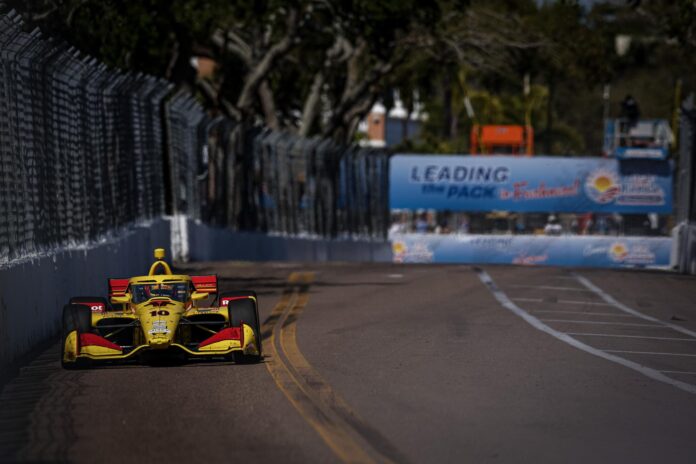
Alex Palou competes during the Grand Prix of St. Petersburg in Florida on March 1.
(David Jensen / Getty Images)
Not as challenging as the race Palou, the most successful Spanish driver in IndyCar history, had to run just to get into a race car.
As a boy growing up in the tiny Catalan village of Sant Antoni de Vilamajor, Palou started kart racing about the same time he started grade school. He was 15 when he finished second in the 2012 European karting championship yet he didn’t see much of a future beyond that.
Lewis Hamilton had finished in the same spot 13 years earlier, then went on to become the most successful Formula One driver in history. But England has a long-established history with open-wheel racing and Spain did not.
“He came from nothing, showing up at a carting track and then having these big dreams and aspirations. And here he is,” said Barry Wanser, the senior manager of IndyCar operations for Chip Ganassi Racing.
“I know he’s very proud he’s the first Spaniard to win the Indianapolis 500. That’s just absolutely incredible.”
But that was never the goal.
“Honestly,” Palou said, “my goal was just to have fun. When we started, I never wanted to be a race car driver for a living. I never thought that it would be possible.”
Before Palou, Fernando Alonso, a two-time F1 champion, was Spain’s most successful open-wheel driver. After Alonso is Carlos Sainz Jr., who has won four F1 races; Pedro de la Rosa, who made more than 100 F1 starts but climbed the podium just once; and Oriol Servià, who ran 79 IndyCar races in nine years but never placed higher than fourth before retiring in 2019, one year before Palou made his debut in the series.
Aside from Alonso, those drivers were good but not great, leaving the road from Spain to success in open-wheel racing a narrow one. That’s a path Palou is now widening.
“I would say that for sure it’s helping future generations that I’m here and that I had success,” he said, “just because they can know that with a normal European background you can come to the U.S. and fight for wins and championships.”

Alex Palou celebrates after winning the Grand Prix of St. Petersburg on March 1.
(David Jensen / Getty Images)
Wanser said what makes Palou so good is his feel for both the car and the track and his ability to communicate with his team.
“He has a very unique ability to understand what he needs the car to do to maximize performance on the tires,” said Wanser, the race strategist for Ganassi’s No. 10 car who has sometimes been called Palou’s indispensable partner. “You’re talking about road courses, street courses, for the primary [tires] — the hards and the softs — and understanding what he needs for qualifying and also what the car needs for reducing tire deg[redation] during the race.”
For now Palou, who turned 29 earlier this month, appears content with mastering those skills in IndyCar rather that following the natural progression into an F1 ride.
He said he went “all in” to win an F1 seat following his first IndyCar title in 2021, but doubts about whether he’d be given a competitive car led him to back out. Rumors linking him to Red Bull’s F1 team surfaced after last year’s Indy 500, but Palou shot those down too, saying he was staying with Ganassi.
Wanser, obviously, is happy with that decision and hopes it will pay off Sunday in Long Beach.
“Alex is very young, right?” he said. “IndyCar is so competitive that we could never, ever think about being complacent. If we start heading down that road, we will get beat and get beat often.
“It’s nonstop trying to constantly improve, knowing every weekend we show up to the racetrack it’s going to be difficult to win.”
More to Read
Disclaimer : This story is auto aggregated by a computer programme and has not been created or edited by DOWNTHENEWS. Publisher: latimes.com