
When Sankar Karuppasamy served as chief information officer at trading card manufacturer Topps, he reported to the chief financial officer. But after moving into the role of CIO at gum maker Bazooka, which was separated from Topps through a $700 million sale to buyout firm Apax Partners in 2023, the technologist began to report to the CEO, Tony Jacobs.
“There’s a lot of transformation going on, with the new owners supporting the investment,” says Karuppasamy of the role that technology plays in Bazooka’s future. The reporting structure shift reflects a broader trend across corporate America, as 65% of CIOs report to the corner office, up from 41% a decade ago, according to consulting giant Deloitte.
Karuppasamy has been deploying AI and machine learning quite broadly across Bazooka’s operations, helping sharpen demand forecasting, speed up marketing and packaging materials, piloting agentic AI in the company’s supply chain, and working on a project that transitions employees away from OpenAI’s ChatGPT in favor of Anthropic’s Claude. OpenAI and Anthropic are in the midst of an intense race that encompasses everything from who is developing the most advanced AI models to who can go public first.
Bazooka has seen its share of technological and economic change over its more than three-quarter-century history. After introducing its Bazooka chewing gum in 1947, the then-Brooklyn, New York-based company debuted Bazooka Joe Comics in 1953 and launched its “wearable” Ring Pop candy in 1977.
The advent of AI comes at a time when the food and beverage industry faces a number of challenges, with inflation-pressured consumers gravitating to private-label brands and overall consumption slipping as more Americans use GLP-1 drugs, which suppress appetites and lower calorie consumption. U.S. retail sales of confectionaries grew 1.5% in 2025, with unit sales down year over year in all categories (chocolate, non-chocolate candy, gum and mints) according to data from the National Confectioners Association.
Seasonality is another challenge for Bazooka. Candy sales spike around major holidays like Halloween, Valentine’s Day, and Christmas. That led Karuppasamy to invest in forecasting and scenario planning from the software vendor Anaplan, which he said utilizes machine learning to better forecast demand from retailers so that Bazooka can more precisely map out its manufacturing plans. Karuppasamy said forecasting accuracy has leapt to 90% from 60% before using machine learning in this manner.
Karuppasamy’s AI playbook is centered on three layers: productivity, changing unique workflows across different business functions, and an early effort to embrace autonomous, agentic AI. In the early days of the generative AI boom, Bazooka used ChatGPT for general productivity use cases.
But as the organization begins to evolve its thinking on AI away from generic use cases and more into developing AI tools for job-specific tasks and agentic AI, Karuppasamy said he was more impressed with what Claude has to offer. Still, he reserves the right to change his mind again. “Something else could pop up next year,” says Karuppasamy. “Because the space is so innovative.”
Bazooka offers employees foundational training to teach the basics of large language models, but while transitioning to Claude, it is also boosting department-level training that will focus on priority use cases and how to practically apply AI. The broad employee base has performance goals they need to hit for how they use AI, as do C-suite leaders when it comes to adoption and usage.
Some priority AI use cases that Karuppasamy has implemented across the business include facilitating faster recipe development, using AI to pull consumer insights from social media and retailer feedback, accelerating the production of marketing materials and ensuring all lingo that is used on its famous red-white-and-blue packaging adheres to local regulations, and enhancing software that’s used in Bazooka’s Pennsylvania manufacturing facility.
One technology advancement that Karuppasamy has resisted: robotics. “We don’t have a huge factory,” he says.
Karuppasamy is also spearheading a pilot program for agentic AI within the company’s supply chain. “Our first goal, before we run an agentic workflow, is to ensure we have a data-ready platform where the agent can work,” he says. Karuppasamy said Bazooka is keeping a close eye on the quality of the data, but also building the proper governance guardrails to ensure no data leaks out improperly.
He’s also chasing a proven outcome where agentic AI can show a tangible business outcome, with some priority use cases including freight management and tariff analysis. “We import a lot of our products from different countries, and it’s a big problem for us to continuously analyze it,” says Karuppasamy. AI, he hopes, can autonomously perform this work and show how tariffs will affect Bazooka’s finances.
John Kell
Send thoughts or suggestions to CIO Intelligence here.
NEWS PACKETS
Anthropic confidentially files for IPO. Mere days after the Claude maker announced a $65 billion Series H financing round that almost tripled the AI startup’s valuation from February, Anthropic on Monday confidentially filed for a public listing as it races to beat rival OpenAI to the market later this year. Anthropic’s latest $965 billion valuation topped OpenAI for the first time, due to investor interest in the company’s strong demand from enterprise clients for its coding and cybersecurity capabilities. Bloomberg has reported that Anthropic is expected to post $10.9 billion in revenue for the second quarter, more than double from the prior three-month period. The outlet also reported this week that Anthropic is allowing 150 additional groups to access the Mythos AI model, which can find cybersecurity vulnerabilities.
OpenAI sued by Florida. OpenAI recently emerged victorious after a jury rejected Elon Musk’s $150 billion lawsuit last month, but it is now in a new legal skirmish after the state of Florida filed a lawsuit against the AI startup, claiming the company aggressively marketed ChatGPT to the public while not disclosing risks. The lawsuit referenced two separate shootings where the alleged gunmen were reported to have asked ChatGPT questions while plotting their crimes. The filing also alleged there weren’t sufficient safety warnings for children. OpenAI, in a statement reported by the Associated Press, said ChatGPT “is a general-purpose tool used by hundreds of millions of people every day for legitimate purposes. We work continuously to strengthen our safeguards to detect harmful intent, limit misuse, and respond appropriately when safety risks arise.”
Don’t count SaaS out just yet. Software-as-a-service shares, under pressure as AI advancements put pressure on their business models and pricing structure, finally caught a break in May and notched their best stock performance as a sector since 2001, according to CNBC. Okta and Snowflake both gained after posting solid quarterly results, with the latter company’s shares also surging on the news that it would pay Amazon $6 billion for the tech giant’s Graviton chips over the next five years, an indication that Snowflake is seeing strong demand for its services. Salesforce also reported higher profits and sales in its quarterly results last week, amid strong demand for the software giant’s AI products.
Wix ties layoffs to AI, but overall impact on jobs remains murky. Wix became the latest tech company to directly link job cuts to AI capabilities, announcing last week that it would eliminate roughly 20% of its workforce. And Salesforce CEO Marc Benioff said during the company’s earnings call last week that he wasn’t hiring more engineers or employees in general and administrative roles, with staff only being added to the sales team. But plenty of questions still remain about how much of a direct link can be made between the actual deployment of AI tools and the total number of jobs enterprises are cutting due to those productivity gains. Fortune has been covering the issue closely, including one report centered on the chief economist at Apollo Global Management, who asserted there is “zero evidence of job losses because of AI,” instead saying cheaper technology will generate more demand for humans to drive a business forward. The New York Times, meanwhile, focused on Schneider Electric, where AI is being infused in manufacturing to augment work and not replace humans.
ADOPTION CURVE
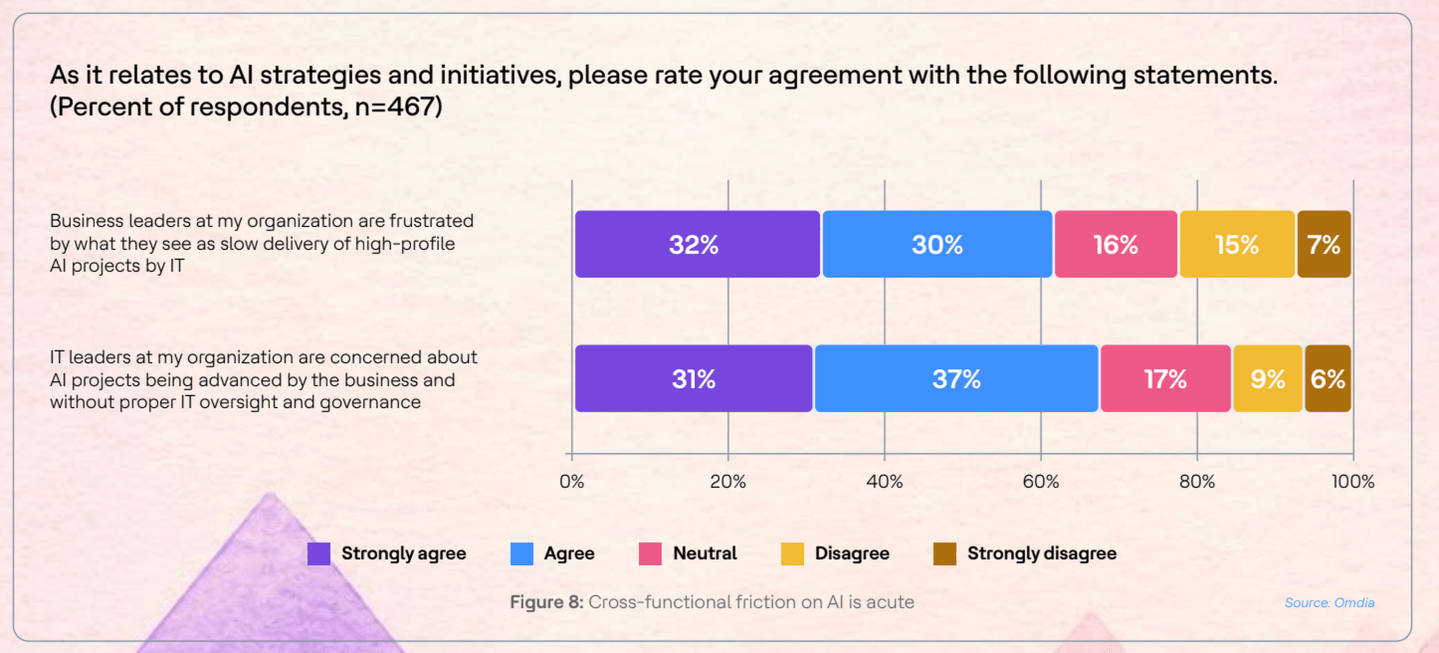
Businesses say IT is moving too slow on big AI projects. Six in ten business leaders say they are frustrated by the sluggish pace of high profile, IT-led AI projects, according to a new survey of 467 senior executives responsible for AI investments at enterprises with more than $1 billion in annual revenue. The study, conducted by IT services and consultancy HCLTech, found that nearly 43% of major AI initiatives are also expected to fail, with some of the greatest challenges including a lack of coordination and collaboration across business functions and misalignment on AI initiatives with business strategy.
Vijay Guntur, chief technology officer and global head of ecosystems at HCLTech, tells Fortune that the business leaders across sales, marketing, and other parts of the organization are buying into the hype cycle of AI and are anxious for all the promised top- and bottom-line benefits to materialize.
But organizations are still missing out on a few key steps, including organizing data, creating new workflow processes, and moving beyond merely sprinkling AI on the margins. “I think both business and IT are underestimating what it takes,” says Guntur.
And yet another, almost counterintuitive challenge to the slow AI adoption narrative: 68% say they are worried AI projects are advancing without proper IT governance. “Organizations are finding it very difficult to get a handle on what systems are being developed, how are they being governed, what is the risk, and how to manage AI,” adds Guntur.
Courtesy of HCLTech
JOBS RADAR
Hiring:
– Spectrum is seeking a head of technology, based in New York. Posted salary range: $263.2K-$393.8K/year.
– Mellon Foundation is seeking a CTO, based in New York. Posted salary range: $375K-$425K/year.
– Brown & Brown is seeking a senior vice president, IT strategy and innovation, based in Virginia Beach, Virginia. Posted salary range: $300K-$325K/year.
– Baxter is seeking a VP of IT, AT and data platforms, based in Deerfield, Illinois. Posted salary range: $304K-$380K/year.
Hired:
– EG Group named Michael Verdesca to the role of global CIO. Verdesca joined the convenience retailer, gas station, and foodservice operator after most recently serving as CIO at Murphy USA, which also runs gas stations and convenience stores. Previously, Verdesca served as CIO at Focus Brands and Jack in the Box and as director of supply chain systems at Longs Drug Stores.
– Stellar Health appointed Falko Buttler as CTO. He joined the healthcare technology provider after most recently serving as CTO at specialty healthcare provider Lantern. Buttler’s prior leadership experience in healthcare include serving as SVP of engineering at Accolade, VP of engineering at PlushCare, and senior director of engineering at Castlight Health.
– Teradata announced that Josh Fecteau, chief data and AI officer, would also assume the CIO responsibilities. The cloud database and analytics software company said combining the roles in a single function would create a more integrated foundation for enterprise-wide AI. Fecteau joined Teradata in 2019 and previously spent seven years at EMC, which merged with Dell in 2016.
– Rokt promoted Sam Dozor to the role of CTO, after previously serving as SVP of engineering at the ecommerce marketing company since February 2025. Dozor joined Rokt through the company’s acquisition of customer data platform mParticle, where Dozer spent over 11 years in various engineering leadership roles. Previously, he served as head of software engineering at Voxy.
– Simpro Group announced the appointment of Salman Bhatti as CTO, overseeing all technology and engineering functions for the software-as-a-service provider. Previously, Bhatti served as VP of engineering at tax compliance software provider Vertex. He also previously held VP-level engineering roles at UKG and Citrix.
– Stinker Stores announced several executive appointments, including promoting Cory Mooney to the role of CTO. Mooney has worked for the Idaho-based convenience store operator since 1995 when he joined as an auditor. He has received numerous promotions since then, most recently serving as VP of IT before joining the C-suite.
– LifeMD named Umesh Sripad as CTO, effective immediately, where he will lead the virtual primary care provider’s technology strategy, AI, cybersecurity, and data infrastructure. Sripad joined LifeMD from the online pet pharmacy PetMeds, where he served as chief digital and technology officer. He also previously served as chief product officer at digital commerce and marketing technology provider PureRED.
– Reborn Coffee announced the appointment of Thomas Tran as chief operating officer and CTO. He joins the California-based coffee retailer after most recently serving as founder and CEO of omnichannel commerce systems manager ZAP Technologies.
Fortune AIQ Special Digital Issue: The AI Economy
From global corporations to local entrepreneurs, artificial intelligence is changing the way businesses operate, compete, and succeed. Explore all of Fortune AIQ, and read the latest collection of stories below:
–After AI stole his clients, one Big Tech ghostwriter is using AI to get them back
–Outnumbered: At $4 billion ClickUp, a 3:1 agent-to-human ratio is rewiring work itself
–How a mom-and-pop car wash chain went from sticky notes to AI-powered operations that are upleveling every part of the company
–Solo founders are using AI to do the work of entire teams—but going it alone has limits
–How EarthRanger uses AI to help protect endangered species—and boost the wildlife tourism industry
–The smartphone’s days are numbered. Meet the device that could come next
Disclaimer : This story is auto aggregated by a computer programme and has not been created or edited by DOWNTHENEWS. Publisher: fortune.com



