Good morning. Boston Dynamics has spent years proving that robots can do extraordinary things. Its next challenge is making them economically viable at scale, which takes a sales operation, cost control and reliable deployment.
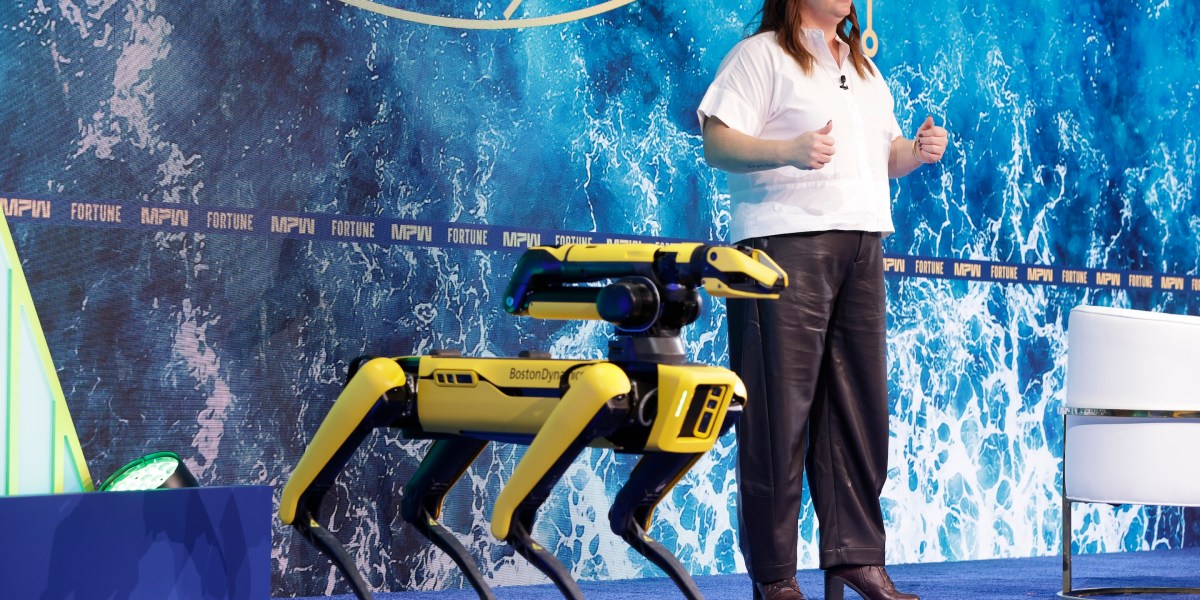
That was the message from Amanda McMaster, Boston Dynamics’ CFO for six years, who served as interim CEO from February until Rohit Prasad took the helm Oct. 7. “Inbound demand at some point dries up,” McMaster told Fortune’s Ellie Austin at the Fortune Most Powerful Women Summit last week. “You need a proactive sales motion.”
When the company was early in its commercial journey, McMaster helped build its operational systems, sales leadership and the service infrastructure customers need to get value from robots.
Spot, the company’s four-legged robot, costs about $100,000 for the base platform and up to $300,000 depending on payloads, she said. It conducts inspections and equipment readings in semiconductor manufacturing, food and beverage production, and public safety. Intel is one of Boston Dynamics’ largest Spot customers. Through the Orbit software platform, customers can search their facilities “almost like a Google Street View,” McMaster said.
She argues that robots are augmenting human labor, not replacing it, by taking on “dull, dirty, dangerous work.” Workers, she noted, are even naming the robots.
Atlas, the humanoid, is a more ambitious test: whether Boston Dynamics can manufacture and deploy advanced machines at scale while bringing costs down. McMaster’s playbook: “Control your cost and then get to scale fast.”
Roughly 70% of an Atlas robot’s bill of materials is actuators, the components that enable movement, and Hyundai Mobis will produce them at cost, McMaster said. Owner Hyundai has also committed to about 50,000 robot deployments across Hyundai Motor and Kia facilities, providing what she called “planning certainty” and “cost target certainty.”
As interim CEO, McMaster faced a different test. About two weeks in, she reorganized the entire company. “We have been very slow to make it,” she said. Her approach: “Rip the Band-Aid off.”
McMaster said the CFO role “was my dream job.” But serving as interim CEO “opened my eyes to what I’m capable of.” The board gave her a say in the final candidates, and Prasad, a former Amazon SVP and head scientist for Alexa and artificial general intelligence, is “going to be phenomenal,” she said.
Prasad inherits deep robotics expertise, an industrial parent and a growing commercial foundation. His challenge will be to pair them with advanced AI to build machines that work reliably in the real world.
Watch a video of the interview, which includes a demonstration of a Spot robot.
Sheryl Estrada
Sheryl.Estrada@fortune.com
Leaderboard
Jennifer Hamann, EVP and CFO of Union Pacific (NYSE: UNP), will retire in early 2027 after 35 years with the railroad. The company will announce succession plans at a later date. Hamann joined Union Pacific in 1992 on the audit staff and held leadership roles in finance, human resources, marketing and sales, investor relations and corporate audit before being named CFO in January 2020, the first woman in the role.
Frank Vargo was appointed interim CFO of Emergent BioSolutions (NYSE: EBS), the public health company that makes treatments for health threats such as smallpox, anthrax, and opioid overdose emergencies, effective Jan. 1, 2027. He succeeds Richard S. Lindahl, who will retire on Dec. 31. Lindahl will stay on as a senior executive advisor through March 31. Vargo joined Emergent in 2019 and is currently VP and treasurer. The company said the leadership change is part of its multi-year transformation plan.
Big Deal
What does a company look like when AI agents outwork its employees? Anthropic offered a look inside its own operations in a report released Oct. 16.
By August, AI agents directed by employees were logging six times as many hours as the employees themselves. At about five years old, the company brings in two to four times as much revenue per employee as Meta and Google did at a similar stage, according to the report. Output rose beyond engineering, too: accounts payable processed more invoices, lawyers handled more contracts and sales reps closed more deals.
But the changes are also showing up in hiring. Junior roles fell from 27% to 9% of technical hires, and hiring managers now weigh judgment and autonomy over narrow expertise. The catch is that human attention has become the bottleneck. Reading everything their agents produce would take even non-technical employees more than half their workweek.
Going deeper
Overheard
“I’ve never ever taken a deal just because it was a high value monetary deal. If I don’t believe in your product, I don’t do it.”
—NBA Hall of Famer and entrepreneur Shaquille O’Neal told Fortune in an interview.
Disclaimer : This story is auto aggregated by a computer programme and has not been created or edited by DOWNTHENEWS. Publisher: fortune.com