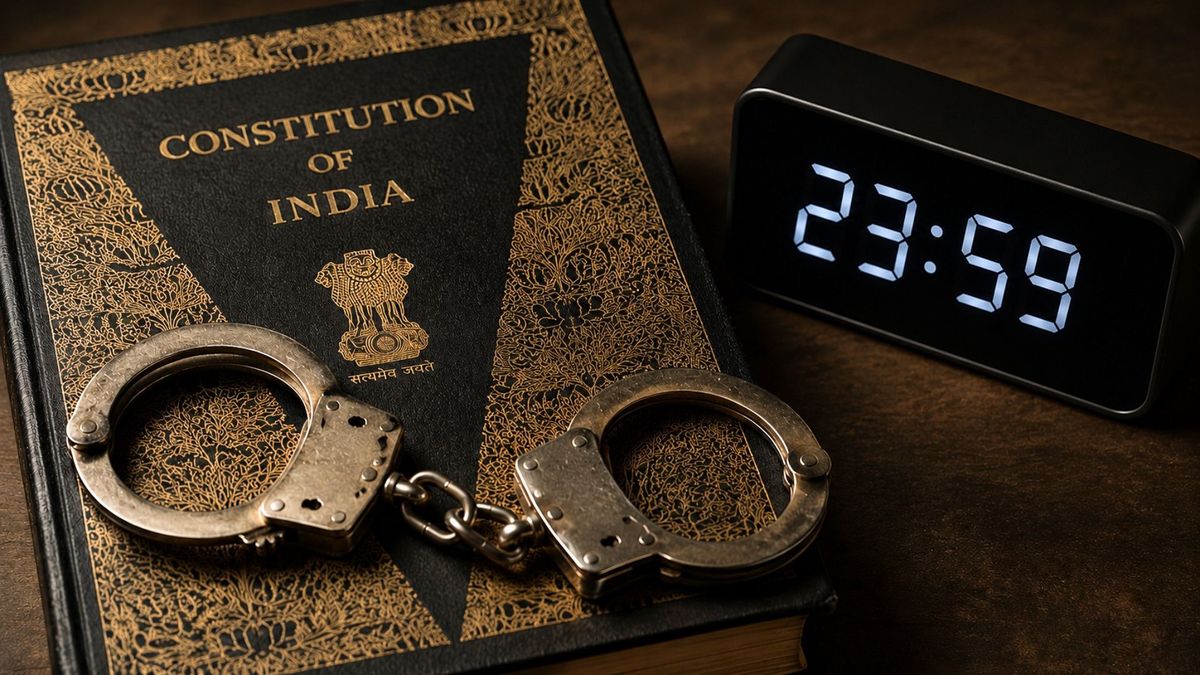
Two leaders of the Cockroach Janta Party were sent to Tihar Jail on Wednesday. A Special Executive Magistrate remanded Saurav Das and Ashutosh Ranka to five days of judicial custody after police accused them of trespassing into Jantar Mantar, violating prohibitory orders, obstructing public servants and breaching the one-year peace bonds they had signed only days earlier. A third leader, Ajinkya Shinde, was released after signing a fresh bond.
Their lawyer argued that an executive magistrate had no power to order judicial custody at all, a question that goes to the centre of this story. The jailing comes while the larger question raised by the Delhi Police detentions of October 9 to 11 remains unanswered. The government’s explanation to the Supreme Court was due on Tuesday, but the hearing was put off to Thursday, October 15, after a member of the bench was unwell, and the Solicitor General was given more time to file an affidavit he said was ready. Under what law were thousands of citizens held? No one has yet said.
Also Read: Delhi Protest: Why the State’s Response Should Concern Every Voter
A Law That Never Defines Detention
The backdrop to the October 10 protest against Chief Election Commissioner Gyanesh Kumar was a prohibitory order under Section 163 of the Bharatiya Nagarik Suraksha Sanhita (BNSS), 2023, barring assemblies of five or more, processions, dharnas, slogans and placards without written permission. What made the scale possible lies in the law itself. The BNSS offers no general statutory definition of detention. A person can be held for hours, released, and told no arrest took place, and the safeguards attached to an arrest quietly fall away.
The BNSS, in force since July 1, 2024, also contains a power the old code never had. Section 172 of the BNSS obliges every person to obey the lawful directions of a police officer acting under its chapter on preventive action, and lets the officer detain or remove anyone who resists, refuses, ignores or disregards them. The person must be taken before a magistrate or, in petty cases, released within 24 hours.
Petitioners before the Supreme Court say people were detained far outside the area covered by prohibitory orders, picked up before disobeying any direction, denied grounds and lawyers, and that journalists and senior advocates were among those held. They say the Delhi Police detentions continued after the Court intervened. At a special sitting on October 11, the Court directed that no one be detained except by procedure established by law, particularly people assembling peacefully outside the areas where Section 163 applied, and ordered that internet services remain undisturbed and Metro and rail services run normally.
An Order Nobody Has Seen in Full
In the days before the protest, Delhi Police said Section 163 was in force in New Delhi and that no gathering would be permitted, at Jantar Mantar or anywhere else. The order itself, with its boundaries, duration and the facts it rests on, has not been made public, though the law requires it to be written and to state those facts. The Supreme Court Bar Association has asked the Court to obtain the scope, conditions and reasons of these orders.
As described by the police, the order barred assemblies of five or more, demonstrations, picketing, slogans and speeches without written permission, and the carrying of firearms, banners, placards, lathis, swords, sticks and brickbats. In practice, the Delhi Police detentions reached far beyond it. On October 11, Senior Advocate Kapil Sibal told the Court the restrictions applied within a four-kilometre zone, yet police were taking people off trains and outside that radius. Other senior counsel said people were detained as far away as Gurugram and Noida without having committed any offence.
Also Read: Former Judges to Probe SIR Voter List Deletions, Hold Public Hearings
How Police Held Protesters Before the BNSS
Until July 2024, police had no general national power to hold someone for disobeying an instruction. The common tool, Section 151 of the CrPC, let an officer who knew of a design to commit a cognisable offence arrest without warrant, only if it could not otherwise be prevented, and for no more than 24 hours. The Supreme Court upheld it in Ahmed Noormohmed Bhatti v State of Gujarat (2005) because those limits sat in its text. In Rajender Singh Pathania v State (NCT of Delhi) (2011), it held that a bare apprehension of a breach of peace cannot justify arrest.
Section 151 survives almost word for word as Section 170 of the BNSS. Delhi Police invoked it, with Section 126, against CJP founder Abhijeet Dipke and two colleagues, detained aboard their flight after it landed. An intention to join a protest is no design to commit a cognisable offence, and the police must say what offence passengers on an aircraft were planning.
Section 172 and the Missing Safeguards
The CrPC never bound citizens to obey police directions, nor let police detain those who refused. Section 172 borrows the idea from state laws such as Section 65 of the Delhi Police Act, 1978, which lets police remove people who defy reasonable directions, then lifts it into the national code, adds the power to detain, and reaches anyone who merely ignores an instruction. The original Bill set no time limit at all, and the 24-hour cap came only after a parliamentary committee asked for one.
The safeguards did not travel with this power. Ignoring a direction can describe purely passive conduct, such as standing still when told to move. The BNSS protections around arrest, including an attested memo, being told the grounds, informing a relative and the right under Section 38 to meet an advocate, are written for arrest, and Section 172 nowhere extends them. A petty case is undefined, so the officer alone decides whether to release someone without a magistrate, and if release comes within 24 hours, no judge examines it. Nothing requires police to record or publish such detentions, and an overbroad Section 163 order taints every direction issued under it.
No Supreme Court ruling has yet tested the provision, but that may now change. On October 12, the Court agreed to hear a writ petition that challenges both the Section 163 order and the constitutionality of Section 172 itself. The petition argues that the phrase “lawful directions” is void for vagueness and violates Articles 14, 19 and 21, and asks the Court to stop the Delhi Police Commissioner from using Section 172 for mass detention. It is one of at least 18 petitions now before the Court arising from the protests.
Why Delhi Police Detentions Stop Short of 24 Hours
An arrest without a serious cognisable offence invites hard judicial scrutiny, while a few hours’ detention ending in release leaves a court almost nothing to examine. On October 11, senior counsel told the bench that authorities were holding people just under 24 hours before releasing them, to sidestep procedural requirements. If so, the Delhi Police detentions work the law’s gaps by design, with custody timed to end just before accountability begins.
Also Read: Election Commission Press Note Fixes What It Said Wasn’t Broken
The Constitution Looks Past the Label
Constitutional rights turn on the substance of custody, whatever the police call it. Article 22 requires that anyone arrested be told the grounds, allowed a lawyer and produced before a magistrate within 24 hours.
D.K. Basu v State of West Bengal (1997) set requirements for all arrests and detentions, including name tags for officers, an attested memo and informing the family. Joginder Kumar v State of Uttar Pradesh (1994) held that the power to arrest does not by itself justify using it. In Pankaj Bansal (2023), Prabir Purkayastha (2024) and Vihaan Kumar (2025), the Court required grounds of arrest to be communicated, holding in the last that failure renders an arrest illegal.
Articles 19(1)(a) and 19(1)(b) guarantee free speech and the right to assemble peaceably and without arms. Judging whether that line was crossed requires knowing how many were held, yet the state has placed no official figure before the Court. Media counts for October 10 alone range from more than 2,000 to close to 7,000.
No One Was Spared
The Delhi Police detentions reached the very people whose work is to hold power to account. Reporters were held on both days, many after showing press cards, and some had phones seized. One senior advocate told the bench he was thrown into a moving bus. Another set out the test the police skipped: necessity first, proportionality after, and no necessity at all to detain, beat or kick unarmed students and children moving peacefully.
Press freedom groups, rights organisations and the UN human rights office called for the release of those held and an inquiry into reported abuse. The Ministry of External Affairs rejected the UN’s concern as unwarranted interference.
On Tuesday, after Senior Advocate Indira Jaising mentioned a petition by the Network of Women in Media, India, the Chief Justice directed that a senior Delhi Police officer be present in court on Thursday to explain allegations that women journalists were assaulted while covering the protests. The police will have to answer for that in person.
A Protest Site Struck Off the Map
The state’s answer to the protests has since moved from the street to the rulebook. On October 11, Delhi Police Commissioner Anurag Kumar issued a standing order de-notifying Jantar Mantar as a protest venue on the recommendation of a Home Ministry committee. Demonstrations are now allowed, subject to permission, at Ramlila Maidan, Burari Ground and CBD Ground in Shahdara.
Before the Delhi High Court on Tuesday, the police said they had acted on the Supreme Court’s directions. The Court’s October 9 order is narrower than that. It observed that it was high time other places with amenities for peaceful protesters were identified, and asked the competent authority to consider the suggestion and decide. It did not direct that Jantar Mantar be closed, and in 2018 the Court had held that protests there could not be banned outright. The High Court has issued notice on a Youth Congress petition over the refusal of permission to protest and listed it for November 17, while other pleas on the closure and the October 10 assaults remain pending.
On October 12, thousands joined an opposition march from Barakhamba Road towards the Supreme Court, which halted at police barricades. Opposition leaders said their petition reached the Court though not in person, and police registered FIRs for violating the Section 163 order. The same day, Leader of Opposition Rahul Gandhi and ten other opposition leaders moved the Court against the electoral roll revision. On Tuesday morning, about 20 CJP volunteers who climbed over barricades into Jantar Mantar were detained. A day later, two of them were in Tihar, and the peace bonds signed on October 11 to secure their release had become the means of jailing them.
Also Read: BNS Rape Law: What If the Victim Isn’t a Woman?
What the Supreme Court Has Said So Far
The Court has moved quickly, though it has yet to rule any detention unlawful. On October 9, a bench led by Chief Justice Surya Kant said Metro and train services could be regulated and must not be stopped altogether, warning against using a hammer to kill a fly.
On October 11, with 45 Metro stations still shut, it issued notice to the Centre and the Delhi Police on a contempt petition. On October 12, it agreed to hear the Bar Association’s petition on lawyers, with the Chief Justice observing that members of the Bar may join peaceful protests at identified locations. All of it now waits for Thursday.
The Questions Delhi Police Detentions Leave Unanswered
The police have a case. The protest application came three days before the event, against a ten-day rule, and twenty FIRs were filed over the weekend, including for assault on personnel. None of this explains the rest. Refusing a protest at Jantar Mantar does not authorise detaining people on trains or in neighbouring cities. Section 172 needs a disobeyed direction and Section 170 a planned offence, and neither fits passengers held in their seats. The detentions at Connaught Place on October 11 came after the Supreme Court had spoken.
When the Court sits on Thursday, the force will have to say under which law thousands were held, publish its Section 163 orders, explain why grounds were withheld, and account for what happened to the journalists. For a force that answers to the Union Home Ministry and guards the seat of government, the Delhi Police detentions have been a loss of face. They have shown how easily a gap in the law becomes a method, and how little stands between a citizen and a police van once the word arrest goes unspoken. Closing Jantar Mantar, and jailing those who walked back into it, does nothing to close that gap. Whether the law that allowed it survives is now a question for the Court.
Disclaimer : This story is auto aggregated by a computer programme and has not been created or edited by DOWNTHENEWS. Publisher: theprobe.in