Life
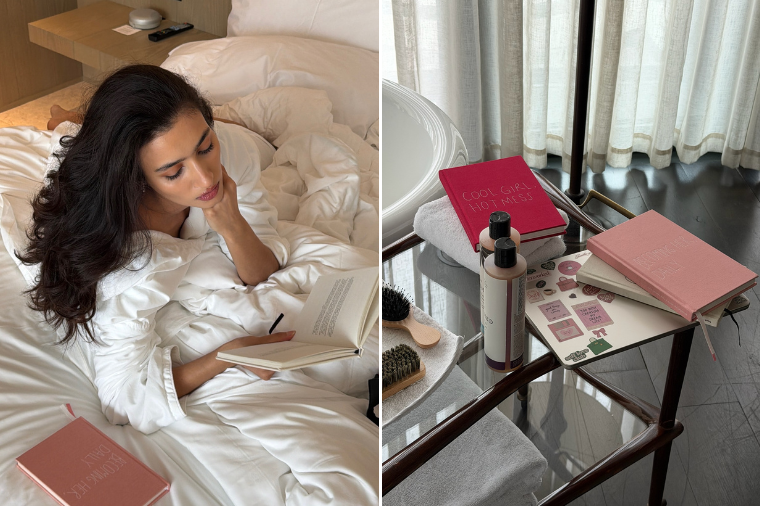
Healing is the having moment, not the quiet, invisible kind it used to be, but the curated aesthetic, camera-ready version that lives across feeds, reels, and soft-lit cafe tables. In a world where self-awareness is currency and “doing the work” has become a part of lifestyle, healing has shifted from a natural process to something of a materialistic activity. But somewhere between a wellness and glow-up routine, a question arises: Are we actually feeling the emotions, or are we just feeling them for the sake of it? This article is on performative wellness, self-awareness culture, and actually feeling your feelings.
Linda Hausser, founder of Faine, a Dubai-based lifestyle brand offering personalized products that merge intentional living, personal growth, and wellness with modern design, talks to Emirates Woman on this very topic. She talks about how healing has shifted to a process of showing the world but is not adapted as a personal space of healing and how journaling can help calm you in a fast-paced world. life
The internet did something extraordinary: it made mental health visible. It also made healing visible. And what becomes visible often becomes performative. But how do we know what healing looks like? What do I actually mean when I say we can see healing?
We are living in an era where being the clean girl, the wellness girl, the self-aware girl, has never been more popular. It started innocently with brands like Rhode and CSB, and now the rise of “non-toxic” consumer brands has shaped a whole new lifestyle aesthetic. Healing is no longer only about mental health, but it has become a lifestyle. We invest more in ourselves, experiences, retreats, and our nervous systems instead of a new handbag, or at least this is what I see with the younger generations. That is also why the wellness industry has seen such a boom: the rise of social wellness clubs, where something private became collective. And we can see this in healing and vulnerability too. Healing became visible and sharable and entered our routines, products, habits, and identities.
There is almost nothing cooler today than working on yourself, healing your gut, your energy, your nervous system, and your real trauma. And there is something pretty about that too, because mental health moved from taboo to conversation. Seeing a therapist almost feels more aspirational today than jet setting around the world or being seen behind a DJ booth ever could.
Now that we have mastered the look of healing, have we also learned the feeling of it? How can we make sure that when we heal, we heal from the root and do not fast-track the process? The internet rewards visibility, and, as we all know, it moves at a fast pace. There is absolutely nothing wrong with that. But healing does not move at internet speed. We cannot fast-track our healing process, so we need to make sure both can exist in parallel.
This generation wants to heal but in their own way, on their own timeline, and does not want to compromise the aesthetics. Now we share the breakthroughs, the healing eras, and the glow-ups. And perhaps this is where healing slowly became performative. Not because people are fake, but because something that used to happen privately became visible. Healing done right can be boring, repetitive, messy, and invisible for a time. Sometimes it is crying in your car, repeating the same thought for weeks, sitting with grief, or writing the same sentence over and over again. Healing should not only become a comfort but also something you really know has such a big impact on everyone’s life. If healing cannot move at internet speed, then maybe we need rituals that slow us down again.
For me, journaling became a tool to slow down, and there is something so magical about sitting in a café with the smell of Arabica and the wind in your hair and letting your thoughts just wander without the distractions of pings on your phone.

Journaling often enters people’s lives during difficult seasons, sometimes after a loss, sometimes after a heartbreak, or simply to check in daily with yourself and disconnect. The beauty of life is that difficult moments often become the doorway into becoming more invested in our mental health, our physical health, and creating awareness around it. That is why many people go through a so-called glow-up phase after a heartbreak. Our mind and our health are some of our biggest assets, yet they are often the areas we maintain only when something goes wrong. Just like we go to the gym to maintain our physical health, mental well-being deserves attention, compassion, and the right tools to support it.
Writing in a journal for the first time after typing on your phone and your laptop for the past decades feels like meditating for the first time. We will not execute it perfectly; like any new routine, it takes time. But with consistency, it will slow us down and bring us back to the present moment. Even if you put the journal down and pick it up again after a couple of days, give yourself grace to adapt to this new powerful routine. Journaling detangles your emotions; it also makes them real.
You will be able to zoom out and make better decisions for your future self. That is why I created 3 different guided journals last year, which are super easy to use for anyone wanting to try this new journey. I created first the grief journal to help you during your heavy times, followed by the heartbreak journal and ultimately the wellness journal. It also became a personal mission of mine to bring more awareness to mental health and create more conversations around it.
As a founder of mental health journals, while I think self-awareness is powerful, I sometimes think we mistake understanding our emotions for experiencing them. For years, conversations around mental health felt hidden; there was shame around having a therapist; it was still a quiet topic in many circles, and we carried heartbreak, anxiety, and loss privately. The internet changed that and gave us language; it became visible, and people learned words like “boundaries,” “nervous systems,” “attachment styles,” and “trauma responses.” We became more self-aware and perhaps more emotionally intelligent than any generation before us.
And there is something pretty about that. But … understanding our emotions and experiencing them are two different things. Because knowing why we hurt does not always remove the pain and knowing our attachment style does not automatically heal loneliness. Experiencing emotions asks something different from us. It asks us to slow down, to sit still, to not immediately optimize like we are used to in life, or to turn every little difficult moment into growth. I wonder if some parts of healing were always meant to stay quiet, because while this generation has mastered the look of healing, the next step might be learning how to really experience it. The internet made healing look pretty, but real healing often happens in the moments nobody sees.
For more on luxury lifestyle, news, fashion and beauty, follow Emirates Woman on Facebook and Instagram
Images: Supplied
Disclaimer : This story is auto aggregated by a computer programme and has not been created or edited by DOWNTHENEWS. Publisher: emirateswoman.com