In the Sundarbans, a honey hunt can begin with a small movement in the sky.
As the tide shifts through the mangrove creeks, the mouals (traditional honey collectors of the delta) watch for giant wild honeybees flying towards flowering keora, goran or khalsi trees. To them, a stream of bees often means one thing: honey lies somewhere ahead.
To the mouals, it is information. For generations, they have followed these invisible routes, trusting that bees know where abundance lies.
But long before the mouals follow the bees through the forest, a message has already passed inside the hive. The bees have shared the route through dance.
Science calls it the waggle dance.
It is one of the most sophisticated communication systems in the animal world, a coded figure-eight movement through which honeybees tell each other where food and water can be found.
How a bee turns food into directions
When a forager bee discovers a rich patch of flowers or a water source, she returns to the hive with more than nectar.
She returns with directions.
Inside the dark honeycomb, she begins moving in a figure-eight pattern. At the centre of this movement, she runs in a straight line and rapidly shakes her abdomen. This is the most important part of the message.
That straight line is the message. Its angle tells her nestmates where to go.
The angle of this straight run tells the other bees which direction to take. If she moves straight upward on the comb, the food lies in the direction of the sun. If she turns at an angle, the bees understand that they must fly at that angle from the sun’s position. The hive, in darkness, becomes a compass.
Then comes distance.
The duration of that waggle run tells the colony how far the resource is. Roughly, one second of waggling signals about one kilometre of flight.
And there is a third layer: quality.
The stronger and more repeated the dance, the richer the nectar source.
If the food is very close, only a few metres away bees do not bother with such detailed coordinates. Instead, they perform a simpler round dance, moving in circles to signal that food is nearby.
Scientists have spent decades decoding this language. The central stretch of the figure-eight, where a bee runs in a straight line while rapidly shaking her abdomen, is called the “waggle run”, and the full movement is known as the “waggle dance”.
Through one small dance, a bee can tell the hive three things: where the food is, how far it is, and whether it is worth the journey.
When the audience changes the dance
This system was first decoded in the 1940s by Karl von Frisch, who discovered that bees could communicate through symbolic movement.
Since then, the dance has kept revealing new layers.
James C Nieh of the University of California San Diego has spent decades studying how bees perform and interpret this language. His research shows the dance is not always fixed.
A study published in the Proceedings of the National Academy of Sciences on March 23, 2026, found that bees dance with less precision when fewer hive mates are watching. When audiences are small, the forager moves around more, searching for followers, and that can affect the accuracy of the message.
Professor Nieh compares the waggle dance to a street performance.
When the crowd is large, the performer can focus fully on the act. But when fewer are watching, the performer scans the audience, shifts position and works harder to hold attention. Bees do much the same.
Nieh’s research found that the bees watching the dance can affect how the dancer performs. Along with scientists at the Chinese Academy of Sciences and Queen Mary University of London, he studied experimental hives and watched the honeybee “dance floor”, the busy space inside a hive where bees gather and respond to each other.
/filters:format(webp)/english-betterindia/media/media_files/2026/06/26/forest-4-2026-06-26-13-16-52.png)
It suggests that communication is shaped by both the speaker and the audience.
And it is hard work.
A dancing bee covers nearly one body length per second, often in complete darkness, on uneven comb, surrounded by moving bodies.
So errors can happen.
At times, bees may point in the wrong direction, signal the wrong distance, or lose the rhythm of the figure-eight. Researchers call these disorder errors.
Yet the system works, and entire colonies depend on it.
How honey hunters read the forest through bees
In the Sundarbans, this dance plays out beyond the hive.
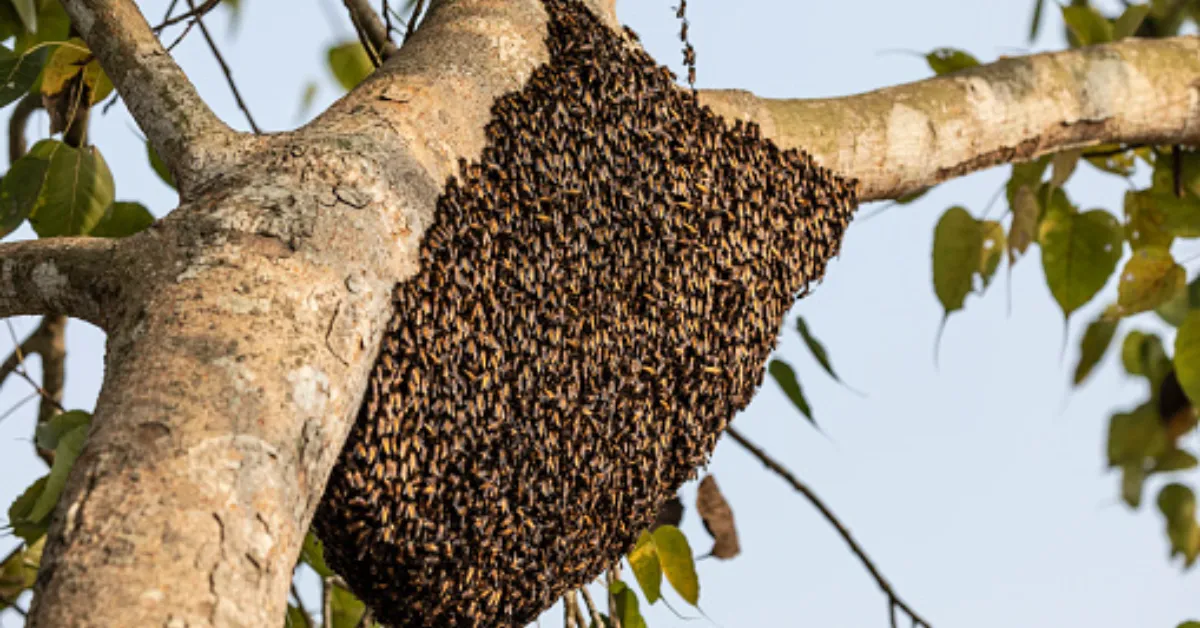
The honeybees build massive open hives high in mangrove branches, often exposed to weather and predators. Every spring, as the blooms return, so do the bees. And with them, the dance.
When one bee finds a flowering patch of keora deep in the mangroves, her dance can redirect hundreds of workers. Soon, the air changes and more bees move along the same invisible route.
That is what the mouals read. They may not see the waggle dance inside the hive, but they follow its visible result: bees moving with purpose through the forest.
To them, bee movement has always been a sign of abundance. And now science confirms what experience had already taught them.
Traditional knowledge and science are meeting on common ground.
Also, the honeybee was never flying aimlessly. It was carrying information (whilst dancing).
Sources:
‘Bee Dancing is Better with the Right Audience’: by Mario Aguilera, Published on 23 March 2026
‘Liquid gold-How creative solutions are making honey collection a less dangerous way of life’: by Julian Wray, Published in 2022
‘In the Sundarbans, local communities harvest honey and protect tigers’: by World Wildlife Fund, Published on 28 July 2022
Disclaimer : This story is auto aggregated by a computer programme and has not been created or edited by DOWNTHENEWS. Publisher: thebetterindia.com