
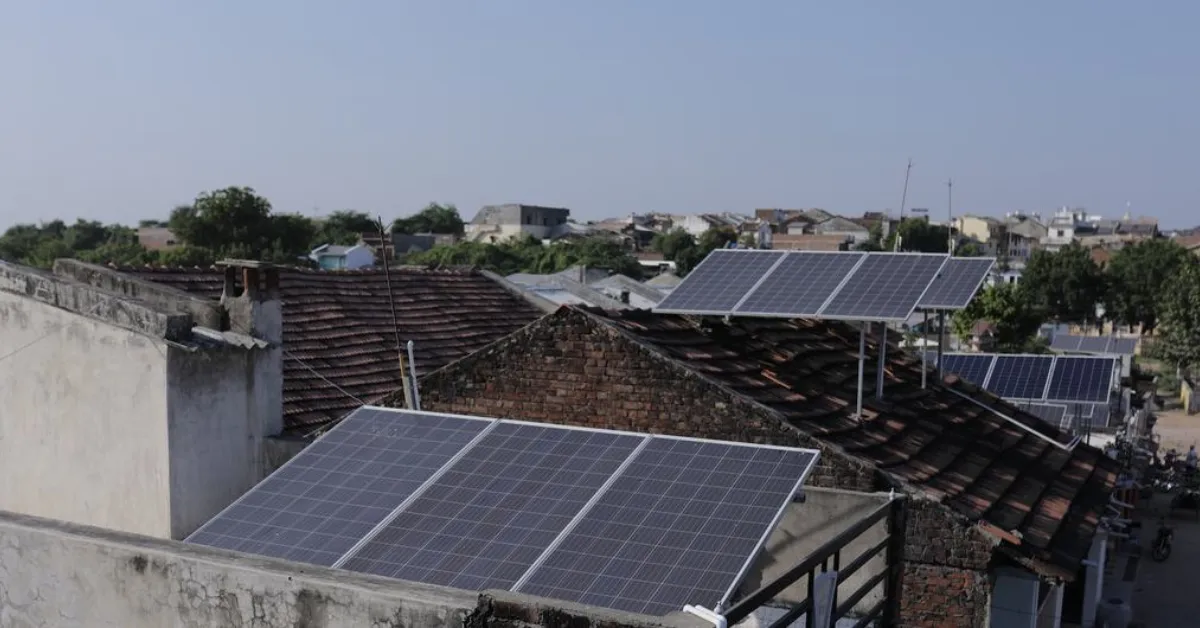
Picture a hot afternoon in Shelakewadi, a small village 14 km from Kolhapur. The kind of afternoon where all you want is a fan that stays on. In Shelakewadi, it does, reliably, without cutting out mid-afternoon, and the reason is something most villages in India are still working towards.
Shelakewadi decided to make its own electricity, and that decision, made roof by roof, family by family, is part of a much bigger story today.
It started with a knock on the door
Nobody handed Shelakewadi its solar future. The gram panchayat had to go out and ask for it.
Members walked door to door, talking to families about putting solar panels on their rooftops. The first reaction was hesitation, and understandably so. A typical household solar system costs between Rs 50,000 and Rs 1.5 lakh, even after government subsidies, and that is a significant financial decision for a village family.
So people started pooling what they could. Rs 5,000 here, Rs 10,000 there, with government schemes covering the rest. One roof after another got its panels, and the village started to change in ways that showed up in everyday life.
Today, Shelakewadi runs almost entirely on solar. Electricity bills that used to cross Rs 2,000 a month are now closer to Rs 100. Some households even earn a little by sending surplus power back to the grid through net metering, and a typical rooftop system pays for itself within four to six years, after which the savings compound year after year.
Mansing Shivaji Shelke (47), a farmer who cultivates sugarcane and groundnuts on his three-and-a-half-acre plot. “We used to spend over Rs 2,000 a month on electricity bills, mostly for irrigation. Now, the bill is just Rs 130, and sometimes, we even earn credits because our solar setup is connected to the grid.”
Electricity in Shelakewadi is made here, by the people who live here, and that changes how the whole village relates to power.
Beyond one success story
Across India, this pattern repeats in different states, at different scales, and through different approaches.
-
Modhera, Gujarat: India’s first fully solar-powered village runs on a 6 MW solar plant combined with over 1,300 rooftop systems. Residents have near-zero electricity bills, and some earn from the surplus power they send back to the grid.
-
Dharnai, Bihar: A solar microgrid brought electricity to a village that had gone without reliable power for decades. The project later ran into challenges around pricing and community participation, proof that technology alone is insufficient. But it demonstrated that solar could reach places where traditional grid expansion had stalled.
-
Karnataka: Villages compete under the Model Solar Village scheme, with the government offering up to Rs 1 crore to top-performing communities. A structured incentive, it turns out, is a surprisingly effective way to accelerate rooftop adoption.
/filters:format(webp)/english-betterindia/media/media_files/2026/04/16/3-2026-04-16-16-21-51.png)
In Modhera, Gujarat, government schools, bus stops, and utility buildings are now fully powered by solar energy. Photograph: (UN News) -
Rajasthan and Maharashtra: Solar irrigation is scaling through the KUSUM scheme, with over 3 lakh solar pumps installed so far. For farmers who once depended on erratic night-time power or expensive diesel, that translates into six to eight hours of reliable daytime electricity, enough to plan a crop cycle around with some certainty.
Each village has its own version of this story, but the thread running through all of them is the same: power is moving closer to the people who need it.
Electricity that travels less, does more
Think about how electricity normally reaches a village. It is generated in a large plant, often hundreds of kilometres away, and travels through transmission lines, losing energy along the way. In India, those losses can range between 15 and 20 percent of total supply. By the time power arrives, it is sometimes unstable, sometimes insufficient, and sometimes simply absent.
When electricity is generated within or near the village itself, those losses shrink, the central grid faces less pressure, and the people using the power have far more control over it. The economics work at a household level, but the gains at a system level are just as real.
There is also the question of livelihoods. Solar systems require installation, maintenance, and management, and that work is technical, regular, and local. It creates jobs that stay within the community, in places that need economic opportunity the most.
Then policy stepped in, at scale
These village-level shifts have been reinforced by policy moving in the same direction. The PM Surya Ghar Yojana is targeting rooftop solar for 1 crore households, with subsidies covering up to 40 percent of the cost, and lakhs of homes have already enrolled.
Maharashtra has announced plans to solarise 100 villages. Telangana is working on a model to develop one solar-powered village in every mandal across the state.
/filters:format(webp)/english-betterindia/media/media_files/2026/04/16/5-2026-04-16-16-25-19.png)
The underlying logic has changed too. Rather than concentrating generation in a few enormous plants and transmitting electricity across long distances, the approach now is to spread production across millions of rooftops, fields, and community installations, each generating power close to where it will be used.
How village solar becomes a national story
This is where Shelakewadi, Modhera, Dharnai, and thousands of villages like them connect to something at a national scale.
India today generates over 1,08,000 GWh of solar power every year, a figure that has placed the country ahead of Japan and made it the world’s third-largest solar power producer, according to the International Renewable Energy Agency. Solar capacity has grown more than tenfold in under a decade, crossing 75 GW.
Large solar parks have driven much of that growth, but millions of smaller installations, rooftops, pumps, microgrids, and community plants, have been adding to it in ways that reach further and go deeper. Rooftop solar alone now contributes over 10 GW to the national total.
/filters:format(webp)/english-betterindia/media/media_files/2026/04/16/6-2026-04-16-16-30-37.png)
Behind that number are millions of individual decisions: a family in Shelakewadi pooling Rs 8,000, a farmer in Rajasthan replacing a diesel pump, a gram panchayat walking door to door because they believed their village could do things differently. That national milestone belongs to them as much as it does to the large solar parks that tend to dominate the headlines.
In Shelakewadi, the conversation has moved on from why solar makes sense to what comes next. The fan stays on through the afternoon. The pump runs when the field needs water. The electricity bill at the end of the month is no longer a source of anxiety, and children can study after dark without having to wait for power to return.
These gradual, cumulative shifts that reshape the texture of an ordinary day long before they show up in any national dataset. And it turns out, that is exactly how a country changes too.
Sources:
‘India becomes world’s 3rd largest solar energy generator’: by Economic Times, Published on 31 July 2025
‘The Solar Surge: India’s Bold Leap Toward a Net Zero Future’: by Press Information Bureau, Published on 19 August 2025
‘The solar surge: India’s bold leap towards net-zero future’: by DD News, Published on 20 August 2025
‘Telangana Plans Solar-Powered Village in Every Mandal to Boost Rural Clean Energy’: by EQ, Published on 27 March 2026
Disclaimer : This story is auto aggregated by a computer programme and has not been created or edited by DOWNTHENEWS. Publisher: thebetterindia.com



