When a wedding procession moves through Chirgaon in Maharashtra’s Raigad district, there is one thing residents do not hear: a DJ.
The village has prohibited DJs and loudspeakers since 2002. The village also restricts firecrackers during festivals and other celebrations. The reason is that Chirgaon’s residents were trying to keep their vulture nests quiet.
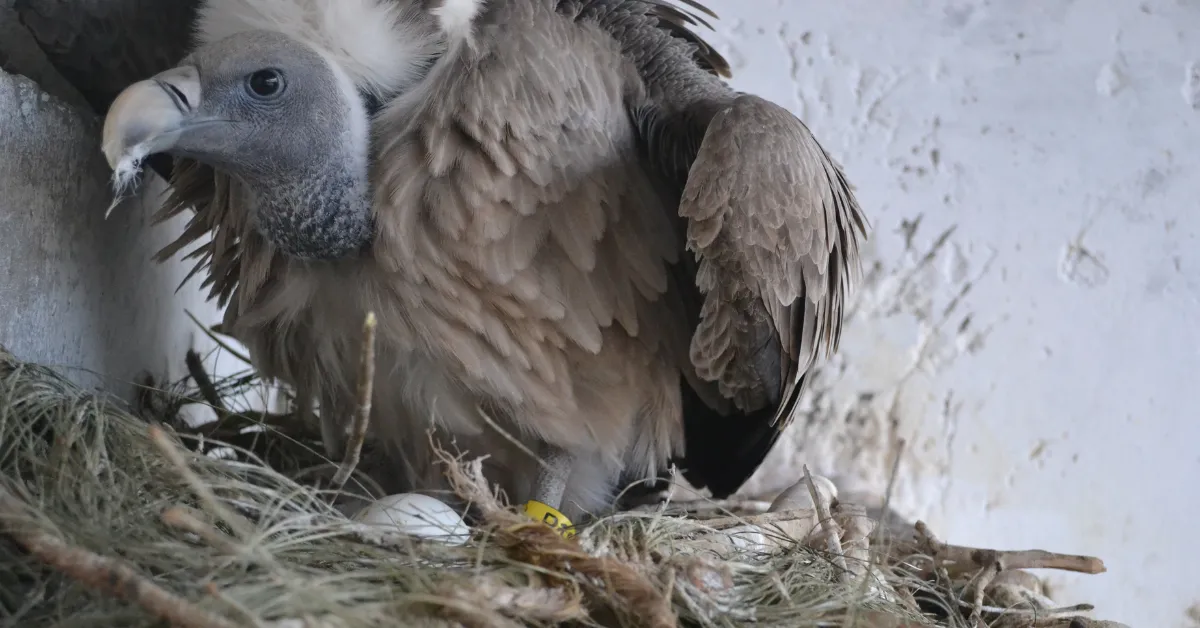
Two decades ago, the village had only 22 vultures of two species, the white-rumped and long-billed vultures. Now, according to the last census in 2022, 347 vultures have been recorded in the area.
The recovery cannot be attributed to the DJ ban alone.
It followed years of work by Premsagar Mestri, founder of the Society of Eco-Endangered Species Conservation and Protection (SEESCAP), along with local bird enthusiasts and villagers. They protected nesting trees, reduced human disturbance around breeding sites and worked to ensure food for the birds.
@maha_tourism MoS @iAditiTatkare has taken initiative for the conservation of #vultures in #Raigad district. With the help of @MahaForest & सिस्केप, some plans will be implemented & 44 he. RF area in Chirgaon may be proposed as ‘vulture conservation reserve’. @AUThackeray https://t.co/rPDLd4Q8oB
— Akshay Mandavkar🌿 (@akshay_journo) February 5, 2021
When Mestri began looking into the decline of Chirgaon’s vultures, the problem had to be understood in the context of a much larger collapse.
India’s vulture population had fallen dramatically from the millions recorded in the 1980s. The decline of the white-rumped, long-billed and slender-billed vultures was particularly severe, with losses exceeding 90% in some species.
What does a DJ have to do with a vulture?
The science of noise pollution provides part of the answer.
A 2023 review in Frontiers in Ecology and Evolution examined 48 peer-reviewed studies published between 1995 and 2021 on how chronic human-made noise affects animal communities.
In 38 of those studies, 79% researchers found at least one negative effect associated with noise exposure. These included reductions in abundance or species richness, nesting, offspring survival and hatching success.
Birds featured in 38 of the 48 studies.
The researchers described several mechanisms through which noise can affect wildlife. Sound can mask signals animals depend on, interfere with communication, distract them from other information in their surroundings and trigger responses associated with perceived danger.
Repeated exposure can also produce physiological stress.
The important point is that noise does not have to physically injure an animal to affect its survival.
For a breeding bird, behavioural disruption can be enough.
If an adult leaves its nest because of repeated disturbance, the immediate result may be a few minutes away from the egg or chick. But repeated interruptions can reduce nest attendance and alter feeding, incubation or protection of young.
Over time, that can affect breeding success.
The researchers also caution that noise does not affect every species in the same way. Its impact depends on the animal, the type of sound, its intensity, frequency, duration and how often it occurs.
What happens when vultures hear people?
Vultures are not fast breeders. A breeding pair generally raises a single chick at a time, which means the loss of a nesting attempt can matter to a small recovering population.
In a 2006 study published in Biological Conservation, researchers Beatriz Arroyo and Martine Razin examined human disturbance around bearded vulture nests in France’s Pyrenees.
They found that human activities affected the birds’ behaviour, primarily by reducing the amount of time they spent attending their nests. The response depended on the activity and its distance from the nest.
The most striking finding concerned very noisy activities.
@maha_tourism MoS @iAditiTatkare has taken initiative for the conservation of #vultures in #Raigad district. With the help of @MahaForest & सिस्केप, some plans will be implemented & 44 he. RF area in Chirgaon may be proposed as ‘vulture conservation reserve’. @AUThackeray https://t.co/rPDLd4Q8oB
— Akshay Mandavkar🌿 (@akshay_journo) February 5, 2021
These were among the activities most likely to cause the vultures to leave their nests, and the effect was recorded even when the activity occurred more than 1.5 km away. By comparison, walkers and cars or planes generally affected behaviour when they were within about 500–700 metres of the nest.
The study also found a relationship between the frequency of human activity and breeding failure. The probability of failure increased as human activities became more frequent, with particularly strong evidence for very noisy activities.
It is not a study of Indian vultures,and it does not establish a specific noise limit for Indian vultures. But it shows why disturbance during breeding can become a conservation concern.
So Chirgaon turned down the volume
Mestri and SEESCAP worked with then-sarpanch Kishor Gulgule and residents to make protection of the birds a community decision. The restrictions were later accompanied by measures to reduce other disturbances, including firecrackers, outsiders entering sensitive nesting areas and photography during the breeding season.
The 43-hectare Chirgaon-Bagechiwadi Devrai, where the birds nest, has also been kept relatively free from unnecessary human activity
The objective was not to create a sanctuary sealed off from people. It was to reduce the kinds of disturbance that could make a breeding site unsuitable.
Sources:
‘Chirgaon Vulture Conservation: No DJ, No Fireworks Tradition Has Been Intact In Chirgaon For 26 Years’: By Leader News Service, Published on 19 September 2026
‘How chronic anthropogenic noise can affect wildlife communities’: By Frontiers in Ecology and Evolution, Published on 5 April 2023
‘Threatened Vultures of India: Population, Ecology, and Conservation’: By EcoHealth, Published on 7 August 2025
‘Recent changes in populations of Critically Endangered Gyps vultures in India’: By Journal of the Bombay Natural History Society, Published in December 2017
Disclaimer : This story is auto aggregated by a computer programme and has not been created or edited by DOWNTHENEWS. Publisher: thebetterindia.com