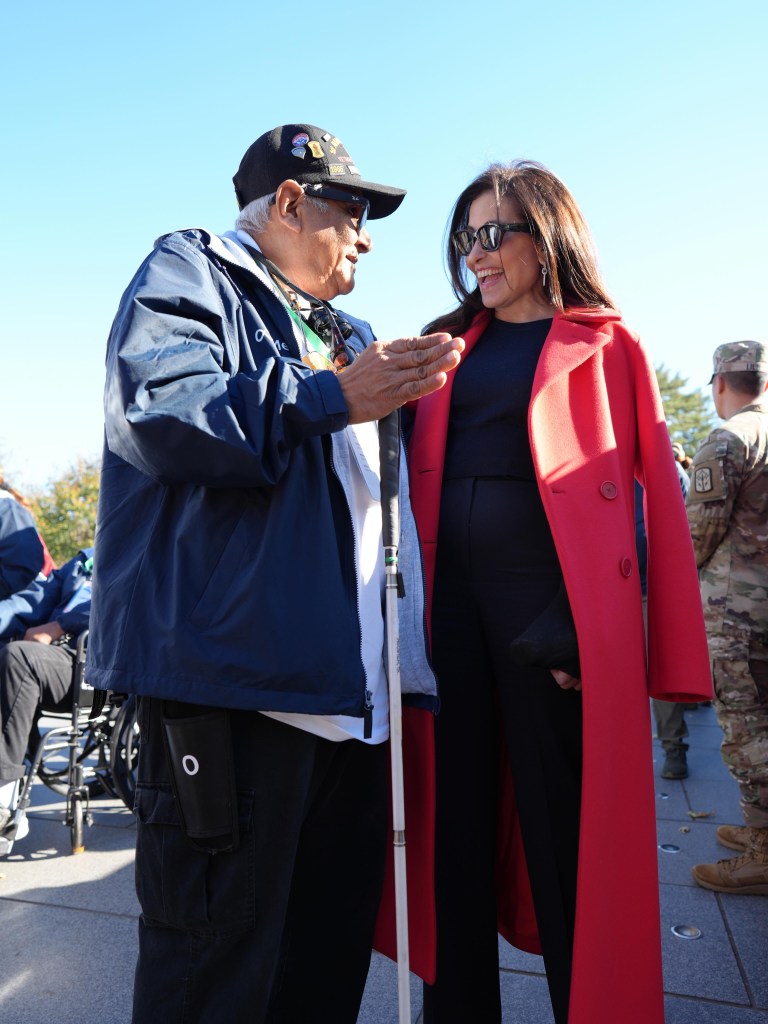
On Tuesday at the Vietnam Veterans Memorial in Washington, Armsted Chambers, a 70-year-old who served in the Marines from 1975 to 1995 with global deployments, used his Meta glasses to look up friends he lost.
It’s one of several ways the AI-enhanced glasses have transformed his life since he was given a pair by the company six months ago. (Veterans can request them by going to bva.org/glasses).
“I’m going to the Korean Memorial now to find if my dad is honored there,” Chambers told The Post. “And I can do all that with these glasses that I never thought I could have done before — it’s a whole new world for me … these glasses are a whole new world,” he added.
Chambers, who lost his sight following an injury in service, is one of thousands of veterans who are gaining independence thanks to the AI glasses as Meta pushes to donate 130,000 pairs to vision-impaired veterans. It’s part of a larger effort from the company to expand its focus on hardware and highlight how AI can transform people’s lives and enable them to live more independently.

This week, for Veterans Day, Meta partnered with Honor Flight — an organization that donates trips to veterans to the war memorials in DC. Their efforts brought roughly 50 blind and low-vision veterans, including Chambers, to Washington. As part of the trip, the vets relied on Meta glasses to read inscriptions aloud and describe the surroundings of the memorials honoring their service. For some, it was their first time using the glasses.
President and Vice Chairman at Meta Dina Powell McCormick said, “It has been incredible to spend time with our veterans and hear how Ray-Ban Meta glasses have helped give them their independence back.”
The glasses’ benefits extend far beyond the trip. Chambers says while he enjoyed using the glasses in our nation’s capital, they have been most transformative in his daily life.
“At one time I was like a hermit stuck in a room… I didn’t do anything,” he said of his life before getting the glasses six months ago.
Now, he puts them on first thing every morning and leaves them on until bedtime. He relies on them to read his mail and medicine labels aloud, answer calls from his wife and others, and tell him the time and weather.
“I don’t have to be so dependent on somebody else,” he said. “The glasses have done so much to lift my spirit, to lift me up.”
When the Meta Glasses first launched in 2021, they were essentially wearables with a camera — able to snap photos, record short videos and pipe music through an open-ear speaker. Last September, the company rolled out a new version with AI capabilities. The specs can now see what the wearer sees and process the world around them — answering questions about their surroundings, translating conversations live and remembering details from earlier in the day.
The broader effort grew out of Meta’s work with Don Overton, an Army veteran who lost his sight in Desert Storm and helped shape features for blind and low-vision users.
“When Don told us that Ray-Ban Meta glasses gave him his independence back, we knew we had to help every blind veteran in America do the same,” Powell said.
While Chambers said the glasses have been transformative, he does joke that there is more he wishes they could do.
He quipped, “I mean, I wouldn’t mind if I could tell them to make me a cup of coffee.”
Disclaimer : This story is auto aggregated by a computer programme and has not been created or edited by DOWNTHENEWS. Publisher: nypost.com