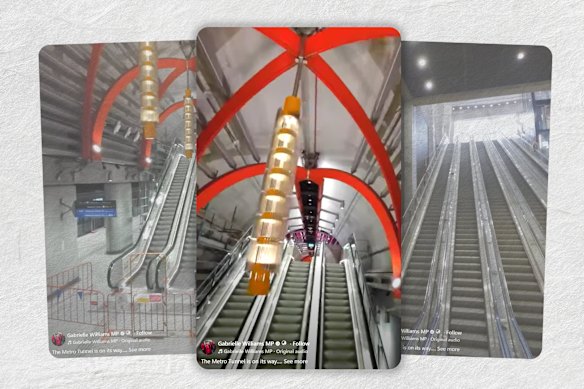

Social media influencers spruiking the Metro Tunnel and other state initiatives failed to properly declare paid partnerships, while videos made by government departments should be attributed when used by politicians, the auditor-general has found.
In a report released Tuesday, the Victorian Auditor-General’s Office (VAGO) said the state’s laws around government communications had failed to keep pace with the increased use of social media, including the use of influencers and departmental content on political feeds.
The report highlighted an ongoing tension around how to separate government and political advertisements in an era when every MP has their own social media pages.
While digital channels are now the biggest advertising expenditure by the Victorian government – with about $40 million spent in 2024-25 alone – state communication laws have not been updated since 2017.
The auditor-general said on Tuesday there were no consistent rules across departments or agencies about when influencers should disclose the involvement of the government in their content.
One social media post spruiking the government’s activity centres program listed the Department of Transport and Planning as a co-author, but failed to disclose it was a paid advertisement. This was later addressed during VAGO’s investigation.
VAGO also pointed to a video produced by Victorian Infrastructure Delivery Agency and shared on both the Metro Tunnel and then-transport minister Gabrielle Williams’ respective social media accounts. Another example showed now-Premier Ben Carroll posting Melbourne Airport Rail content.
In both cases, the auditor-general said the content was shared to the politicians’ pages without it being attributed to the original taxpayer-funded sources.
“These examples show that when agency-produced content is shared without clear government branding or strict attribution requirements, it can easily be repurposed for political purposes,” the report said.
“This may weaken public confidence that government communications are impartial and produced solely in the public interest.”
The report also warned about the crossover between videos, posts and other material being created by taxpayer-funded agencies or departments which was then repurposed for the pages of politicians.
VAGO said that while MPs and ministers could boost the visibility of content created by government departments, they identified several times when politicians did not identify the original source of their videos as taxpayer-funded agencies.
The Suburban Rail Loop Authority was also found to be providing monthly social media content to its minister and local MPs along the route of the project, including “tailored” content specifically for their pages.
“Creating, tailoring or adapting content solely for politicians’ personal websites or social media accounts is not an appropriate use of public resources and is inconsistent with the apolitical requirements of the Act and digital guides,” the report says.
In another instance, VAGO found the premier’s media centre, a website for releases issued by the state’s leader, was originally set up for government purposes but now houses party-political content despite sitting on the government’s “Single Digital Presence” platform, which requires content to be apolitical.
Of the 201 media releases assessed between March 1 and April 22, the auditor-general considered 173 had party political language, and mentioned opposition MPs and parties.
Following the report, the website has been updated with its copyright statement declaring that the content was created by the “Office of the Premier”.
“Our public service is fiercely independent and the best at what they do,” a government spokesperson said.
“We have always followed the rules, but as technology changes, there are always ways to improve how we communicate.”
Shadow Attorney-General James Newbury said the report showed the government had misused public resources and was politicising the public service.
The report has highlighted one of the complexities social media has created for government and political communications.
Official pages, such as the US president’s “POTUS” account on X, are typically transferred from one leader to another.
Former premier Daniel Andrews was also encouraged to hand over his Facebook page and its massive following to Jacinta Allan when he retired. However, he ultimately retained the profile, in part because it was linked to his identity rather than the office of the premier.
Geoffrey Robinson, a senior lecturer in politics at Deakin University, Geelong, said the difference between government and political advertising had long been an issue.
“It’s not just informing the public about programs; it’s also promoting the broader image and personality of the government, you know, and particular personality of the leader in particular,” he said.
Robinson said there was now pressure for politicians to constantly put out material, taking the cycle of communications from a press release once a week to posting on Instagram every day.
Start the day with a summary of the day’s most important and interesting stories, analysis and insights. Sign up for our Morning Edition newsletter.
From our partners
Disclaimer : This story is auto aggregated by a computer programme and has not been created or edited by DOWNTHENEWS. Publisher: www.smh.com.au