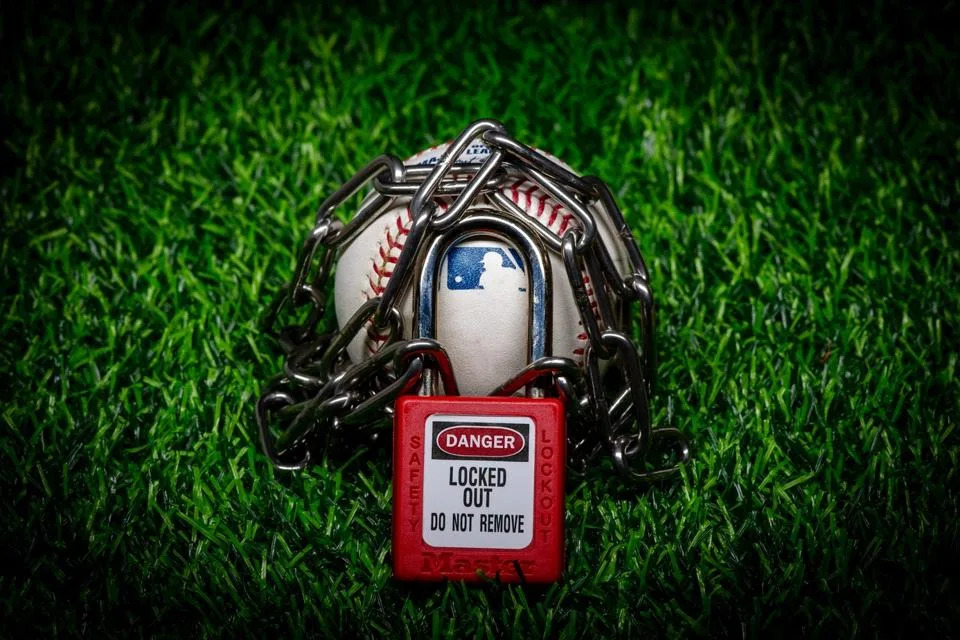
In less than a month, Major League Baseball is expected to impose a lockout on players as it pushes to implement a salary cap. If the lockout drags into Spring, political forces could push on either side of the labor battle to break an impasse.
On December 1st, just before midnight, it’s expected that the owners will lockout the players. In the offseason, the pressure to reach a new labor deal is limited, and not until spring training is threatened will there be urgency for the sides to reach a deal.
Advertisement
Currently, all management proposals have been tied to a salary cap, a red line for players who have consistently opposed one in Major League Baseball. If the game of chicken pushes into missing regular-season games, politicians on both sides of the aisle are likely to jump into the conversation.
The NLRB And Pressure From President Trump
We have to go back to the 1994-95 strike to see the last example of the most drastic moves both the league and MLB Players Association took around the salary cap dispute.
After the league canceled the World Series in September of ’94, President Clinton announced in October that he was appointing a mediator in an attempt to resolve the conflict. The efforts went nowhere, with each side moving incrementally but coming nowhere near an agreement. By the end of 1994, the league declared an impasse in negotiations and declared that they were implementing a cap system against the players’ will. The union immediately filed an unfair labor practice charge with the National Labor Relations Board (NLRB). Frustrated by the lack of progress through mediation, Clinton ordered the sides to the White House and declared that if the sides didn’t reach a deal by February 7, 1995, he would take the recommendations of mediator William J. Usery, Jr. on a settlement. The problem was, Clinton’s pressure had no teeth as any recommendation would not be binding.
Advertisement
Ultimately, on March 26, 1995, the NLRB voted 3-2 to seek a court injunction forcing the owners to reinstate the provisions of the old collective bargaining agreement. That ultimately landed the case in a Manhattan courtroom in front of U.S. District Court Judge Sonia Sotomayor (yes, the same Sonia Sotomayor who now sits on the Supreme Court of the United States). On March 31, 1995, Sotomayor granted the NLRB’s request for the preliminary injunction against the owners, saying, “When a contract ends, the parties must not alter mandatory subjects until a new agreement is reached or a good-faith impasse is reached.”
Fast forward to a potential scenario in 2027 with regular-season games lost, the NLRB and the president could, once again, play a role. Trump has already commented on the matter.
“If you don’t have a salary cap, you don’t have a sport, because they can’t help themselves,” Trump told reporters on June 5 aboard Air Force One. “Football has a salary cap. They should have done it a long time ago.
“It’s shocking, frankly, that they didn’t put a cap on many years ago,” Trump added, seemingly referring to the MLB strike in 1994 and 1995. “They had a chance to do a cap, but they blew it.”
Advertisement
Trump has not been shy about using the bully pulpit in the past and could do so again, applying pressure on the NLRB if the union claims an unfair labor practice against the league. And in Trump’s second term, he’s aggressively reshaped the NLRB, making it more employer-focused through board filings and appointments.
Remember, the ruling in 1995 by the NLRB board was as a razor thin 3-2 ruling in favor of the players. Now, a ruling for the owners could be more favorable.
The Blue Wave And Congress Injecting Themselves Into The Dispute
Back to the 1994-95 strike, Congress was a passive player. At the time, House Speaker Newt Gingrich stated, “I’m not sure Congress is the right place to try to organize the national pastime.” Senate Majority Leader Robert Dole added, “We’re very, very reluctant to have Congress get involved.”
Advertisement
Note that at the time, both the House and Senate were controlled by the Republicans. By next year, Democrats will have a sizable majority in both as the midterm blue wave will dramatically alter Congress’s dynamic.
It’s unclear how much stomach the new coalition has for inserting itself into MLB’s labor battle, but it is decidedly more union-friendly than it has been in the past.
As a means of applying pressure, one or more bills could be introduced to remove MLB’s antitrust exemption, something the league has continually fought to maintain.
Threats of repealing MLB’s antitrust exemption have come from both sides of the aisle in the past. In April 2021, several Republicans signed on to the Competition in Professional Baseball Act in an effort to strip MLB of its antitrust exemption. U.S. Senator Cory Booker (D-NJ) also signed on via amicus brief, saying, “For over a century, professional baseball has enjoyed a free pass to break the rules of fair competition because of a flawed Supreme Court ruling—one that the Court itself has acknowledged was a mistake,” said Senator Booker. “The one-of-a-kind antitrust exemption gives leagues the power to artificially control salaries, ticket prices, team relocations, and more, harming players and baseball fans alike. It’s time the Court fix this error and ensure that baseball, like every other sport, plays by the same rules of fair competition.”
This article was originally published on Forbes.com
Disclaimer : This story is auto aggregated by a computer programme and has not been created or edited by DOWNTHENEWS. Publisher: Sports.yahoo.com