
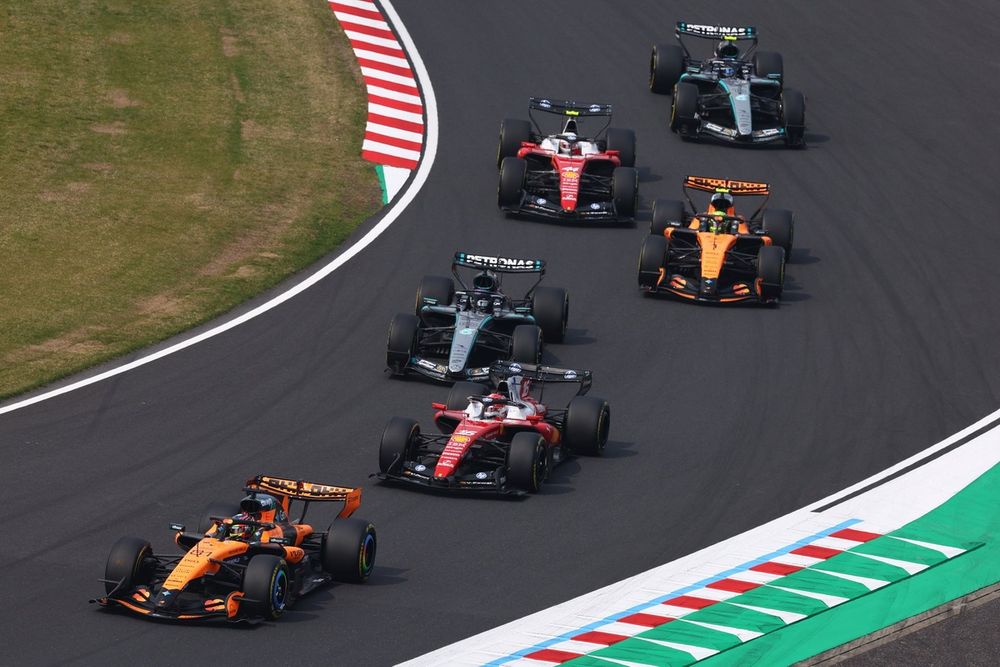
With Formula 1 forced to cancel two rounds shortly after the start of the new season, our reporters attempt to assess how those races might have played out — taking into account the opening rounds, the characteristics of the Bahrain and Saudi Arabian circuits, and the developing trends in the pecking order.
What would qualifying and racing look like at the tracks with the new cars?
Jake Boxall-Legge:
After the six days of pre-season testing in Bahrain, the paddock had come to the conclusion that the Sakhir circuit was a more “harvest-rich” circuit thanks to the collection of hard braking zones around the course. In that respect, you’d have expected a similar spectacle throughout the weekend as the Chinese Grand Prix, where energy management was less of a topic and the wheel-to-wheel racing might have been viewed as a bit less ‘artificial’ compared to that seen on the more energy-poor circuits.
What was interesting through the Bahrain tests, however, was the need for drivers to keep the engine revs up to ensure the turbo could continue to spin. In comparing Charles Leclerc’s best lap of testing (a 1m31.992s) versus Oscar Piastri’s pole time from 2025 (1m29.841s), you could see the methods employed to do so: Piastri ran in second gear through the opening corner, while Leclerc used first gear for an extra 2000-3000rpm at that phase, and the Monegasque also kept about 5% throttle through the slower corners in order to maintain that engine speed. Without the MGU-H, the turbo no longer has the capacity to spool instantaneously; thus, maintaining the engine speeds – and by association, exhaust output – ensures the turbo continues to rotate.
One can thus assume that, despite a few minor differences here and there with the lap-by-lap approach, Bahrain would have presented a familiar racing spectacle, albeit perhaps with a few more side-by-side moments through Turn 11 and 12 as some drivers held off from deploying power and others chose to spend it.
Although Bahrain might have been reassuring to those unconvinced by F1’s current era, Jeddah would have likely done the opposite. You have the hard stop at Turn 1, but that’s genuinely about it; every other corner is of a high-to-medium speed concoction and probably would have been a disaster waiting to happen. Think about the notoriously troublesome sightlines between the barriers, and the mix of drivers at part-throttle, or super clipping, or deploying. Bernd Maylander might have led more laps than the winner, and the medical centre might resemble Homer Simpson’s lawn when he acquires a trampoline (tramapoline! trabampoline!).
Charles Leclerc, Ferrari, George Russell, Mercedes, Oscar Piastri, McLaren
Photo by: Andy Hone/ LAT Images via Getty Images
Straight mode would also have been a consideration here. “I think racing with your wings open on the straights at 340 kph, sooner rather than later there’s going to be a big crash at very high speeds,” Carlos Sainz said in China. “Places like Jeddah, with open wings on this…I don’t like it, I don’t like having to race flat out at 340 kph, with no downforce in the car and the wings open”. On safety grounds, it’s probably a net positive that F1 hadn’t gone to Jeddah with the regulations still in a nascent stage.
Either that, or everyone would be running around in a low power state with nowhere to charge up…
Would Mercedes still dominate?
Ronald Vording:
The most logical answer to this question is ‘yes’. The April break is much needed for some teams, but that certainly does not apply to Mercedes. In fact, for Toto Wolff’s team, two races have been lost where the team could have capitalised on the initial competitive order.
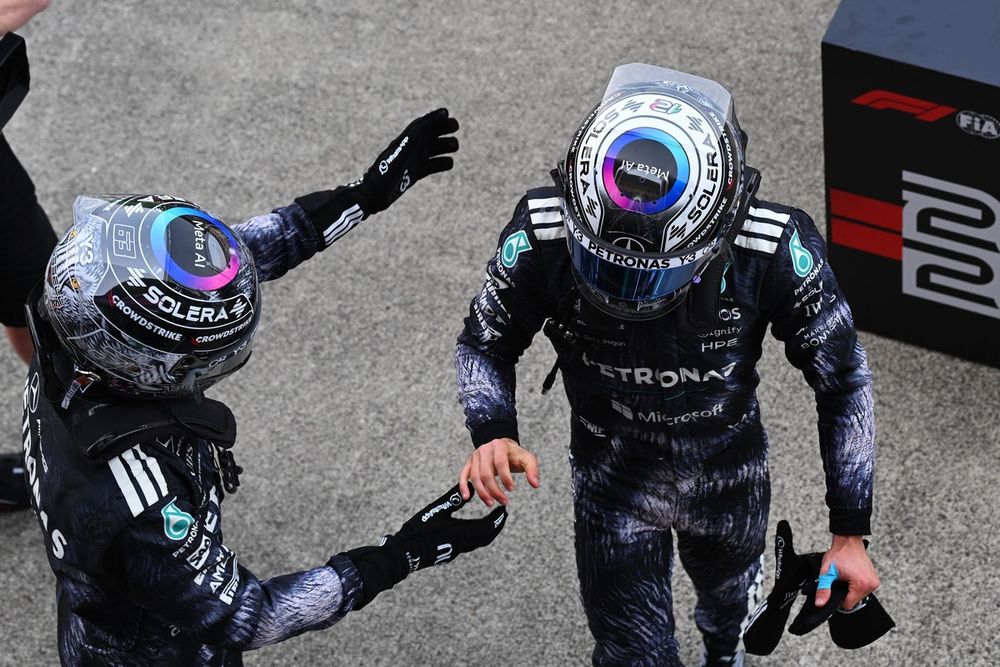
McLaren made a significant step in Japan, mostly in terms of PU understanding, but Mercedes was still the benchmark. When asked by Motorsport.com, George Russell explained that he considers that initial advantage in terms of PU learning to be “only fair” for a works team.
“I think we definitely hit the ground running in the first three races and you actually saw that with all of the PU manufacturers, or at least ourselves and Ferrari, that we as the factory team have a better understanding of the energy management compared to the customer teams,” Russell said.
“And that’s only fair because we have hundreds of people working towards that and we’ve been working on the simulator towards this for three years now.”
George Russell, Mercedes, Andrea Kimi Antonelli, Mercedes
Photo by: Sam Bagnall / Sutton Images via Getty Images
Those differences will gradually level out, as the current number two in the championship order noted. “Naturally, those major differences we saw in Melbourne, I think have already closed up, and everyone’s going to continue to get a greater understanding race by race.”
The break gives rivals more time for that. Russell does not expect ‘drastic’ changes in Miami, and Mercedes still starts that weekend as the clear favourite, but two races have been lost that would very likely have had a Mercedes driver on the top step of the podium. And two races have been lost before changes to the compression ratio measurements come into effect in June.
In Miami, it will be interesting to see what effect the upgrades have. McLaren team principal Andrea Stella said McLaren was targeting Miami anyway – regardless of the calendar changes – which in recent years has often led to the introduction of very successful upgrades in the Sunshine State. The question of whether McLaren can repeat that under these regulations may well be one of the aspects to look forward to most, although that only underlines that Mercedes has missed the opportunity to extend its championship lead even further before that, in Bahrain and Jeddah.
How different would the race strategies have been?
Stuart Codling:
So far in 2026, the default strategy has been a one-stop race since the latest generation of Pirelli tyres has proved more robust than expected (and, indeed, hoped). Throughout its time as F1’s sole tyre supplier, Pirelli has been expected to create rubber which offers good grip up to a certain point, and then tails off rapidly, opening up the potential for different strategies.
In practice it’s been difficult to strike a balance between life and grip, resulting in a generation of tyres which have been too sensitive to thermal degradation, forcing drivers to manage those sensitivities rather than pushing hard throughout the race. Ahead of last season, though, Pirelli responded to drivers’ requests for a tyre they could push harder… and the outcome was more one-stop races because the tyres were more resilient to thermal stress.
It was a classic case of being careful what you wish for.
This scenario has carried forward into 2026 despite the tyres being entirely new. All three grands prix so far have been one-stop affairs for the majority of the grid, with very little divergence in terms of starting compounds.

One-stop strategies were the most common across the three events
Photo by: Sam Bagnall / Sutton Images via Getty Images
In Melbourne nine of the top 10 finishers started on the medium compound (C4 for this event), and only three stopped more than once. Here and in China, the pitstop timing was dictated by appearances of the safety car.
By round three, Japan, all bar one of the drivers who took the start did so on mediums (C2 at Suzuka), and the majority swapped to hards in the same six-lap window (16 to 22).
Are there any reasons to believe the cancelled Bahrain and Saudi Arabia rounds might have played out differently? Perhaps.
Bahrain’s track surface is famously abrasive, a deliberate design choice using specially imported stone in the aggregate mix. In last year’s race every driver stopped at least twice, there was a healthy variety of starting compound (new mediums vs new/used softs), and there was a substantial variation in the timing of the first pitstops.
The top two finishers, McLaren’s Oscar Piastri and Mercedes’ George Russell, ran different strategies (used softs/new mediums/new mediums vs used softs/new mediums/used softs), although Russell fell back with a technical problem late on. For most drivers the final pitstop timing was dictated by a safety car deployment.
For Jeddah last year Pirelli shifted its compounds a step softer, in the hope of promoting greater strategic variety, but this didn’t translate into reality since it was a one-stop race in which eight of the top 10 finishers started on mediums and seven pitted within four laps of one another. That’s because it’s a narrow circuit on which it’s difficult to overtake, so teams guard track position carefully.
Which midfield teams would have performed better?
Ronald Vording:
This question is much harder to answer than the Mercedes one. First of all, Bahrain and Jeddah are two completely different circuits in terms of energy management, which means that the assessment of the midfield is not necessarily the same for both tracks.
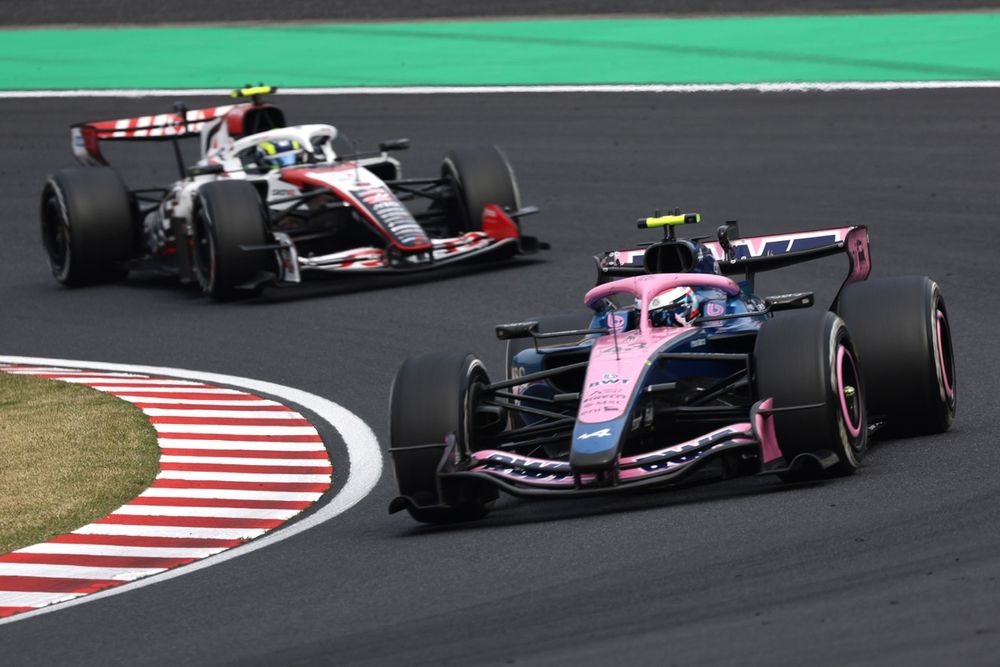
If we look back at winter testing, Haas and Alpine left a strong impression in Bahrain. After testing, consensus in the paddock was that these teams would lead the midfield, although it must be said that Audi and Racing Bulls have been able to surprise at various moments since then.
Nevertheless, there is certainly a case to point to Haas and Alpine. The American team made a strong impression in Shanghai – a less harvesting-poor circuit than Melbourne – by beating Red Bull “on merit”, as Haas team principal Ayao Komatsu put it. Part of that strength could also have been utilised in Bahrain. Alpine’s Pierre Gasly managed to stay ahead of Red Bull in Suzuka, meaning that Haas and Alpine have both shown the potential that was already attributed to them in Bahrain.
Haas and Alpine emerged as top midfield teams
Photo by: Mark Thompson / Getty Images
The only caveat we must make here is that Bahrain would have been a very popular venue for upgrades. Whereas McLaren immediately focused on Miami, Bahrain would have been an ideal location for many other teams to introduce new parts – both logistically and due to the data from winter testing. And this development race can change the pecking order in the midfield on a weekly basis.
It will be interesting to follow how Haas performs in that regard. Komatsu rightly noted that his outfit is still “by far” the smallest team on the grid. That already makes it highly impressive how Haas has dealt with this technical turnaround, but also raises the question of how the team will cope in the intense development battle. For Bahrain and Jeddah, however, it would have been a safe bet to point to Haas and Alpine, with Audi and Racing Bulls as the main outsiders for a points finish.
Would overtaking have been easier or harder?
Stuart Codling:
Bahrain is what engineers describe as an “energy rich” circuit in that its balance of corners to straights lends itself to a more conventional way of driving: the straights aren’t so long that the cars run out of energy long before the end.
McLaren team principal Andrea Stella pointed that out at the start of the season, when he was asked if the racing style seen in Australia was representative of other circuits.
“I would say that would be a more similar racing to what we were doing before,” he said of Bahrain. “Because you drive the car in a more traditional way. You harvest in braking, you deploy in exit, as you go on power on the accelerator pedal.”

Bahrain could have delivered another overtaking fest
Photo by: Sam Bloxham / LAT Images via Getty Images
Now, a possible consequence of that would be less of the ‘yo-yo racing’ which defined Australia and, to a lesser extent, Japan, and more of the conventional outbraking into slower corners, as in the Chinese GP. So while there may have been more overtaking than in previous years, many of these moves would not have been of the ‘unearned’ variety caused by differing levels of charge.
It would have been a very different picture in Jeddah, which was expected to be among the three most ‘energy poor’ tracks along with Albert Park and Monza. There are lot of flat-out sections, even though not all of them are straights as such, and very few heavy braking events.
That would have made energy harvesting under braking very limited, forcing drivers to do more lift-and-coast and super clipping. This might have fed into more overtaking than usual in Jeddah, but the majority would have been uncontested passing moves set up by variations in battery charge.
We want your opinion!
What would you like to see on Motorsport.com?
– The Motorsport.com Team
Disclaimer : This story is auto aggregated by a computer programme and has not been created or edited by DOWNTHENEWS. Publisher: motorsport.com



