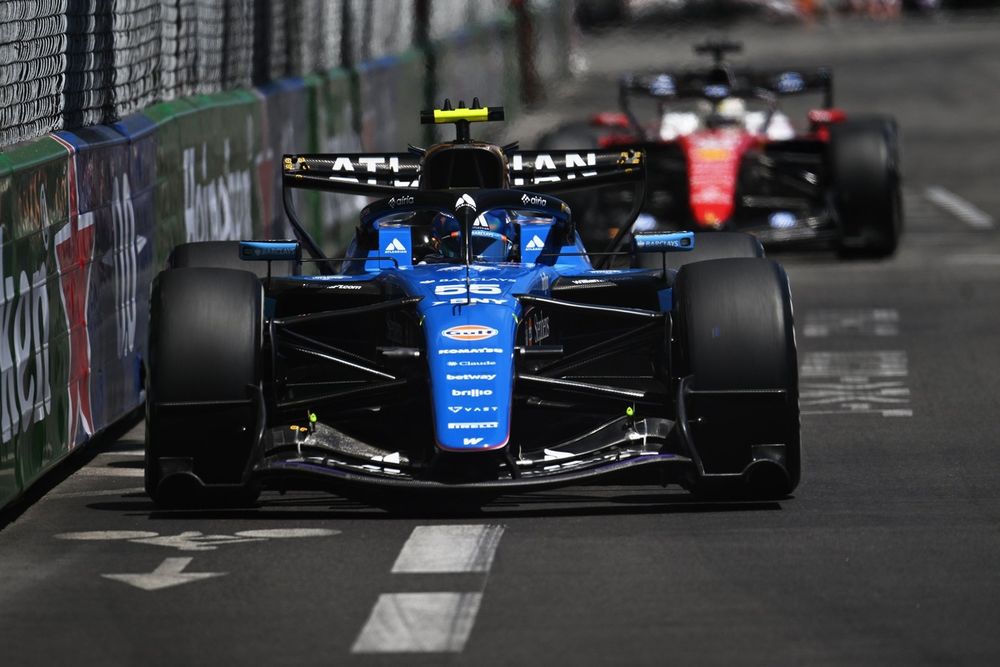
With seven races completed, Formula 1 drivers have collected just a single penalty point this year – with Franco Colapinto receiving one for failing to slow sufficiently under yellow flags during the Barcelona race. There have still been no penalty points issued for incidents arising from battles on track.
This is the result of revised FIA guidelines introduced ahead of the season, giving stewards much greater flexibility in deciding whether – and how many – penalty points to award. While the recommendations for sporting penalties remain largely unchanged, the section covering penalty points has been significantly revised. In many cases, stewards can now decide how many points, if any, to issue for an infringement – particularly when it comes to collisions.
That is exactly what the F1 drivers had asked for. In their view, handing out penalty points for collisions that were simply the result of hard racing was the wrong approach.
The principle itself remains unchanged: drivers who accumulate 12 penalty points receive an automatic race ban – as happened in 2024 when Kevin Magnussen was forced to miss the Sao Paulo Grand Prix after exceeding the limit.
The system had often been criticised by the drivers, who argued that penalty points were being issued for relatively minor infringements or collisions caused by optimistic – but not reckless – overtaking attempts.
“Obviously driver penalty points is something that could result in a race ban,” GPDA director Carlos Sainz explained, when asked by Motorsport.com. “And I think a driver should get a race ban if you’re continuously dangerous towards your competitors, towards the marshals, or you’re misbehaving towards FIA and stewards.
Carlos Sainz, Williams
Photo by: Eric Le Galliot
“If those two or three things are happening, we are happy to receive penalty points, but if we are doing a little mistake on the speed limiter, we are doing track limits, which is not putting anyone in danger, we’re just… anyway you’re penalising us with race time already.
“We don’t believe penalty points should be awarded, because you’re not infringing a yellow or a red flag, you’re not endangering anyone, you’re not putting a competitor at risk, you’re not misbehaving – and that’s what we pushed forward. And so far, to be honest, the FIA have been extremely helpful with that.”
One of the biggest changes compared to last year concerns causing a collision. In the previous guidelines, this offence carried three penalty points alongside the sporting penalty. Under the new version, stewards can award anywhere between zero and three points, depending on the severity of the incident. One example came in China, where Esteban Ocon received a 10-second time penalty for his clash with Colapinto but no penalty points on his licence. The updated guidelines also include a new note stating: “Penalty points for causing [a collision] should be adjusted based on the severity of the incident caused”.
Another notable change concerns forcing another driver off the track. Unless the stewards judge the move to have been “reckless”, it no longer carries penalty points, compared to two under the previous guidelines. The same applies to ignoring blue flags: the new guidelines recommend no penalty points, instead of one or two under last year’s version.
However, for incidents where stewards believe a collision happened with “apparent deliberate or reckless intent”, the driver will still receive four penalty points – the same as under the previous guidelines.

Rui Marques, FIA Race Director
Photo by: Mark Sutton / Formula 1 via Getty Images
According to Sainz, the FIA has been receptive to making the requested changes. He also praised the improvement in communication with the governing body, saying it has reached a level of trust the drivers had with former race director Charlie Whiting.
“I think we were all insisting in briefings, and obviously conversations were held,” he said, “and also since the arrival of Rui [Marques, the current F1 race director], the team and the set-up there now within the FIA is the most collaborative set of people I’ve worked with since Charlie. And it’s honestly running quite smoothly and quite well, and I feel like I can just tell they listen to us a lot, and honestly we are now in a good place with them.
“Sometimes we bother them too much, sometimes they bother us a bit too much, but it’s like a typical relationship, but I must say it’s smooth right now, it’s a good relationship.”
Happier Bearman
One of the drivers for whom the new approach came as a relief is Oliver Bearman, who spent much of last year on the verge of a race ban – and still tops the current “penalty points table” with eight. He says the previous approach had led drivers to hold back when racing each other.
“All of us were kind of having the same mindset,” he said, when asked by Motorsport.com. “OK, you should be penalised for doing mistakes, but this kind of penalty point system and the way that they were being dished out so freely in previous years was not really incentivising us to try anything, to race.
“And if we want to have a spectacle, have a race, let us try to overtake, knowing that if you mess it up, you’re going to be penalised.But you’re not going to lose out on a race later in the year potentially for that, which is good. Yeah, I’m happy with that, and I think everyone was pretty unanimous.”

Oliver Bearman, Haas F1 Team
Photo by: Simon Galloway / LAT Images via Getty Images
Bearman received four penalty points at Silverstone last year for crashing while entering the pit lane under red flag conditions during third practice. The stewards concluded that, although the regulations required him to return to the pit lane slowly and with caution, he instead attempted to “simulate entering into the pit entry road under race conditions”. The Haas driver agrees that such an offence fully deserved a harsh sanction, while many racing incidents do not necessarily need to result in penalty points.
“I did a really silly mistake in Silverstone,” he said, “and if that happens again to anyone, they will receive the same amount of penalty points because that’s a dangerous move. But, you know, I remember I got one for contact in Monza last year, Carlos and I came together, we both were penalised, we both spun round.
“Actually, later on in the year, all the drivers and the stewards agreed that I shouldn’t have got a penalty, and if anything, it should have been the other car. I got a penalty point for that, and so, you know, that type of scenario seems a bit unfair, but, of course, if you do something dangerous, then you should be penalised in terms of penalty points.
“Yeah, because you know that you’re going to be penalised if you do it wrong, but, you know, dishing out penalty points so freely, like they did last year, seemed like the wrong move, and, you know, as always, the FIA has been incredibly receptive on that.”
We want your opinion!
What would you like to see on Motorsport.com?
– The Motorsport.com Team
Disclaimer : This story is auto aggregated by a computer programme and has not been created or edited by DOWNTHENEWS. Publisher: motorsport.com