The last heir of the greatest American golf dynasty stood at the center of the ballroom at the Rockville Links Club and did what he had always done.
He looked for dad.
Members of the Turnesa family have been gracing the ballroom at “The Links” for so long and to such great effect that Marc’s shuffle to the center of the room had hardly attracted attention. The crowd enjoying dinner had to be hushed, and Marc had to wait at the lectern, sheepishly, for their silence.
Marc Turnesa does not scare easily … or ever, really. His secret weapon as a player — on the PGA Tour for several years, and across pro golf for more than a decade — was his proclivity for calm. (“He doesn’t really think about anything when he’s over the golf ball,” one longtime associate once told me.) But on this day, in this most familiar of places, something came over him. He looked worried, and worse, unsettled.
Up until fairly recently, Marc didn’t have to crane his neck more than a few degrees in this setting to see Mike Turnesa’s face. For the vast majority of Marc’s life, Mike was never more than a 5-iron away from his spot in the center of the ballroom — including in the moments he probably ought to be elsewhere. Mike would saunter through the clubhouse of this town club like a tomcat, a fat cigar in his hand and a loose, black pullover around his shoulders. The smoke would waft into his salt-and-pepper hair as he strolled, usually with a grin across his face and a quip in the holster, for so many hours and over so many years that eventually the course was as much home as any physical place had been.
On this day, though, Marc turned his head a few degrees more. His father’s physical presence wasn’t in the ballroom, at the range, or in the clubhouse — but he was heresomehow. He had to be. Mike Turnesa would never miss a party in his honor … not even from the grave.
And so Marc looked, his eyes eventually wandering up toward the ceiling, where it seemed dad might be hiding between the beams.
“You know, I was thinking about him today,” Marc said. “How many hours we spent out on the range. He was a tinkerer, you know, with that Sony camcorder. This has always been a special place to us…”
He paused.
“To all of us,” he said. “And I guess what I want to say is thank you. I just can’t say thanks enough.”
And then, in front of the room, the unflappable heir of this great family did something surprising. He began to cry.
ONE AFTERNOON IN the summer of 1908, a great American family was born.
Vitale Turnesa didn’t know where his day would end when he set out from his lower Manhattan tenement for a very good walk. He did not know he was on the brink of charting the next 118 years. He knew only that his cousin had purchased some land somewhere in Westchester, and he wanted to see how it looked.
As the legend has it, Vitale started walking in Manhattan on that day and kept walking until he had made it to Elmsford, N.Y., 26 miles from the Lower East Side. He stopped because he’d found a construction site in Elmsford that caught his eye: The routing for a new, 9-hole golf course in a beautiful downtown area.
As luck had it, the crew was looking for work on the course, which they were calling Fairview Country Club, and soon young Vitale was hired as Fairview’s first-ever head greens superintendent. It was the last job he ever had.
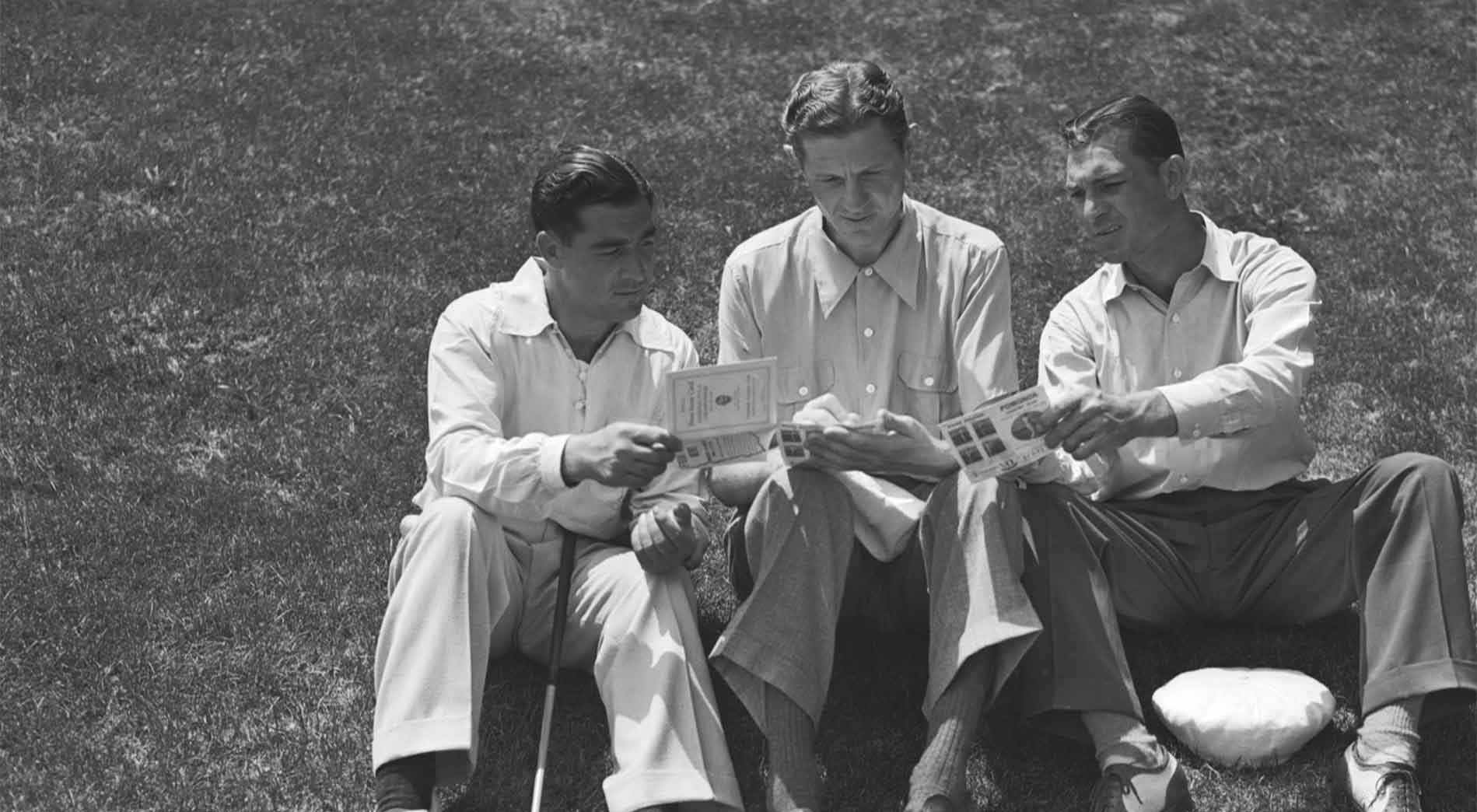
Vitale raised seven sons and two daughters with his wife, Anna, from the fairways of Fairview, and that first family would form the core of perhaps the greatest American golf family of the 20th century. Thirteen Turnesas would go on to dedicate their lives to golf as club pros and serious players, five would win big-time pro events, and two would win major championships.
Today, the stats make it seem like golf came to the family by dumb luck and sheer talent, but the truth is less glamorous. For much of the family, golf was a compulsion more than it was a calling — something fathers and sons did for lack of viable alternatives. This became a central irony as the sport morphed into the “family business”: For much of the family’s history, Turnesas had hoped golf was a ticket to a somewhere else.
“I told Marc he has to remember he represents seven guys who, other than Willie, didn’t have an education,” Joe Turnesa, one of Marc’s second-cousins, told Golf Digest in 2009. “They came from parents who couldn’t read and write. He has a responsibility to carry on in the memory of those guys. Marc has a legacy.”
Forty years before Marc became a PGA Tour pro, the responsibility of a life in golf nearly kept his father out of the sport. As the story goes, it was the late 70s and Mike Turnesa was trying to break into the industry as an assistant pro at another prominent Westchester golf course, Knollwood Country Club.
From the outside, it seemed like a pretty good arrangement, says Sandy Turnesa, who was married to Mike for years and remains close to the family. Mike’s dad, Mike Sr., was still the head pro at Knollwood. As an assistant, Mike could learn from his dad until he was ready to fly the nest to a head pro position at some other Westchester club.
But if Mike Sr. was hoping to see his son stay in golf, he certainly wasn’t paying him like it.
“He was getting out of golf because we needed more money,” Sandy remembers. “He was making $5,000 a year, and he was ready to give it up so he could support the family.”
Today, the family has its theories about Mike’s inauspicious start in the golf industry — theories about money and familial disposition. But the real explanation for Mike Sr.’s reticence might be simpler than that: He knew golf’s penchant for heartbreak. In 1948, Mike Turnesa Sr. played the best golf of his life in the finals of the PGA Championship only to lose to an all-time performance by Ben Hogan. He spent the rest of his life at Knollwood wondering what might have been.
Still, Mike Sr. had passed along his family’s stubbornness to his namesake, and Mike was determined to make the family business work. One day he heard about a head pro opening at Rockville Links, a small town club on Long Island, and submitted a resume. It was a last-ditch effort — a big swing before another life called — and it hit. One night, while Mike was out bowling, Sandy got the call.
“They told me, ‘Don’t tell him, so we can tell him,’” Sandy says. “I said, ‘Sure.’ The minute he walked in the door, I told him he got the job. He couldn’t believe it. He was so happy. He thought we died and went to heaven.”
At the Links, Mike quickly learned what generations of Turnesa men already knew: golf is not a job but a lifestyle. Long hours. Weekends. Holidays. An acclimation to brain activity in the 4 a.m. hour. Too few days off. Too many entitled clients. And that’s all before the ball goes in the air. If a miracle had brought the family into golf, Mike learned that a perfectly ordinary sense of hustle and toil had kept them there.
“If he wasn’t working, he was usually on the range,” Marc says. “That was how life went.”
Over time, the Turnesa disposition seeped into Mike’s bloodstream: he worked tirelessly, saved his shekels carefully, and spent almost never — cutting his own lawn well into retirement. In one famous example of his frugality, Mike picked up the same dime three times before realizing it’d fallen out of his own pocket.
His sweat equity built, too. Around the Links, Mike began to live up to the family name, earning a reputation as a teaching pro on the bleeding edge of innovation. In the 80s, that reputation arrived chiefly from one piece of revolutionary new technology: A Sony camcorder, which Mike could use to easily replay and rewatch his student’s swings.
“He absolutely loved that thing,” says Kevin Berry, a longtime Links member and student of Mike’s. “He was obsessed.”
Yes, Mike was an adoptee of video swing analysis long before the practice was in vogue, and he was quickly endearing himself to a generation of members with his … unusual teaching methods.
“You’d take a lesson from Mike — it was like half an hour watching Mike hit shots … and then you’d hit a few,” Berry says. “He was notorious for it, but it was fine. Everybody’s like, ‘Man, Mike, I love watching you hit’ — and after he hit balls you’d pay him $100.”
Mike Turnesa Sr. poses for a photo.
Getty Images
In a career of teaching, no student proved more capable than Mike’s own son, Marc. Marc Turnesa was like his dad: he wanted a life in golf — and he was willing to scratch and claw to get it.
As Sandy tells it, she knew her son had inherited the family disposition almost immediately. As a kid, Marc came home late only once: At 10 years old, when it’d taken him longer than usual to sink 100 straight three-footers from the practice green at the Links. It was a tradition he’d kept secret from his parents; he’d come up with the idea on his own.
“I started to laugh, and I said, ‘Well, that sounds like serious business,’” Sandy recalls. “He said, ‘Well, I am serious.’ And I said, ‘Okay, so what are you saying to me?’ He said, ‘I think what I want to do is play golf on the junior high school team and the high school team, and I want to get a golf scholarship to college. And after college I want to go on little tours until I get on the big tour, and I want to be on the PGA Tour, and I want to win.’”
Sandy smiles as she reaches the punchline.
“And he was ten.”
The elder Turnesa was careful about his teaching methods when it came to Marc. He never wanted his son to feel pressured into the sport on account of his last name, or worse, resentful of it. Like his own father, Mike feared what a life in golf might look like for his son. Unlike his father, Mike never placed his finger on the scale.
“He was so good with me about it,” Marc says now. “Looking back, he kind of just let me fall in love with the game. I never felt any pressure from him.”
By the time Marc was in his twenties, his work had paid off. Marc had made it to high school, college, the little tours and the big tours. Suddenly, he was playing each week on the PGA Tour and still ascending. In 2008, Marc’s breakthrough finally came: he won the Shriners Open in Vegas, and secured a few more years on the big tour. In 2011, he closed the loop entirely, qualifying for his first U.S. Open at Congressional, the family’s 46th start (and third generation) in the national championship.
Thanks to his last name, Marc’s ascent to the pros was a frequent source of interest in the golf community. But Mike’s role in his son’s success was often left out of the story.
“He’s what got me into the game,” Marc says. “It wasn’t my great uncles or my grandfather — we hardly saw them. It was my dad … and that freakin’ Sony camcorder.”
Nevertheless, Mike never seemed too bothered to be left out of the story.
“He was so humble,” Sandy says. “Completely honestly, I don’t think he knew his own worth.”
By 2017, Marc had largely fallen out of pro golf thanks to a combination of injuries and bad luck and bad golf. It wasn’t a particularly sad retirement story, but it left Marc feeling incomplete. He had worked toward certain golf goals for years, and the end of his playing career meant contending with the reality that some of them would not be accomplished.
Top of the list was a chance to compete in the Masters. Decades earlier, Mike Sr. had played in the first Masters, which meant a Masters invite for Marc (with its traditional pre-tournament site visit) would bring all three generations of the family to Augusta National. Now, with Marc’s career dwindling, both father and son knew well enough to know their chances of a journey to golf’s holy land were on life support.
But then one day, the phone rang.
It was Marc. He’d called in a favor with a friend of a friend — a retirement present for Mike, who was preparing to step down at the Links after 36 years.
The son still remembers how he asked the question.
“Dad, do you want to go play Augusta National?”
The scene at the Turnesa.
GOLF
ON A PERFECT MORNING in late-May, Mike’s smile radiates around Rockville Links.
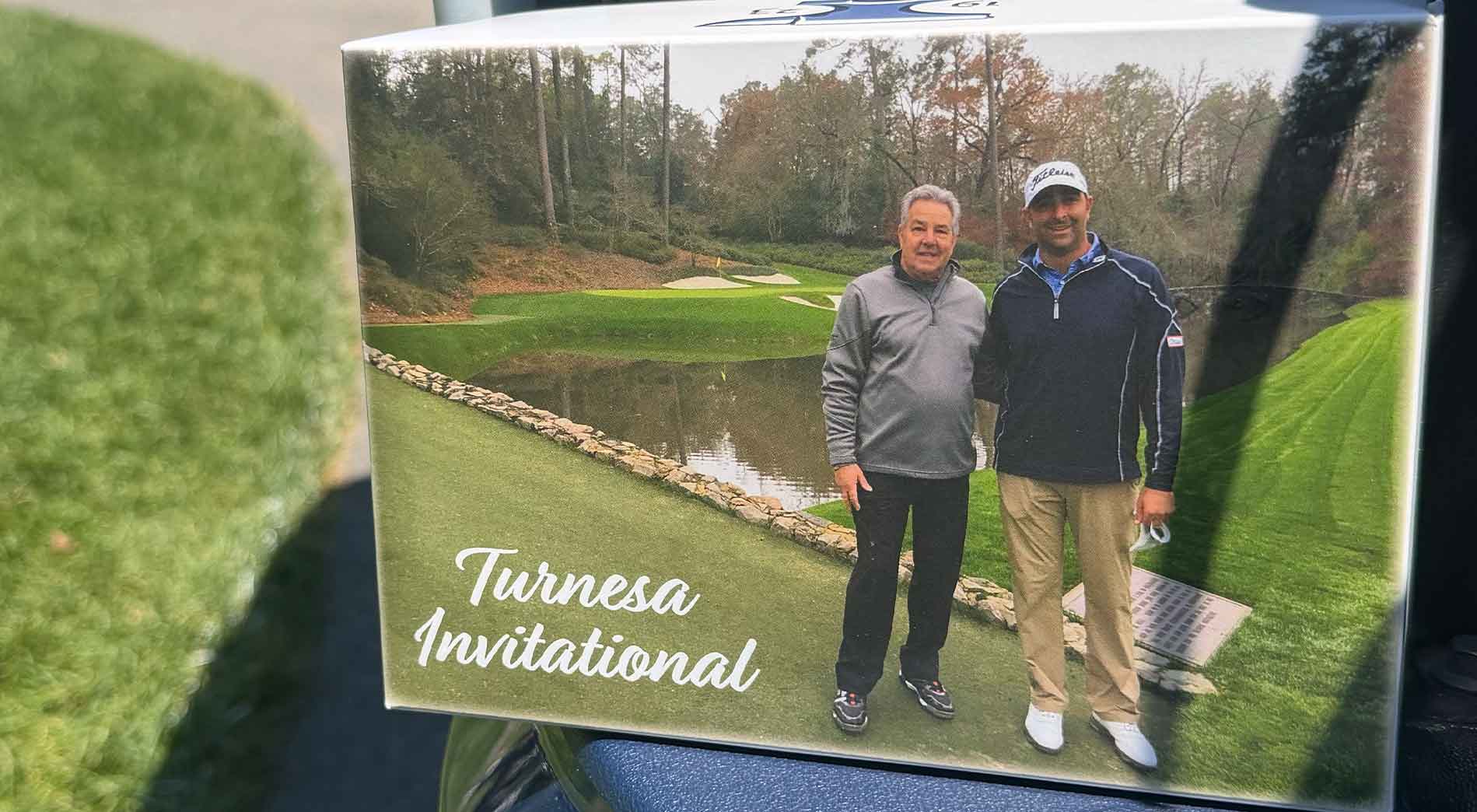
In the clubhouse, a sign stands out front greeting guests at “The Turnesa,” a pro-am tournament going on its seventh year. At the check-in desk, players are handed a dozen golf balls with a photo etched into the box. The shot has become famous around these parts, not least because it depicts the most famous par-3 in golf — the 12th hole at Augusta National — with two of the club’s favorite native sons in the foreground.
It was a cold December day in 2017 when Mike and Marc Turnesa made their pilgrimage to Augusta. Mike whined about getting on the plane — on account of the connection in Atlanta and the checked bag fee — but he went anyway, wearing that old grin on his face. The course was soft and played “like 10,000 yards long,” Marc remembers. Both father and son shot around even-par. When it was over, they lingered for a minute on the 18th green.
“I mean, that was the crown jewel,” Marc says. “I don’t know how it gets better.”
Marc was grateful for the memory then. He was even more grateful the following spring, when Mike went out to cut the lawn one day and had a stroke. He died from the complications on May 10, 2018, less than a year after his retirement.
The funeral was a stately affair that featured a considerable chunk of the Links’ membership. Marc delivered the eulogy, unflappable as ever, sharing stories of the legendary Sony camcorder and the man who wielded it. He ended the speech on an unusually tender note: sharing the text his dad had sent him every morning of his pro career.
“Everybody knows how good you are, you just need to believe it yourself.”
It was powerful golf advice, but it might have been even more powerful life advice. Mike might’ve loved that camcorder, but he was always better teaching from the heart. He just knew.
Today, Mike’s legacy lives on in complicated terms. Marc and his siblings have had only one child, a girl, meaning Marc is at risk of becoming the final male heir to his corner of the Turnesa legacy.
“It’s sad,” he says. “The name is dying. Now it’s just whatever’s written, that’s all that we have.”
The Turnesas have felt the weight of this reality often since Mike’s death. On Father’s Day, and U.S. Open Sunday, they will wonder once more about the family golf legacy, and about the game that has given so many generations of their family such purpose and direction and community and heartbreak. The Turnesa journey in golf has never been perfect, but it has always been theirs.
“I don’t think anybody really completely succeeds,” Sandy says. “You do the best you can with who you are.”
And if you’re lucky, your best is good enough to last a lifetime. In the places, the people, and even the jobs.
As he stepped off the lectern with tears in his eyes at The Turnesa, the last heir of this corner of an American golf dynasty seemed at ease. The family story was too long and complicated for Marc to explain to a group of hackers and teaching pros. It was also not quite relevant.
The real story of the day was much simpler.
“It’s in the blood,” Marc said as he wiped his eyes and surveyed the room. “All of this. It’s in the blood.”
And then Marc Turnesa took a deep breath and stopped looking for his dad. Maybe because he’d already found him.