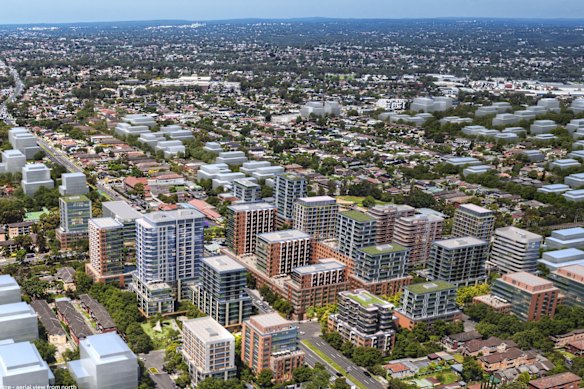

It promises faster and more frequent services, but the long-awaited Southwest Metro is set to transform far more than the daily commute as sweeping rezoning changes pave the way for tens of thousands of new homes to be built along the 30 kilometre rail corridor.
Suburbs surrounding nine stations on the metro line due to open on Friday are being reshaped into multi-storey housing precincts under new planning controls aimed at accommodating up to 59,500 additional homes.
The changes form part of a broader NSW government push to boost housing supply around public transport infrastructure and suburban town centres.
They also herald a dramatic shift in the character of suburbs along the rail corridor where residents, developers and businesses are weighing up the opportunities of population growth against concerns about density, infrastructure and affordability.
Under the new planning framework, Bankstown has been earmarked for 14,000 extra homes; 15,000 will be split across Punchbowl and Wiley Park; 18,000 across Belmore and Lakemba; and substantial increases in density have also been targeted for Campsie, Canterbury, Dulwich Hill and Marrickville.
Analysis of NSW Planning data shows developers are already capitalising on the changes, with 6239 apartments now proposed in the rezoned suburbs under state-significant planning applications lodged with the Department of Planning and Housing Delivery Authority.
The largest is a $1.8 billion redevelopment of Bankstown Central by its owner, Vicinity Centres, which includes plans for 2673 apartments in new residential towers above the shopping complex.
NSW Planning Minister Paul Scully said the rezoning changes would support more homes with strong connections to public transport.
“Unlocking thousands of new homes along the Southwest Metro line is an example of the government matching a transport infrastructure investment with housing growth in communities young people, families and key workers want to live in,” he said.
The scale of the housing ambition far exceeds the former Baird government’s 2015 target of 36,000 dwellings along the rail line. Of the 59,500 homes now proposed, 50,500 fall within the Canterbury-Bankstown local government area – a surge that, if fully realised, would increase the total number of dwellings in the council area by 37.5 per cent from 133,317 to 183,817.
While the uplift in density offers many renters and first homebuyers a potential foothold in Sydney’s punishing property market, the scale of transformation is exposing familiar fault lines in Sydney’s housing debate: how to build more homes without overwhelming infrastructure and eroding the character of existing suburbs.
In Campsie, the NSW government this month approved a 33-storey residential tower on London Street that would exceed the suburb’s rezoned height limit by 13 storeys, while a separate planning proposal for 346 apartments on Ninth Avenue would stand even taller at 39 floors.
Colin Cosier, a member of the Campsie Public School Parents and Citizens Association, has objected to the Ninth Avenue proposal, arguing the building was “inappropriate” for the site and would place excessive pressure on local infrastructure.
Canterbury-Bankstown Council’s co-ordinator of strategic assessments, Patrick Lebon, similarly objected to a 425-unit project across three towers on Evaline Street in Campsie, describing its scale as “unprecedented” and “inconsistent” with the council’s long-term vision for the town centre.
Fears of a loss of heritage and neighbourhood character have added to community concerns. Earlier this year, a campaign to save Bankstown’s historic St Paul’s Anglican Church failed to prevent its demolition after the Department of Planning approved plans for the site to be redeveloped into 185 apartments.
Bankstown resident Suzana Zekic, who lives next door to a site earmarked for an eight-storey unit complex on Sir Joseph Banks Street, said residents often felt “powerless” as large-scale developments progress through the planning system despite community opposition.
“It feels like it’s all out of our hands and that you don’t have a say on what’s being built in your area.”
Despite local pushback, opposition to greater density along the metro corridor is far from universal.
Justin Simon, chair of pro-housing group Sydney YIMBY, said the rezoning changes would provide more housing options for many first homebuyers priced out of inner-city areas.
“There are many young people who work in the CBD who are now having to live further and further away and spending hours commuting each day because they can’t find anywhere else that’s affordable,” he said.
UNSW City Futures Research Centre Professor Chris Pettit said concentrating housing around transport corridors could also reduce Sydney’s reliance on urban expansion into outer growth areas, where access to public transport and essential services is often limited.
For local traders such as Dina Kheir, who has run her Punchbowl florist for 30 years, the rail line and prospect of more residents represented an opportunity to recover after years of disruption during metro construction works.
“Local shopping strips have been really struggling in the current climate but having those faster train services is really going to open the door for a lot of people to live here and shop here,” she said.
“It also makes us more accessible to other parts of Sydney.”
While the rezoning changes are aimed at supporting more homes along the metro line, questions remain over whether many of the new apartments will genuinely cater to lower-income households.
Western Sydney University urban research professor Ehsan Noroozinejad pointed out that mandated affordable housing contributions for new developments in rezoned areas including Bankstown and Lakemba are set at 3 to 4 per cent for up to 15 years – a figure he argues should rise to 10 to 15 per cent in perpetuity.
“Given the scale of housing stress in Sydney, I see 3 to 4 per cent as a useful contribution but insufficient on its own,” he said.
Noroozinejad also warned rezoning changes could push up land values along the metro line – an increase he said would flow onto development costs and ultimately to apartment prices and rents.
Urban Taskforce chief executive Tom Forrest supported the rezoning changes but cautioned that labour shortages, financing constraints, taxes and rising construction costs remained barriers to getting projects built.
“That means the yield in terms of the number of dwellings will need to be higher to justify the development, particularly in areas where units have traditionally sold at lower price points than in other parts of Sydney,” he said.
Bankstown State Labor MP Jihad Dib pointed to projects such as the redevelopment of Bankstown Hospital as evidence that investment in infrastructure would support the growth in density.
A Transport for NSW spokeswoman said the Southwest Metro would initially be capable of carrying about 17,000 passengers an hour in each direction during peak periods, and capacity could be expanded if demand required it.
A new pedestrian and cycling route, the MetroWay, is also being built between Sydenham and Bankstown. Similar in concept to the Inner West GreenWay, the project is due to open in 2028.
As the Southwest Metro prepares to launch, Pettit said the overarching challenge would be to ensure the benefits extend beyond faster and more train services.
“The real test for the government is making sure that the social and community infrastructure is in place to keep up with the thousands of additional residents who’ll eventually live around those stations.”
The Morning Edition newsletter is our guide to the day’s most important and interesting stories, analysis and insights. Sign up here.
 David Barwell is an urban affairs reporter for The Sydney Morning Herald.Connect via email.
From our partners
Disclaimer : This story is auto aggregated by a computer programme and has not been created or edited by DOWNTHENEWS. Publisher: www.smh.com.au