The numbers, frankly, should not add up. A brand barely seven years old, born without the backing of a luxury conglomerate, built on the memories of a man who once trekked alone on the Chinese Silk Road — and yet Maison Crivelli is sitting in the top five at iconic UK department stores, and being courted weekly by hedge funds and private investors. Thibaud Crivelli, founder and the restless creative behind the coveted fragrance house, is not entirely surprised. He always believed this was coming.
He is, in many ways, the perfect embodiment of the seismic shift currently reshaping the global fragrance industry. For decades, the perfume market was dominated by the great luxury houses — LVMH, Kering, L’Oréal — their blockbuster scents distributed across department stores the world over, their marketing budgets dwarfing the entire annual turnover of independent maisons. But something has changed. According to Scento, the niche fragrance segment is now projected to grow at a 9.1 per cent compound annual growth rate, more than three times the mass market’s 2.69 per cent. Business Research Insights has reported that niche and indie houses have already increased their market share by 10 percentage points, while traditional brands have declined. “David”, it seems, has finally found his sling.
Crivelli, 41, is a man built from contradictions and continents. His Italian surname traces back to a family that fled to France in the 1400s. His grandfather was born in Melbourne. His mother’s side journeyed from France to Vietnam, then to Lebanon, then to Morocco. He grew up between a pharmacist father in La Roche-Posay, surrounded by nature and muddy forest walks, and the lore of ancestors who crossed oceans before communication even existed. “I think my childhood was really nurtured by that family culture, a call from the Middle East and Asia and the Pacific region, cosmetics, entrepreneurship,” he says. Add to that a decade working in marketing and sales across Asia, backpacking alone through the Chinese desert for three weeks at a stretch, and an almost freakish facility for languages — Mandarin, Portuguese, Italian, Spanish, Farsi, and counting — and you begin to understand the raw material from which Maison Crivelli was made.
The brand is rooted in Crivelli’s synesthesia abilities — he has an instinctive blending of the senses, where a market in Hanoi becomes a smell, where ruby gemstones have a sweetness, where a starry night yields a scent. “I discover perfume the way I live,” he says. “Our most memorable experiences are moments infused with both sensory elements and surprise. Those two elements together create a lasting mark.”
It is a philosophy that runs through every bottle in the collection, each one anchored not in a destination but in a lived moment: myrrh encountered while trekking through Namibia, hibiscus tasted in a jewellery market, tuberose perceived while stargazing with his father. “I always say, we never tell you where we are — it’s more about how we live and what we perceive.” The perfumer receives a mood board of memories; the formula follows. What the wearer does with it after that is entirely their own.
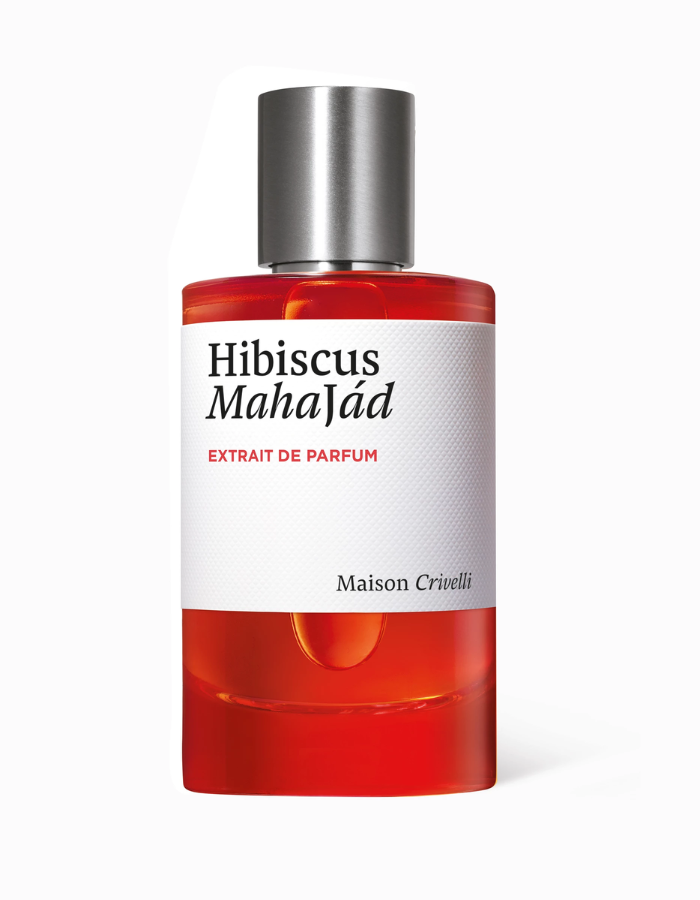
The results have been extraordinary. The launch of Hibiscus Mahajad — an extract built around the warmth of an afternoon, Damask rose and hibiscus lifted with blackcurrant and mint, deepened with vanilla and leather — multiplied the brand’s total Paris sales tenfold within a single month. “After two weeks, people were coming back saying, I’ve never had so many compliments in my life,” recounts the founder. It now accounts for 40 per cent of total brand sales. In South Africa and Nigeria, Crivelli is known simply as Mr Hibiscus and Afrobeat artists are DMing him about collaborating. And everyone from fifteen-year-olds who saved up their pocket money to buy his fragrances — after discovering the brand on TikTok — to perfume connoisseurs in their 50s are turning up at Crivelli events, because the scents speak to them on a profound level. “I love that today the perfumes are used by customers from so many different cultural backgrounds, religions, and age groups,” says the CEO. “What has happened with the word of mouth has been spectacular,” he adds — and he is not wrong.
This kind of cross-cultural, cross-generational magnetism is precisely what the numbers are beginning to reflect across the niche sector. Scento has reported that around 60 per cent of fragrance buyers now value brand narratives over traditional factors like celebrity endorsement or advertising reach. According to Business Research Insights, over 60 per cent of new niche launches are now gender-neutral compositions that prioritise mood and emotional resonance over conventional gender labels. Maison Crivelli has been ahead of both curves from the beginning, its sleek, clean, intentionally unshowy packaging polarising distributors when it first launched — “the bottle is not good for the region,” some early advisors told Crivelli — and now it functions as one of its strongest selling points in the very same markets. “Taste will change,” he told them back in the beginning and Crivelli was right.
The brand’s success at Harrods is perhaps the most telling proof point, as it regularly ranks as one of the store’s top sellers. A Paris boutique is imminent. Selfridges, Galeries Lafayette, Bloomingdale’s — the brand’s retail footprint is expanding at a pace that would be remarkable for any house, let alone one that, four years ago, employed exactly four people. Today the headcount is approaching 100.
And yet Crivelli remains definitely independent. He owns approximately 80 per cent of the company. Investment enquiries arrive weekly from hedge funds and private investors; he rarely takes the calls. “I hope I can keep the governance, the control — not just in terms of shares, but also in terms of project management,” he says. It is a position that would make most founders nervous. Crivelli does not seem nervous. He seems, if anything, curious.

According to Grand View Research, the global luxury niche perfume market is projected to more than double in value, from $3.8 billion in 2024 to $7.6 billion by 2032, growing at a compound annual growth rate of 9.1 per cent — a trajectory that tells its own story about where the fragrance industry’s future lies. The drivers are not mysterious: consumers, particularly younger ones, are done with the idea of a single mass-produced signature scent. They want stories, ingredients with provenance, founders they can find on TikTok explaining the moment a perfume was born.
“More and more people are engaged with the brands and the stories and also the founders,” Crivelli observes. “Perfume is so emotional, so personal — you can’t fake it.” He would know. Everything about Maison Crivelli is, for better or worse, real — pulled from forests and markets and starlit memories, bottled and offered to strangers in the hope that it might unlock something in them too. “Perhaps you will remember your grandmother, your childhood, a summer house,” says the CEO. “And it’s actually this that matters.”
As the giants in the perfume industry slowly cede ground and the independents are clearly on the march, it is exactly Crivelli’s heartfelt sincerity that will surely turn out to be the most powerful ingredient of all.
-For more on luxury lifestyle, news, fashion and beauty follow Emirates Woman on Facebook and Instagram
Images: Supplied & Feature Image: Supplied
Disclaimer : This story is auto aggregated by a computer programme and has not been created or edited by DOWNTHENEWS. Publisher: emirateswoman.com