

Australia’s Test bowling attack ranks among the best in the world over the last 50 years, having broken new ground as a quartet and taking an unprecedented number of wickets as a four-man unit.
Statistically, Pat Cummins, Mitchell Starc, Josh Hazlewood and Nathan Lyon sit comfortably in the same pantheon as some of the best West Indian attacks from the late ’70s.
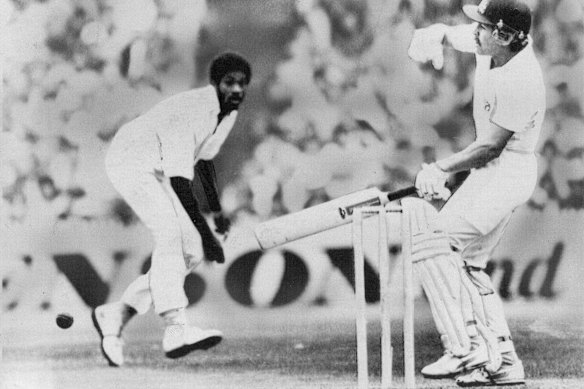
Michael Holding, Andy Roberts, Joel Garner, Malcolm Marshall and Colin Croft combined hostility with control. People have described facing them as like facing an execution squad, offering no respite from either end.
In Durban against South Africa last week, Australia out-bowled, out-batted and out-fielded their opponents and deserved their decisive victory. Central to the win was the attack.
Like past combinations from the late 1990s and early 2000s – comprising Glenn McGrath, Shane Warne, Jason Gillespie and Brett Lee – today’s attack offers the ultimate balance of precision, elite spin, pace and nagging persistence.
The South African quartet of Dale Steyn, Morne Morkel, Vernon Philander, and Jacques Kallis from the late 2000s and mid-2010s also dominated an era favouring batting.
Then there was Pakistan’s outstanding attack: Imran Khan, Wasim Akram and Waqar Younis, with the spin of Abdul Qadir, another brilliant group who turned the old ball into lethal weapons capable of tearing through middle orders.
Like the great West Indian combinations of the late 20th century and the Australian attack of the early 2000s, Cummins’ men thrive on discipline.
Hazlewood mirrors McGrath’s relentless probing line; Cummins attacks the stumps with fuller lengths; Starc provides the left-arm angle, swing, and X-factor pace; Lyon provides the control and sustained pressure of an elite spinner.
While the historic West Indian pace battery holds the crown for sheer terror, and the 2000s Australian attack for ultimate match-winning balance, this crop matches them in longevity, relentless line and length and the ability to consistently grind down opponents through partnership bowling.
In Kingsmead, batsman Matt Renshaw set the tone for Australia in the first innings with support from Cummins and Lyon. The desperation to post as high a score as possible from 6-124 on a challenging wicket was obvious.
On his return to Test cricket, Nic Maddinson looked so desperate not to get out in the first innings that he made scoring look impossible. He soaked up much of the strike, and his dismissal was almost a relief to him.
Marnus Labuschagne looked more intent on scoring, and his resulting footwork was crisper. We may yet see the real Labuschagne by the end of the series. The real Steve Smith, meanwhile, is never far away. His dismissal soon after lunch on the first day, though, surprised everyone.
South Africa didn’t bowl badly, but they didn’t bowl enough good balls in clumps to put pressure on the middle order on a wicket that was offering bounce. South Africa’s spinners were disappointing. They didn’t bowl a line or length suited to the conditions, so the Australians scored easily.
Renshaw was a tremendous success in the middle order. His game against spin worked in the conditions. This part of his game has developed in recent years. With his sweeping, he is ambidextrous and drove the spinners to distraction by carefully choosing his shots. He doesn’t try to over-hit his sweeps, relying on timing and placement to taunt the bowlers. He is a big man and uses his reach to advantage.
Cummins could easily have been a genuine all-rounder if his bowling hadn’t demanded so much. He has a solid defence and an abundance of power. He was determined to lead by example, and his partnership with Renshaw was critical to the match.
Lyon is a fierce competitor who has become a better-than-useful tail-ender, handling short balls with the aplomb of a higher-rated batter. He is the perfect foil for a batter in this situation. His defence is solid; he is fearless and rotates the strike well.
The Australians again gave a masterclass in bowling in any conditions through immaculate lines and lengths. Few have matched their ability to bowl together for extended periods. It must be like water torture to bat against them.
Cummins is a class act. His return from injury to bowl at an elite pace, full and at the stumps, is exceptional. He consistently directs his bouncer with precision and utilises it efficiently, seldom wasting it. His default length is fuller than most, so every ball demands a response, and his full-blooded attack demands wickets. He is inspiring.
Starc looked a little rusty, but that is the beauty of this group. If one doesn’t get you, someone else will.
Hazlewood was brilliant. His line rarely changes, and he bowls a suffocating length. It must feel as if you are batting against a boa constrictor. It is only a matter of how long it takes for him to squeeze the life out of you.
Hazlewood and Lyon have returned from serious injuries and have resumed business as usual. Their professionalism showed in how wholeheartedly they committed to their rehabilitation.
Lyon showed his opposition spinners how to bowl in the conditions. His line, length, and pace were ideal, and his relentlessness was top-class.
The opposition spinners gave the Australians too much room, which let the pressure off too often. Lyon’s pace, with maximum revs and line, is much harder to reverse-sweep than his two opposition spinners.
The second-innings situation gave Maddinson some freedom, and he looked like a different player. Had he been more fortunate with the timing of his earlier selection, he could easily have played much more Test cricket.
Australia got some luck in this Test because South Africa were without their two best pace bowlers, Kagiso Rabada and Lungi Ngidi. Had Rabada played, the outcome could have been very different. His absence was deeply felt, and the Proteas will need him for the rest of the series to change the result.
With Steve Smith passing the concussion tests, he will play in the second Test. That is a bonus for Australia, as he remains the group’s most reliable batter. His batting is key for Australia, and so is his brilliant fielding. Australia would not want to lose him.
The bowling attack and Steve Smith are still critical to the side’s success.
 Greg Chappell is a former Australian captain. He led Australia in 48 of his 87 Tests, scoring 7,110 runs at an average of 53.86.
From our partners
Disclaimer : This story is auto aggregated by a computer programme and has not been created or edited by DOWNTHENEWS. Publisher: www.smh.com.au



