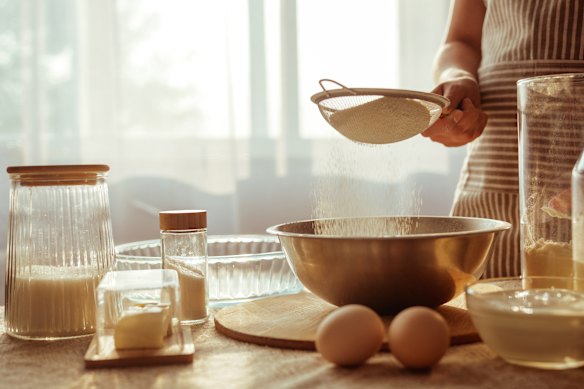
From fizz tests to sniff tests, Miss Trixie Drinks Tea shares her tips on knowing when 11 essential baking staples are past their best, and what to do about it.

If you’re an occasional baker, it’s not only motivation, time and a killer recipe standing between you and the perfect cake. It might also be stale staples lying in wait to sabotage your sponge, kibosh your kougelhopf and flatten your financiers.
We checked in with expert baker Alice Bennett from Miss Trixie Drinks Tea to find out which ingredients need to go.
Baking powder
“Baking powder definitely loses its oomph,” says Bennett. Keeping your powder dry is key to maintaining tip-top condition. “Always keep it in an airtight container in a cool, dry place but if it’s been open for a year, replace it, regardless of the use-by date.” There’s a fizz test too: put a teaspoon of baking powder in a heatproof bowl and pour over a few tablespoons of boiling water. If it fizzes ferociously, it’s still good.
The best recipes from Australia’s leading chefs straight to your inbox.
Flour
“If flour smells stale, musty or dusty, you don’t want to use it,” says Bennett. She cautions against topping up storage canisters before the last of the existing flour is used. “Empty out that last bit of the container and put it in your green waste bin. It’s better than hiding old flour at the bottom of a jar.” Because self-raising flour contains baking powder, it can deteriorate more quickly. Again, moisture is your enemy.
Vanilla extract, essence and paste
Because of their alcohol content, vanilla preparations keep well. “The problem can more be that the tube or tub gets sticky or claggy,” says Bennett. “It doesn’t affect the end product, but it can make it less pleasant to use. Make sure you clean the nozzle or rim after each use and make sure it’s properly sealed when stored.”
Dried yeast
“Keep it in the fridge and use it as fast as you can,” says Bennett. “In most recipes, you mix yeast with lukewarm water. It should start to go a bit foamy and then become cloudy. If it doesn’t, your yeast is dead.”
Brown sugar
If you’re an infrequent baker, your nice, soft brown sugar may turn out to be neither nice nor soft at all. If it’s not been kept in an airtight container, it may indeed have dried into a hard, craggy lump.
You can reintroduce moisture by bagging sugar up with a slice of bread, but Bennett prefers to use the hard sugar for a recipe that requires heating, thereby melting the lumps. “I would see it as an opportunity to make caramel, butterscotch, mud cake, rum sauce, or sticky toffee sauce,” she says. “If you’re making one of them, hard sugar is no issue.”
Butter
If butter smells sour or rancid, it’s gone bad. “I’d be saying goodbye to it in that case,” says Bennett. If you’ve bought discounted butter that’s about to expire, you can freeze it. “But use that butter for melting, rather than thawing it and using it to cream with sugar,” says Bennett.
Eggs
“You’ll know when an egg is off because it will absolutely stink,” says Bennett. The safest way to use eggs is to crack each one in a small bowl to check it’s good, then add them to a larger bowl one by one.
Spices
“Fresh spices like ginger, nutmeg and cinnamon should be quite pungent, almost so they make you sneeze,” says Bennett. “If they don’t, they are probably a bit flat.” In most cases, that just means using more. “You can also add a pinch of salt, because that will enhance the spice flavour.”
If the spice is a main focus of a recipe – such as with a ginger cookie – it’s worth buying it fresh especially, but if it’s just a pinch of spice in a cake, a sub-par sprinkle will not cause a cake fail.
Chocolate
“The biggest risk to chocolate is heat,” says Bennett. “It gets that awful white colour and tastes like chalk.” There’s not much you can do about heat-damaged chocolate, except go to the shops for fresh supplies.
Nuts
It’s best to buy fresh in small quantities and use quickly, especially for recipes in which nuts are a major ingredient, such as carrot or hummingbird cakes. “You can certainly tell when they taste old, dusty and lose their crunch,” says Bennett.
Milk
Bennett is a fan of long-life milk for baking. “You can keep it at room temperature, it doesn’t go off, and it rarely splits a mixture,” she says. “It’s a secret weapon.”
From our partners
Disclaimer : This story is auto aggregated by a computer programme and has not been created or edited by DOWNTHENEWS. Publisher: www.smh.com.au