There’s a reason the longest day of the year seems to fly by so fast in Germany. Here’s how to feel the rhythm at the country’s biggest, free street music celebration in 2026.
Every year on June 21st, Germany bends its rules. Much of the usual bureaucracy around street performance disappears. Pavements fill with musicians, parks become stages and entire cities seem to transform themselves into festivals for a day.
Welcome to Fête de la Musique – a global celebration that began in France in 1982 with a simple idea: anyone should be able to play music anywhere. They shouldn’t have to pay for the privilege and nor should people have to pay to hear them.
In Germany, that philosophy has evolved into something genuinely special. More than 180 cities now take part, with over half a million visitors and thousands of volunteers bringing it all to life.
At its heart, Fête de la Musique isn’t about polished performances or big crowds. It’s about reclaiming public space and turning one day – the longest of the year – into a shared celebration of music and the joy of stumbling across something unexpected.
So how can you make the most of it? The simplest advice is also the best: don’t over-plan.
Choose an area, go on foot and follow the sound of guitars, horns or basslines. In 2026, there’s more to discover than ever.
Berlin
The capital of Fête de la Musique in Germany is undoubtedly Berlin. Since first joining in 1995, the city has turned the summer solstice into a sprawling, all-day music experience that touches every corner of the capital.
Classical ensembles, indie bands, jazz trios, electronic DJs and solo street performers will be performing everywhere around the city, from major thoroughfares like Karl-Marx-Allee and Unter den Linden to half-hidden squares and parks.
In addition, a different part of Berlin is selected by the organisers for special attention each year. So anyone who rarely explores the city beyond Mitte, Kreuzberg or Prenzlauer Berg may want to think about a trip to Reinickendorf in 2026 – to experience some of the best of what the festival has to offer in leafier surroundings.
READ ALSO: When can you swim in Berlin’s Spree River this summer?
In total, roughly 800 performances are expected to take place across more than 300 stages this year, spread across all 12 districts. You can see a map of all the official events here.
The main outdoor events take place between 4pm and 10pm, when Berlin’s usual restrictions on noise come back into force.
But despite the fact that the 21st falls on a Sunday this year, many Berliners can still be expected to move the celebrations indoors at this point, as clubs across the city pick up where the street performers leave off.
Places like Gretschen, Ritter Butzke and Kater Blau are planning to host free DJ sets and concerts well into the early hours.
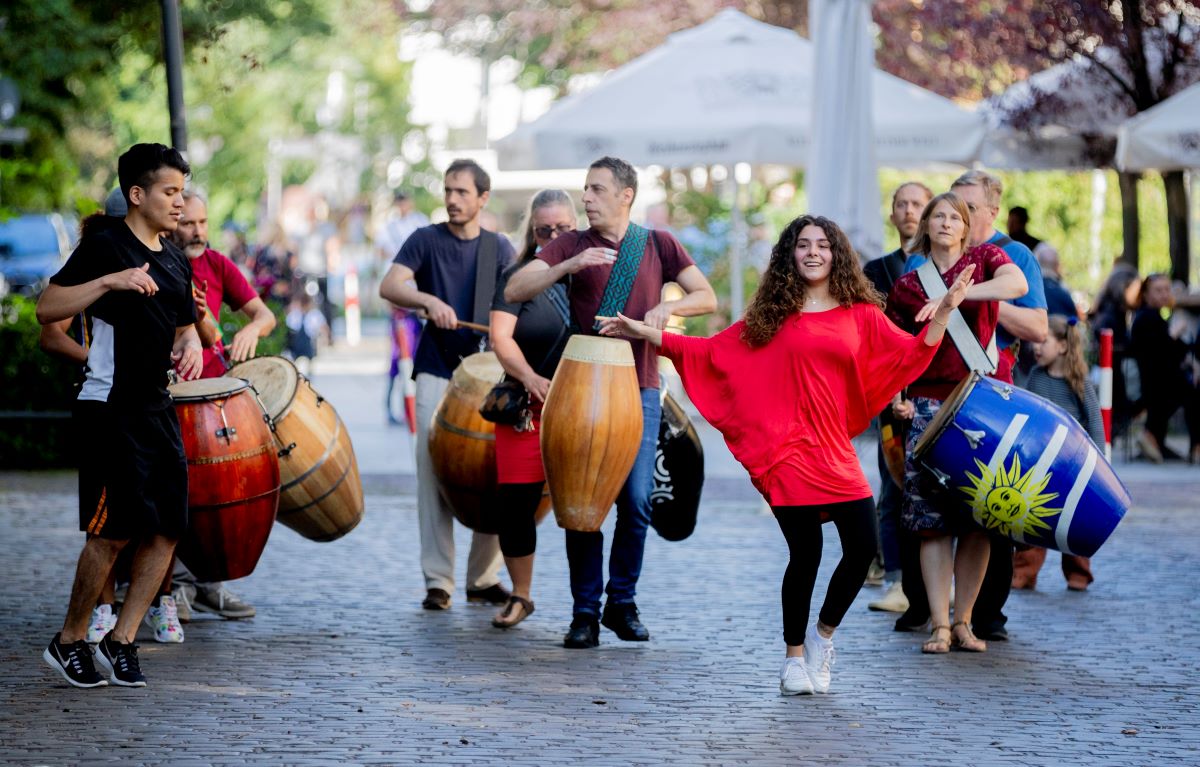
A group performs the folkloric dance movement form “Candombe” and music from Uruguay in Berlin-Schöneberg as part of the Fete de la Musique. Photo: picture alliance/dpa | Christoph Soeder
A nationwide celebration
While Berlin might steal the spotlight, Fête de la Musique is very much a nationwide event. On June 21st, you can step outside almost anywhere in Germany and find music happening nearby.
From Munich and Dresden to Hamburg and Cologne and dozens of towns in between, each location brings its own flavour.
Some lean into choral gatherings or park-based performances, while others focus on curated stages or specific genres.
READ ALSO: How to make the most of Germany’s open‑air cinemas this summer
Hannover, for example, reflects the fact that it plays a central role in coordinating the German Fête de la Musique network. Visitors can expect a well-curated mix of street stages, experimental performances and relaxed acoustic sets – a great option if you prefer something less overwhelming than Berlin.
In eastern Germany, Leipzig stands out as one of the country’s most established festival hubs. With over 40 stages and venues, it has developed a strong reputation for German-French cultural exchange, supported by institutions like the Institut français.
One of the most exciting stories this year is Lüneburg, which is hosting its first-ever Fête de la Musique. Impressively, local organisers have put together a program featuring more than 60 concerts at over 20 locations.
You can find local guides to what’s happening in your area here.
Making the most of it: final tips
If this is your first Fête de la Musique in Germany, it can pay to keep these essentials in mind:
- Go early and stay flexible: The main action runs from 4pm to 10pm, but the real joy comes from wandering.
- Travel smart: Public transport is your best friend, especially in bigger cities.
- Expect the unexpected: Some of the best acts aren’t on official listings – they’re happening spontaneously in parks or on bridges.
READ ALSO: Deutsche Bahn launches new family ticket for summer travel
- Join in: Whether you’re a musician or have access to a space, the festival actively encourages amateur participation.
- Remember the golden rule: nobody pays and nobody gets paid (although there may be some exceptions at late night, indoor venues).
- Check the forecast before setting out: Pack sunscreen, woolly socks or an umbrella as required.
Disclaimer : This story is auto aggregated by a computer programme and has not been created or edited by DOWNTHENEWS. Publisher: thelocal.de