
Solar eclipse fever is gripping Germany. Here’s how to make the most of the rare celestial event on Wednesday August 12th, and catch a glimpse of some shooting stars too.
Grab your special glasses because we’re in for an exciting spectacle on Wednesday evening!
Germany is set to experience a (nearly total) solar eclipse, with up to 90 percent of the sun being obscured by the moon.
What is a solar eclipse?
A quick overview of the facts: the moon orbits the earth, and the earth orbits the sun. Eclipses happen when the Moon passes directly between the Sun and Earth, casting a narrow band of shadow across our planet.
It creates a strange twilight during which temperatures drop, shadows appear at strange angles and some animals go to sleep.
Since the solar eclipse on August 12th, 2026, is a partial one in Germany, the moon will not block out the entirety of the sun’s light for viewers here. But the phenomenon from Germany will still be pretty special, with 80 to 90 percent totality.
Observers in parts of Greenland, Iceland and northern Spain will experience a total solar eclipse.
Wherever you are, it’s important to never look directly at the sun without proper eye protection (more on that below).
When can you see it in Germany?
In Germany, the solar eclipse (known as the Sonnenfinsternis in German, or SoFi for short) will happen at slightly different times depending on where you are.
In Flensburg and List auf Sylt, in the far north of Germany, the eclipse begins as early as 7:11pm, while the spectacle in Oberstdorf – at the southernmost tip of Germany – does not start until 7:24pm.
In Berlin, you’ll start to see the dark creeping in at 7:15pm, with the peak at 8:08pm, and the whole event will finish at 8:34pm. This coincides roughly with the sunset, which is 8:39 in Berlin on Wednesday — but note that the sun may disappear earlier or later depending on your view of the horizon.
In Hamburg it starts at 7:13pm, with the peak at 8:07pm.
In Munich and Stuttgart, the start time is 7:22pm with the peak scheduled to take place at 8:15pm. In Düsseldorf and Cologne the eclipse begins at 7:18pm with the peak at 8:12pm. The eclipse is not fully over in the west until around 8:56pm.
You can find out the rough timing for different regions on this site.
How best to observe it
To best watch the eclipse, you’ll want to find somewhere with an unobstructed view of the west, ideally with no trees or buildings in the way. A large flat area, such as Tempelhofer Feld in Berlin, a hill or a roof terrace would be ideal.
Some places are hosting special events for the occasion, such as at planetariums or observatories.
READ ALSO: How to view the solar eclipse from Germany on August 12th
Protective eyewear needed
Don’t forget that you need special eclipse glasses, certified to the DIN EN ISO 12312-2:2015 standard, to look directly at the sun.
Experts warn that you should never look directly at the sun without adequate protection (and sadly sunglasses are not enough). Doing so carries a risk of severe and irreparable eye damage caused by retinal injury.
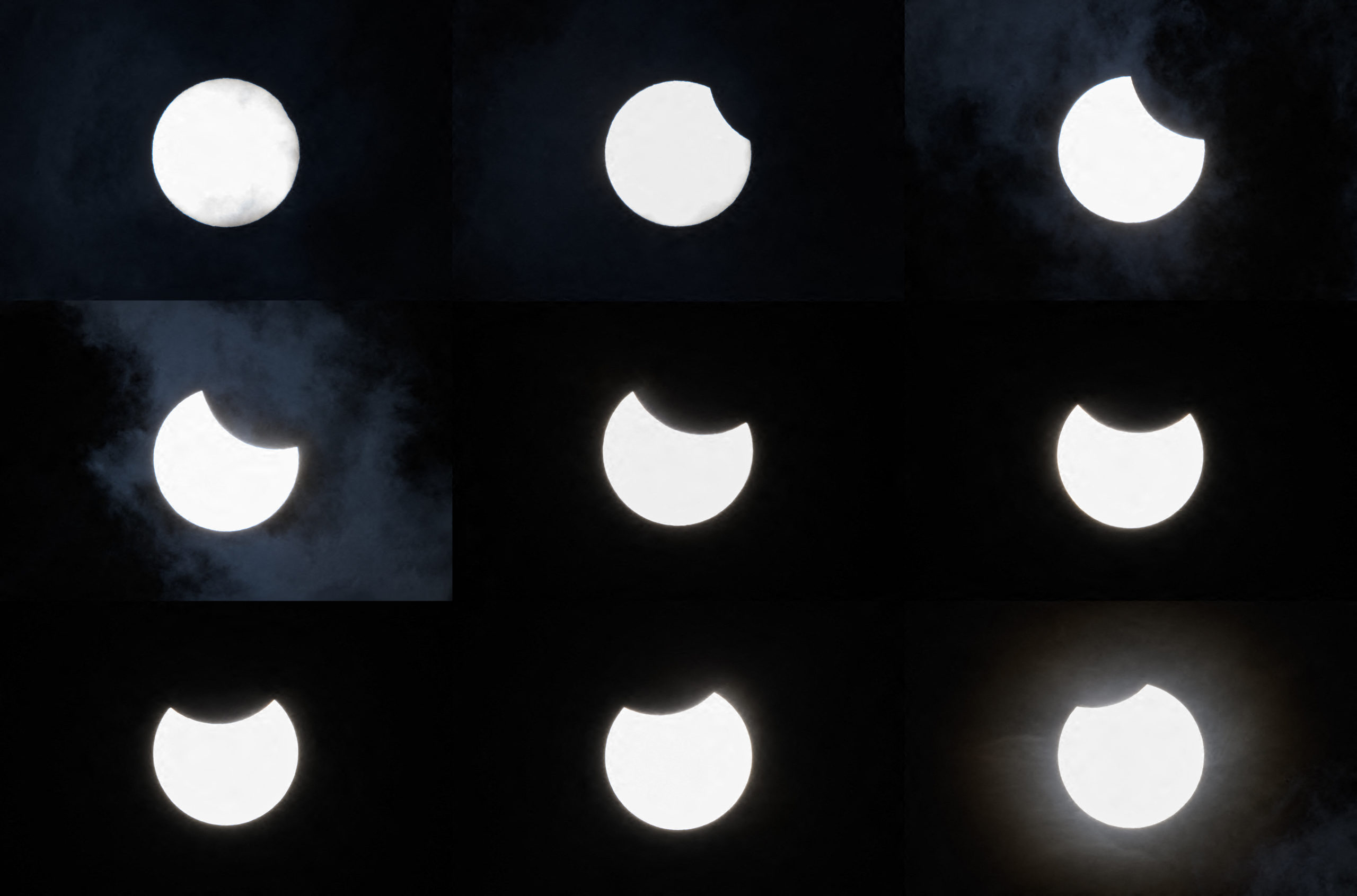
A partial solar eclipse, as seen from Nantes on March 29, 2025. (Photo by Loic VENANCE / AFP)
Retailers in Germany have been selling out of stock so you’d be quite lucky to find a pair of specs at this late stage. However, a reader told The Local that the Planetarium Berlin has been giving out eclipse glasses this week.
If you’re not able to find any glasses, there are alternative ways to view the eclipse such as creating a pinhole camera or watching via shadows. You can read more in our explainer here:
What about the weather?
With any luck the skies will remain clear this evening, although forecasters say scattered clouds are expected in the north of Germany.
Overall, it’s a warm day so make sure to prepare properly and bring plenty of water and sunscreen.
READ ALSO: How hot will it get in Germany this week?
You can also livestream
Viewers in Germany or beyond can also watch the eclipse live via the European Space Agency (ESA) livestream. The ESA will be broadcasting live from the Observatorio Astrofísico de Javalambre in Teruel, Spain. It will also be shown on the ESA’s YouTube channel.
How rare is a total solar eclipse?
It doesn’t happen often. The last total solar eclipse visible from Germany was August 11th 1999.
A total solar eclipse, where 100 percent of the sun is covered by the moon, will not be visible again in Germany until September 3rd, 2081.
The next partial solar eclipse in Germany happens on August 2nd, 2027. However, the coverage of the sun during that event will only amount to around 30-50 percent depending on where you are in Germany.
Stargazing extravaganza
Keep your eye on the skies after the sun sets because there’s a chance to see another spectacle.
August 12th marks the peak of the Perseid meteor shower, when you may spot dozens of shooting stars in the atmosphere.
That is expected to occur later in the night. The best views will be from rural settings with less light pollution.
READ ALSO: How to watch the Perseid meteor shower in Germany
Happy sky and stargazing!
Disclaimer : This story is auto aggregated by a computer programme and has not been created or edited by DOWNTHENEWS. Publisher: thelocal.de




