A little piece of my soul shrivels up every time I get a message laying out how another company plans to use personal data in ever encroaching ways for AI training. I got one of those emails recently from Google, with the subject line: “New privacy settings for Search services.” It’s part of Google’s global rollout happening over the next few months that will change how it handles users’ Search history data.
Every piece of media, from photos you upload for reverse image searches to audio of you speaking with Google Translate, may be retained in your account and used to improve Google’s AI models.
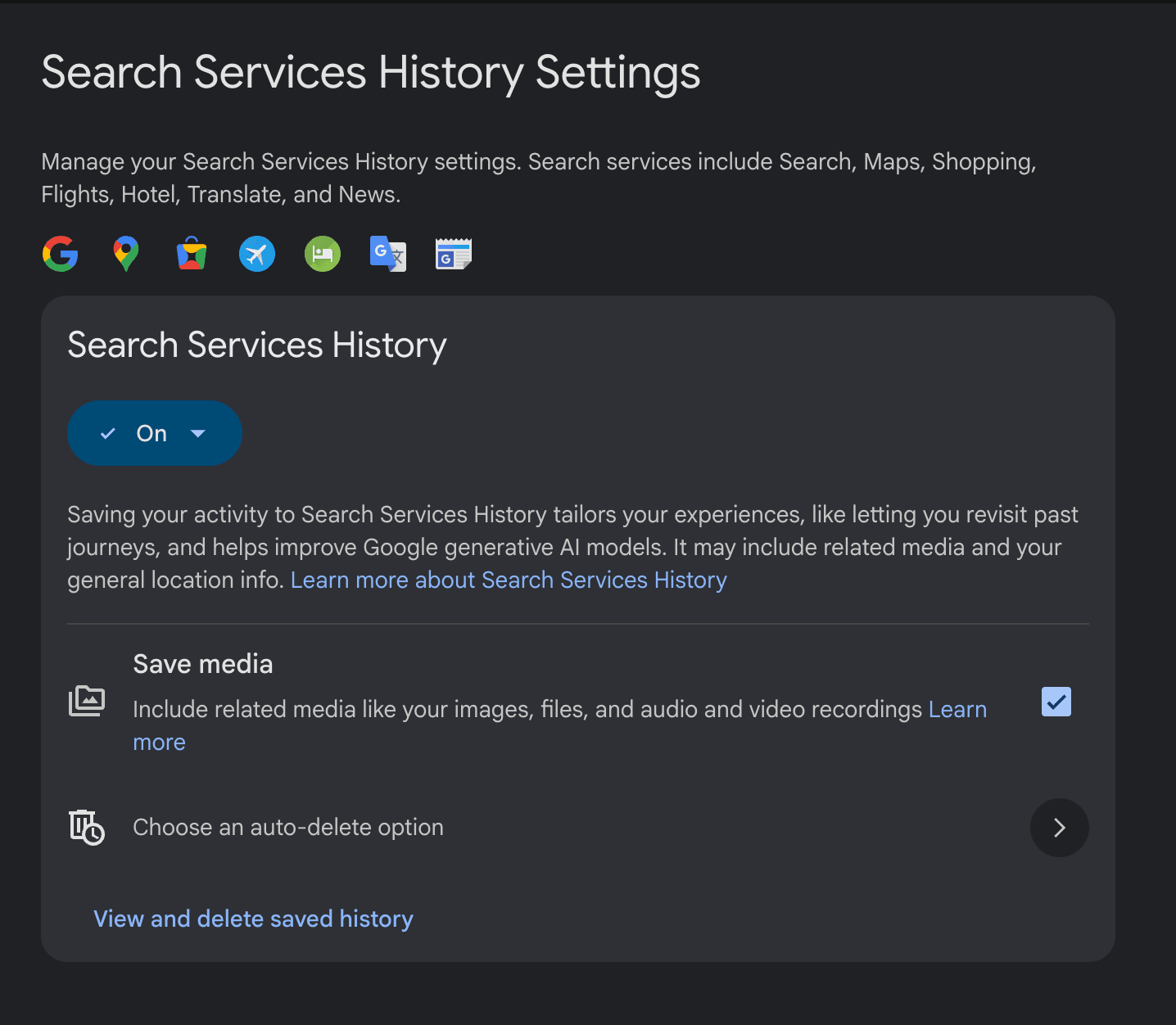
This new option in Google’s account settings, called Search Services History, was already enabled when I visited the page for the first time. (If a user previously disabled Google’s Web & App Activity and Search Personalization toggles, then it would be off.) Also, the box to save all my uploaded media from Google Search for AI training was already checked. Great.
When this rolls out to your account, you can visit Google’s My Activity page and then select the Search Services History tab to opt out. This page gives you a solid sense of what Google saves from your Search history. It’s also where you can turn off the entire setting and delete your activity. It’s critical to uncheck the box next to Save media if you don’t want your image uploads used for AI training.
It’s worth doing this change now rather than later. There’s not much you can do after your media data is thrown into the AI blender. “If your saved media is used to train our AI models, it is disconnected from your Google Account. This training data will be kept for up to 4 years, even if you delete the original activity,” read the pop-up when I turned off this feature. That’s such a long time for my random image Search uploads to float around in the digital ether.
“These new settings help users get more relevant results and revisit their searches—including visual and voice searches—and they can be turned on or off at any time,” says Davis Thompson, a Google spokesperson, over email when reached for comment. He did not answer WIRED’s question about this feature being on by default.
What’s really being saved here? Google is clear that it’s starting to store much more than just what you type into Search. “Your saved media includes your images, files, and audio and video recordings from your interactions with Search services,” reads the page’s description. “This includes things like Google Lens images, recordings from Search Live or Translate speaking practice, content you upload, and voice searches.”
This is because AI models don’t just need text data to improve; they need diverse inputs in other forms, like audio or video. If Google can gather more data, and more types of data, from its vast array of users, then maybe it could innovate faster than its competitors.
Google’s massive user base is spread across multiple services, giving it an edge in data collection. “Google is in a unique spot compared to a lot of the other companies with this,” says Thorin Klosowski, a senior security and privacy activist at the Electronic Frontier Foundation. “Because they offer so many services that people have been using for so long and have grown pretty comfortable and complacent with the amount of data collected.” Apps that people use every day have a kind of built-in inertia, so changes that users don’t like may not be enough to drive them to alternative services.
Being forced to opt out of AI training seems to be the standard across sites and platforms. It doesn’t have to be this way. “I think ‘opt in’ is really asking the bare minimum of these companies,” Klosowski says. “Asking their users to consciously choose to enable these features is the least they can do.” Google would have to make a stronger case to users on why these features could be helpful if they weren’t automatically just turned on, Klosowski says.
In Google’s email sent to my testing account on June 23, the first sentence framed this change as giving me “even more control over saved history.” Google then provided examples in the message showing how saving this media may be helpful. “For example, this lets you revisit your past visual searches with Lens or continue a Search Live conversation about a song you heard.” In contrast, it’s notable that Google didn’t provide similar examples after stating near the end of the email that this saved media will be used for AI model training. Rather, the message just continued to the next detail.
This is another major software change that is worth slowing down to process the change for everyday users. “It creates this extra layer of math that a consumer has to do about whether they feel comfortable using the tool they’ve been using for a long time,” says Ben Winters, director of AI and privacy at the Consumer Federation of America.
I’m constantly overwhelmed that it’s always on me to opt out of data training for every service. It leaves me feeling like a schmuck who’s probably going to miss something buried in all these settings, no matter what.
Winters sees this change from Google as placing the onus on users to avoid AI training, which may contribute to widespread user exhaustion bordering on nihilism. “There’s an increasing feeling of powerlessness and hopelessness about even trying to protect your data, because every little thing is going to be squeezed out of you,” he says.
Disclaimer : This story is auto aggregated by a computer programme and has not been created or edited by DOWNTHENEWS. Publisher: wired.com