

Each week, Good Weekend’s how-to column shares expert advice on how to navigate some of modern life’s big – and small – challenges. This week: How to perform CPR.
Some people are disinclined to perform cardiopulmonary resuscitation (CPR) on a person because they don’t want to make things worse. “But when someone is unconscious and not breathing, they’re effectively dead,” says Simon Cowie, a former paramedic, now cardiac-arrest spokesperson at the Heart Foundation. “There is nothing worse.”
Cowie’s point is that any attempt at CPR is better than none. Indeed, according to the Heart Foundation, only one in 10 people survive a cardiac arrest outside hospital – though this doubles if someone starts CPR early. Survival chances jump to 60-70 per cent if CPR and an automated external defibrillator (AED) are used within the first three to five minutes.
So, how does one perform CPR? How many breaths to compressions was it again? Actually, the Heart Foundation now encourages untrained rescuers to focus on compressions only, unless instructed otherwise by the Triple Zero operator.
The rescue breaths [two for every 30 compressions] weren’t always being done effectively, explains Cowie. “The compressions were working to move blood around to the brain and organs, and build up the [patient’s] blood pressure, so it made no sense to stop doing that in order to do something less effective. Also, when someone becomes unconscious, their blood has residual oxygen in it.” These days, advice boils down to “Call, Push, Shock”. The first and third of these steps involves calling triple-zero and using an AED, if there’s one on hand. Compressions alone (the “push”) will not restart a stopped heart; a shock is needed.
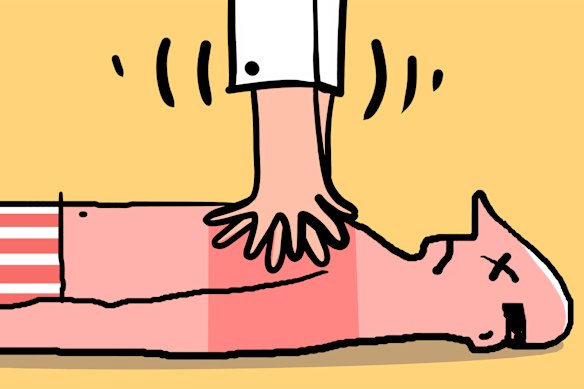
While awaiting paramedics and/or the AED, ensure the patient is lying flat on a hard surface. Kneel beside them and place one hand on the centre of their chest. Place your other hand on top of the first and link fingers. Then, with locked elbows and employing your body weight, commence compressions – about 100-120 per minute. Pump to the rhythm of the Bee Gees’ Stayin’ Alive or, if that’s not in your repertoire, Row, Row, Row Your Boat.
But don’t go so gently down the stream: for an adult patient, compressions need to be firm. (For children, infants and newborns, use, respectively, one hand on the centre of the chest, two fingers on the lower half of the breastbone, and two thumbs on the lower third of the breastbone. Compress the chest to about one-third of its depth.)
Cowie knows that, to some, this will seem daunting. But waiting for help isn’t an option: “Without your assistance,” he says, “this person probably won’t survive.”
Get the best of Good Weekend delivered to your inbox every Saturday morning. Sign up for our newsletter.
Read more from Good Weekend:
From our partners
Disclaimer : This story is auto aggregated by a computer programme and has not been created or edited by DOWNTHENEWS. Publisher: www.smh.com.au



