

One of the ways the Atmos Rewards program stands apart from most other airline loyalty programs is that it lets its members choose how they earn redeemable points and status points. Here’s what you should know when choosing how to earn with Atmos Rewards.
Earning with Atmos Rewards
Through the end of 2026, Atmos Rewards members earn based on the distance they travel. But, starting on Jan. 1, 2027, Atmos Rewards members will earn via one of the following methods:
- By distance traveled: Paid flights earn 1 point and status point per mile, while award flights booked with Atmos Rewards points earn 1 status point per mile
- By price paid: Paid flights earn 5 points and status points per eligible dollar, while award flights booked with Atmos Rewards points earn 1 status point per 20 points redeemed
- By segments flown: Paid flights earn 500 points and status points per segment, while award flights booked with Atmos Rewards points earn 500 status points per segment.
However, eligible-fare restrictions apply, and Alaska Saver and excluded basic economy fares won’t earn points or status points. Additionally, these are the base earning rates; elite members will also earn elite bonuses as redeemable points (but not status points).
Your choice will apply to all Alaska, American and Hawaiian Airlines flights and to all partner flights booked via the Alaska or Hawaiian websites or mobile app.
For eligible other-partner flights, your choice applies if you earn by distance traveled or by segments flown. But if you earn by the price paid, you’ll earn a percentage of flown miles when you book flights directly with other partner airlines. Additionally, members who opt to earn based on the price paid will earn based on distance traveled for vacation packages that don’t disclose the actual fares.
As a reminder, you’ll earn Atmos Rewards elite status when you meet the following status-point requirements within a calendar year:
- 20,000 status points: Atmos Silver (Oneworld Ruby)
- 40,000 status points: Atmos Gold (Oneworld Sapphire)
- 80,000 status points: Atmos Platinum (Oneworld Emerald)
- 135,000 status points: Atmos Titanium (Oneworld Emerald)
You can make your selection already, but it will only apply to flights on Jan. 1, 2027, and beyond. Once you choose an accrual method, you can change it only once per calendar year.

Daily Newsletter
Reward your inbox with the TPG Daily newsletter
Join over 700,000 readers for breaking news, in-depth guides and exclusive deals from TPG’s experts
By signing up, you will receive newsletters and promotional content and agree to our Terms of Use and acknowledge the data practices in our Privacy Policy. You may unsubscribe at any time.
Related: Alaska and Hawaiian expand ‘Atmos Communities’ with 6 new options to save and earn
When earning Atmos Rewards points by distance traveled is best
If you primarily credit long, inexpensive flights to Atmos Rewards (or redeem relatively few Atmos Rewards points for these flights), earning by distance traveled may be best.
Doing so would give you 1 point and 1 status point per mile on paid flights and 1 status point per mile on award flights booked through Atmos Rewards. You won’t get any class of service bonuses, so flying a long-haul flight in economy will earn the same as a long-haul business-class flight if you earn by distance traveled.

A good rule of thumb is that earning by distance is better if your flight distance is typically more than five times your eligible airfare. Otherwise, earning by the price paid is likely better unless you mostly fly sub-500-mile flights, in which case segments may be better.
To put numbers to this rule of thumb, consider a 2,500-mile flight. As long as this flight costs less than $500 (or less than 50,000 Atmos Rewards points), earning based on distance rather than price will be preferable.
Related: Atmos Ascent vs. Atmos Summit: Which is better for Alaska and Hawaiian flyers?
When earning Atmos Rewards points by price paid is best
If you usually credit expensive paid tickets or frequently purchase premium-cabin fares, earning by price paid may be best.
Doing so would give you 5 points and 5 status points per dollar spent on paid flights and 1 status point per 20 points redeemed for award flights through Atmos Rewards. The price paid doesn’t include taxes and fees, but does include carrier-imposed surcharges and eligible paid seats on Alaska and Hawaiian.

A good rule of thumb is that earning by price is best when your eligible spending is more than 20 cents per mile flown, or when you redeem more than 20 Atmos Rewards points per mile flown.
To put numbers to this rule of thumb, consider a 2,500-mile flight. As long as this flight costs more than $500 (or more than 50,000 Atmos Rewards points), earning based on price rather than distance will be more rewarding.
Related: Why 7,500-point economy awards are my go-to Atmos Rewards redemption
When earning Atmos Rewards points by segments flown is best
If you primarily credit short, inexpensive flights to Atmos Rewards (or redeem relatively few Atmos Rewards points for short award flights), earning by segments may be best.
Doing so would give you 500 points and status points per paid segment and 500 status points per award segment booked through Atmos Rewards. Atmos Rewards defines a segment as a single flight number, so you’ll only earn one segment even if your flight has multiple stops if the flight number is the same for each segment.

Specifically, earning by segments beats distance if your average segment is under 500 miles. And earning by segments beats price if your average fare per segment is less than $100. As such, travelers who primarily fly on intra-Hawaii flights and intra-West Coast flights should consider whether earning by segments makes sense for them.
And, since Huakaʻi by Hawaiian members will earn a 50% bonus on points and status points for Neighbor Island flights, this option could be particularly lucrative for Hawaii residents who are part of this community.
“Segments for a lot of people in Hawaii — their primary travel is neighbor island,” Brett Catlin, Alaska Airlines’ senior vice president of network, loyalty and partnerships, told TPG. “So if they’re in Huakaʻi they’re going to get 750 points for a 100-mile flight. That’s a big payoff for that segment.”
Related: Why American Airlines flyers should pay attention to Alaska Airlines Atmos Rewards
A note on partner flights if you earn by price
However, these calculations and metrics may all go out the window if you frequently credit flights you book directly with airlines other than American, Alaska or Hawaiian to Atmos Rewards. That’s because if you opt to earn by price paid, you’ll earn a percentage of flown miles when you book eligible paid flights directly with partner airlines besides American.
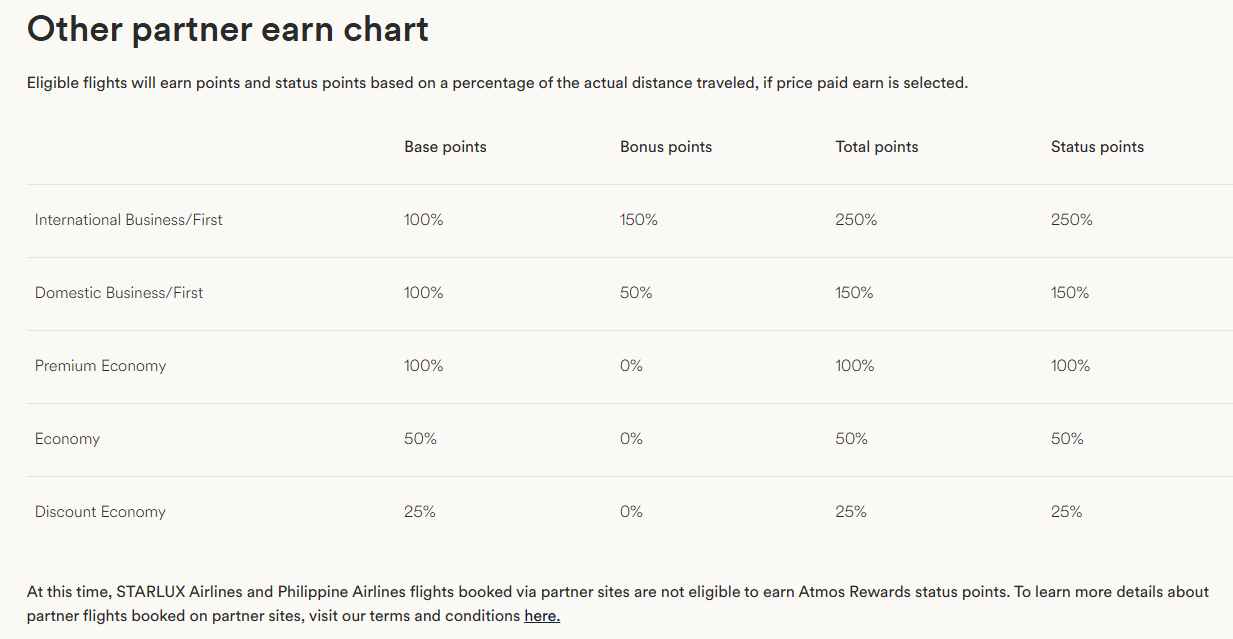
Based on this chart, paid economy flights will earn significantly worse (25% or 50% compared to 100%) when you book through other partners (besides American) if you choose to earn based on price instead of distance. Meanwhile, paid premium economy flights will earn the same whether you earn based on price or distance (100% either way), and paid business/first flights will earn more if you choose to earn based on price instead of distance.
Related: Best time to apply for Atmos Rewards cards based on offer history
How to determine which Atmos Rewards earning method is best for you
In general, you’ll want to earn by distance if you mostly book long, inexpensive flights, by price if you book mostly expensive flights and by segments if you mostly book short flights. But it’s worth running the numbers on your expected year before you select an earning method. In particular, here’s how to compare each accrual method:
- Distance vs. price on paid flights: Distance wins when your average eligible fare costs less than 20 cents per mile flown.
- Distance vs. price on award flights: Distance wins when you redeem less than 20 Atmos Rewards points per mile flown on average.
- Segments vs. distance: Segments win when your flights average less than 500 miles per segment.
- Segments vs. price on paid flights: Segments win when your average eligible airfare is less than $100 per segment.
- Segments vs. price on award flights: Segments win when you redeem less than 10,000 Atmos Rewards points per segment on average.
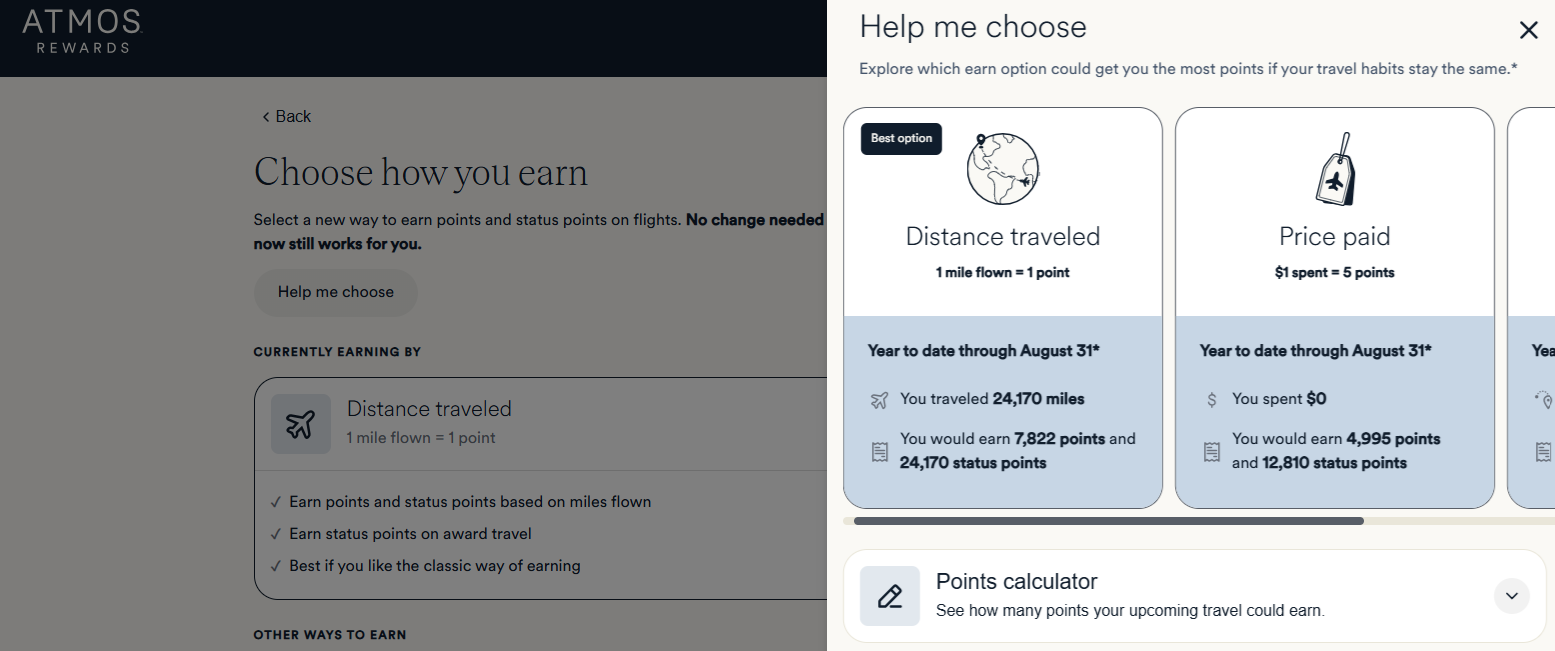
If you’re a frequent Atmos Rewards user, you can also click “Help me choose” on the accrual choice page to see how your flights through Aug. 31 of this calendar year would have earned under each method. Or you can use the points calculator to see how upcoming travel would earn with each method.
To help you compare the accrual methods, consider how each of these three traveler profiles could earn 40,000 status points to secure Atmos Rewards Gold status:
| Traveler profile | Annual eligible flying | By distance | By price paid | By segments | Best accrual method |
|---|---|---|---|---|---|
|
Long-distance bargain traveler
|
40,000 miles, $4,000 spent and 16 segments |
40,000 |
20,000 |
8,000 |
Distance |
|
High-spend traveler
|
15,000 miles, $8,000 spent and 20 segments |
15,000 |
40,000 |
10,000 |
Price paid |
|
Short-hop frequent flyer
|
20,000 miles, $6,000 spent and 80 segments |
20,000 |
30,000 |
40,000 |
Segments |
These examples assume all flights are eligible for the standard accrual rates shown above. And these examples ignore the other ways to earn status points, such as through the Global Locals community or spending on Atmos Rewards credit cards.
Related: How to reach Atmos Rewards elite status with the Atmos Summit Visa
What I’m choosing for my Atmos Rewards earning method
I initially thought earning by price paid might make sense for me. But once I dug into the details, distance-based earning looks like the better fit for how I actually buy flights.
Most of the paid tickets I book are in economy, and I frequently book directly with overseas Atmos Rewards partners. Under price-based earning, many of those partner-booked economy fares would earn just 25% or 50% of the distance flown. Distance-based earning instead lets me earn one point and one status point per mile flown on eligible flights. And although I fly in business class fairly often, those trips are usually award redemptions rather than paid premium-cabin fares.
I’m still not thrilled with that choice, though. Distance-based earning gives me the same number of points and status points regardless of the cabin I fly in.
How to select or change your Atmos Rewards earning method
You can go to the Atmos Rewards accrual choice page, sign in and select your earning method. However, once you confirm an earning method, you can change it only once per calendar year.
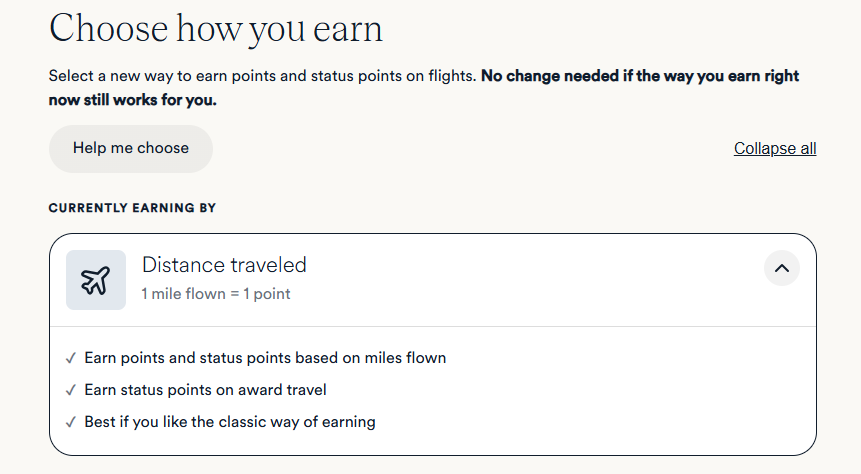
Members who join before the end of 2026 default to distance-based earning, while members who join on or after Jan. 1, 2027, default to price-based earning. If you want to keep earning by the default method, no action is required.
Bottom line
No single Atmos Rewards earning method will be best for everyone. Consider how far you typically fly, how much you spend, how often you redeem Atmos Rewards points and where you book partner flights before making your selection.
For my travel patterns, distance-based earning looks like the best option. But travelers who frequently buy expensive tickets or take short flights may come out ahead by earning based on the price paid or the number of segments flown instead.
Disclaimer : This story is auto aggregated by a computer programme and has not been created or edited by DOWNTHENEWS. Publisher: thepointsguy.com







