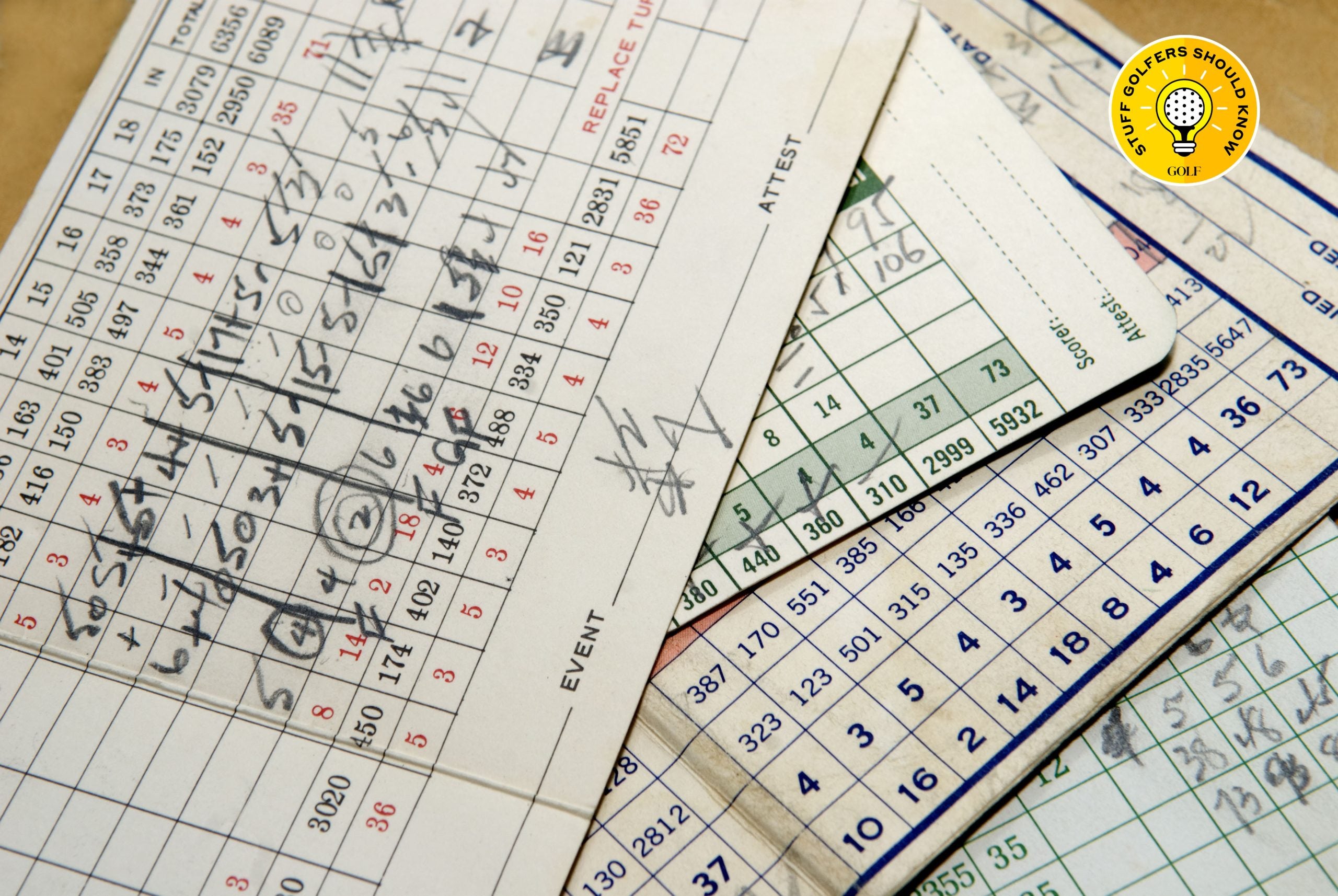
Do you play tough courses? Don’t give us your opinion. Stick to facts.
You’ll find them printed on the scorecard, conveyed in two numbers: Course Rating and Slope Rating.
You’re probably familiar with those terms. You might even have a sense of what they measure. But just in case . . .
Plainly put, Course Rating tells you how difficult a course is for a scratch golfer. A rating of 71.4, for instance, means that a scratch player is expected to shoot around 71 when playing well under normal conditions. Slope Rating, meanwhile, measures how much more difficult the course is for a bogey golfer relative to a scratch golfer. The bigger the difference in their expected scores, the higher the slope.
Together, these numbers help level the playing field. They’re used to calculate your Course Handicap, the number that helps determine how many strokes you get (or give) when you tee it up against your friends.
Sounds straightforward enough. But those numbers don’t materialize out of thin air. Establishing them requires a year-round effort involving trained volunteers, course visits, spreadsheets and plenty of math. Not Einstein-level math, but math nonetheless. There’s more to the process than you might think. Here are 10 things to know about how it works.
It’s a numbers game
There are roughly 16,000 golf courses in the United States. That’s a lot of ground to cover, and it requires a lot of volunteers.
Those volunteers pitch in on behalf of the USGA’s allied golf associations around the country, and their numbers vary from one region to the next. The Northern California Golf Association, to cite one example, relies on 67 course-rating volunteers. They go through roughly 50 to 60 hours of training and are expected to rate at least five courses a year. Most rate many more than that.
The NCGA rates upwards of 50 to 55 green-grass courses annually, part of a constant rotation that has raters circling back for updates. Courses are generally due for a fresh evaluation every seven to eight years. If a course undergoes a significant renovation, raters return sooner.
No one works alone. Course raters go out in groups, led by an allied golf association staffer.
Yardage isn’t the same as distance
Top on their list of tasks is to measure the course. Not the yardage; the effective playing length, which accounts for factors that can make a hole play longer or shorter than it measures.
Five factors come into play: roll, elevation, altitude, wind and doglegs or forced layups. A soft landing area can make a shot play longer. A downhill approach can take some away. At higher elevations, the ball travels farther through the thinner air. And so on. Wind is factored in, too, based on typical conditions.
The result is a more realistic picture of how a hole plays, rather than how long it measures.
Raters look at 10 obstacles
From a distance, a group of course raters can resemble a gaggle of bird-watchers, peering through devices into the near distance. They’re not looking for osprey. They’re checking for obstacles.
The rating system considers 10 factors on every hole, each evaluated for its effect on scratch and bogey golfers:
Topography: Slopes, uneven lies and elevation changes.
Fairways: The width and shape of the landing area.
Green target: The size and difficulty of the green relative to the approach shot.
Recoverability and rough: How much trouble awaits after a wayward shot.
Bunkers: Their placement, depth and difficulty.
Crossing obstacles: Hazards, such as water, and other unhappy places that must be carried.
Lateral obstacles: Trouble running alongside a hole, including water and out-of-bounds areas.
Trees: Their size, placement and shot-blocking potential.
Green surfaces: The speed and contours of the putting surface.
Psychological factors: A cumulative measure. Taken together, to what degree are these obstacles apt to mess with a player’s mind?
Each factor is assigned a rating from zero to 10. A hole without bunkers, for instance, gets a zero in that category. A water-laden hole with creeks along the edges and a huge pond to carry might rate as a 10.
Quantitative measures, qualitative takes
The course rating system produces hard numbers. But those numbers often arise from lively debate. According to Jeremy Gray, assistant director of course rating for the NCGA, no category inspires more back-and-forth than green surfaces, whose speed and wrinkles can draw different reactions from different raters. Just as beauty is in the eye beholder, so is the difficulty of reading a break. A skilled green reader might see a straightforward putt where another golfer sees a knotty puzzle. Reasonable people can agree to disagree, which is one of many reasons why the rating isn’t left to a single person.
Playing the course is part of it
There’s a perk to the job. Course-rating volunteers get to play the courses they’re evaluating. But those rounds aren’t purely recreational. They’re part of the process.
Walking the holes and experiencing the shots firsthand gives raters another opportunity to cross check their work. They can compare what they’ve measured and recorded with what they encounter in actual play, making adjustments where necessary.
The process takes time
Unlike scores that you post toward your handicap, course ratings don’t appear immediately. Arriving at a final number can take anywhere from two to five months, depending on the evaluation and the work involved.
The NCGA, for example, releases updated ratings quarterly. And because courses are evaluated on a rotating schedule, there’s always another batch of properties waiting for attention.
Wind direction used to count
Before the introduction of the World Handicap System in 2020, raters considered prevailing wind direction as well as speed when evaluating how a course played.
That process has since been streamlined. With so many courses in so many places, assessed by so many different raters, sticking to a single metric — average daytime wind speeds during mid-season — eliminates variables such as the effect of wind direction on individual shots. The simpler method implemented with the WHS helps ensure that wind as a factor is being applied consistently across the board.
Slope is about the difference, not just the difficulty
A high Slope Rating doesn’t necessarily mean a course is harder for everyone in the same way. It means the course presents a bigger challenge to bogey golfers relative to scratch golfers.
To arrive at that number, raters also calculate something called a Bogey Rating, which estimates how a standard bogey golfer would play the course. That figure is compared with the Course Rating. The greater the difference between the two, the higher the Slope.
Why does that gap matter? Because certain obstacles affect less accomplished golfers more severely. The same deep bunker that a scratch golfer escapes easily might be an eternal pit of despair for a high-handicapper. Same with forced carries. What a good player might clear with the ease of Evel Knievel, a short hitter might have little hope of crossing.
113 is the base number. And 155 is the ceiling
A Slope Rating of 113 represents a course of standard relative difficulty. It’s the baseline used in converting your Handicap Index into a Course Handicap. A Slope above 113 means the course plays relatively harder for bogey golfers than for scratch golfers. Below 113, the opposite is true.
The scale runs from 55 to 155. That’s the official range, meaning 155 is the highest possible Slope Rating. You’d only see a Slope Rating as low as 55 on a short course, not a full-length 18.
Course Rating has no comparable fixed ceiling. It’s expressed in strokes to one decimal place and reflects the expected score of a scratch golfer. On a brutally tough course, that number can climb well above par, even into the 80s. Unlike Slope, it isn’t confined to a predetermined numerical range.
The raters don’t decide which hole gets the No. 1 handicap
Here’s a common misperception: While the allied golf associations determine par for individual holes and for the course as a whole, the do not decide which hole gets the No. 1 handicap designation. That is, the hole assigned the lowest stroke-index number for handicap purposes.
That’s up to the golf course itself.
So if you think that short par-3 with the flip wedge shouldn’t be the toughest hole on your course, don’t lodge a complain with your local golf association. Take it up with the club.
Disclaimer : This story is auto aggregated by a computer programme and has not been created or edited by DOWNTHENEWS. Publisher: golf.com