If you scroll to the interactive map at the bottom of this article, you can search for your own local polling station to learn how your neighbours voted, or look at any other booth around the state.
The Bendigo suburb of Epsom is home to a Bunnings, a Hungry Jack’s, a Chemist Warehouse – and many angry voters.
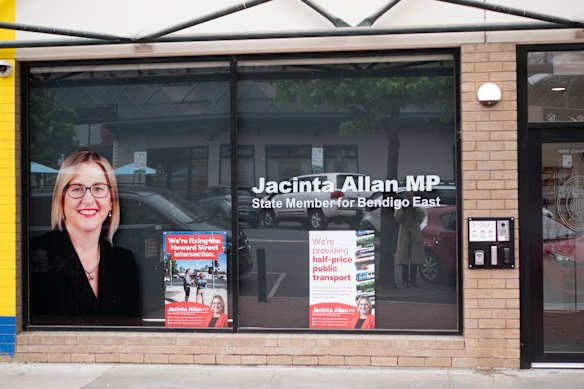
Like hundreds of thousands across the rest of Victoria, the people of Epsom – in the seat of former premier Jacinta Allan – turned on Labor when given the chance on Saturday.
At the 2022 election, Allan claimed more than 52 per cent of the 1152 valid votes cast at Epsom. On a two-party preferred basis, she took the booth 67-33.
That reversed at the weekend. Labor candidate Tim Rickwood could muster only 16.8 per cent of the primary vote in Epsom. On the two-party preferred count, he was muscled away 65-35 by the Nationals’ Andrew Lethlean.
Even by the standards of the weekend election, the 35-point collapse in Labor’s primary vote in Epsom was stunningly large. But across booths around the state, Labor’s vote was slashed by at least 20 points.
Allan didn’t face the voters of Epsom. But Ben Carroll did stand for re-election in his Melbourne seat of Niddrie.
Four years ago, Carroll won the primary vote in 13 of Niddrie’s 16 booths. On Saturday, he managed to win just one of 18. That single victory, by just seven votes over Liberal Samantha Byrne, was in the Keilor East booth.
That’s the booth closest to the proposed rail line extension to Tullamarine airport that Carroll spent much of his short time as premier promoting.
The victory in Keilor East was Pyrrhic. On a two-party preferred basis, the former premier did not win one booth in an electorate he had represented since 2012.
To the north-east, the seat of Mill Park has been safely in Labor hands since 1992, and before that it formed part of John Cain’s seat of Bundoora. That ended on Saturday.
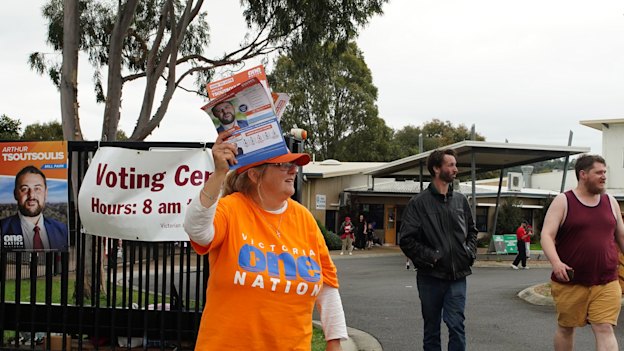
Pauline Hanson and her state leader, Warren Pickering, headed to Mill Park on the final full day of campaigning. It almost paid off.
In The Lakes booth, in 2022, Energy Minister Lily D’Ambrosio won 50 per cent of the primary vote. One Nation did not field a candidate.
Four years later, new Labor candidate Elizabeth Nealy could attract just 23.8 per cent of the primary vote.
This was a repudiation of Labor, but not an embrace of the Liberal Party whose candidate, Joel Drysdale, gained just 27 per cent of the primary vote.
The big winner was One Nation’s Arthur Tsoutsoulis who landed with a bang, claiming 26.4 per cent of the vote among The Lakes’ electors.
So strong was Tsoutsoulis, and so weak Nealy, that by Sunday afternoon the contest for Mill Park was between One Nation and the Liberal Party. Labor had been pushed into third.
While Pickering was ebullient on Saturday night after One Nation’s extraordinary performance, it did not translate into victory for himself.
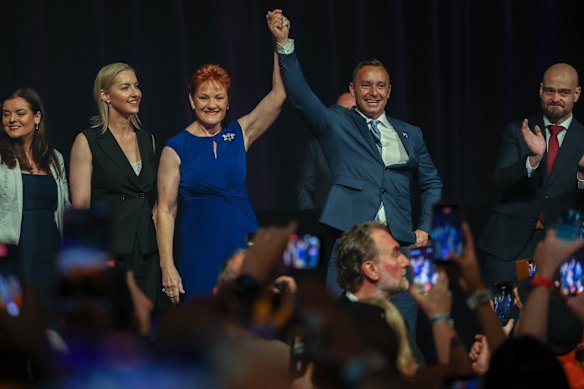
Pickering had stood in the seat of Pakenham where Labor was defending a margin of just 0.4 per cent.
In the Pakenham Central booth, Labor’s primary vote cratered, from 31.7 per cent in 2022 to an abysmal 12.9 per cent.
Pickering increased One Nation’s vote in that booth from 5.8 per cent 37.1 per cent. But it would not be enough. Liberal candidate Radmila Dyson actually went backwards at Pakenham Central with her party’s primary vote slipping five percentage points to 26 per cent.
But preferences from an unlikely alliance of the Greens, Labor and the Victorian Socialists helped Dyson turn a marginal Labor seat into a safe Liberal one.
It was a similar story in the state’s north.
Former Nationals leader Peter Walsh had held the seat of Murray Plains on a 22 per cent margin. In the tiny booth of Dingwall, just south of Kerang, he had polled 89 per cent of the vote in 2022. The Greens candidate did not attract a single vote.
At Kyabram, the seat’s largest booth, Walsh had managed a still very respectable 56.9 per cent.
But his retirement, and the rise of One Nation, opened an electoral door.
At the weekend, the Greens still couldn’t find a voter at the Dingwall booth. New Nationals candidate Brett Hosking did, but not nearly as many as Walsh. He and One Nation’s Garner Smith both managed 47 per cent of the Dingwall booth vote.
In Kyabram, the Nationals’ vote fell by 15 percentage points while Smith managed more than 38 per cent of the vote. Hosking will hold on, but the Nationals’ margin is now less than 2 per cent.
The election’s biggest winner was Liberal leader Jess Wilson, who led her party out of the electoral wilderness.
But even though she comfortably won her seat of Kew, there are signs of enduring pressure.
In the Kew booth, Wilson’s primary vote climbed from 35 per cent to 42 per cent. Independent Sophie Torney, who gave Wilson trouble in 2022, again highlighted the threat posed by the non-aligned. Her primary vote in Kew increased from 28 per cent to 31 per cent.
Apart from Wilson, another winner out of the election was Greens leader Ellen Sandell, who increased her margin in the seat of Melbourne.
The Docklands booth had been Sandell’s weakest in 2022, picking up 30 per cent of the vote. This time, she managed 32.5 per cent despite Labor’s vote in the booth collapsing by more than 20 points.
The Liberal vote in Docklands lifted from 22 per cent to 29 per cent, One Nation garnered 8.6 per cent while, on the far left, the Victorian Socialists’ Jordan van den Lamb doubled his party’s support to 8.9 per cent.
Across the seat of Melbourne, the Victorian Socialists picked up 12.1 per cent of the vote – better than One Nation and within spitting distance of Labor’s 16.8 per cent.
In an election of firsts, the Victorian Socialists gained more than 110,000 primary votes or 4 per cent of the statewide vote. In 2018, the party gained just 0.4 per cent of the vote.
Start the day with a summary of the day’s most important and interesting stories, analysis and insights. Sign up for our Morning Edition newsletter.
Disclaimer : This story is auto aggregated by a computer programme and has not been created or edited by DOWNTHENEWS. Publisher: www.smh.com.au