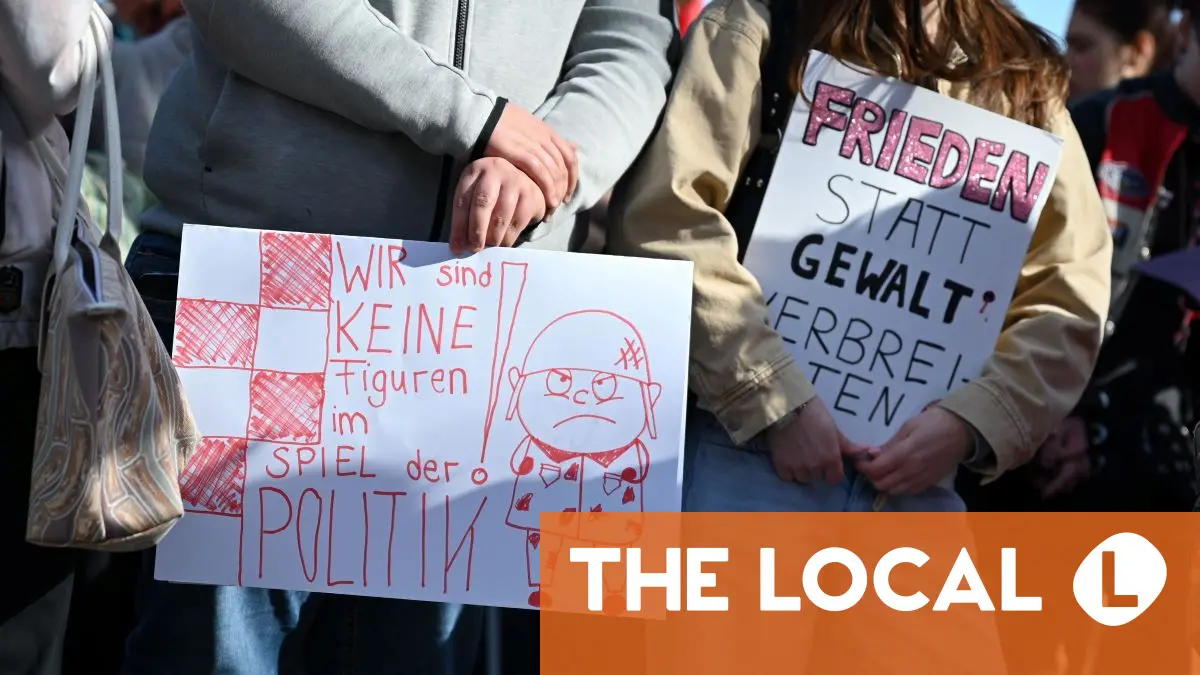
More than 100,000 protestors are set to march in at least 23 cities across Germany as part of nationwide youth-led demonstrations on Saturday, October 31st.
Nationwide demonstrations organised by youth alliance ‘Gen Z regulates’ (GenZ-regelt) are scheduled in cities across Germany on Halloween.
A website created by the organisers says that the demonstration is about “education, health, climate action and an affordable life, against conscription and against austerity.”
In response leaders from the federal black-red government are warning about potential violence, and major authorities have said they are monitoring for threats.
So what can we really expect from Germany’s nationwide youth protests on Halloween day?
130,000 demonstrators across 23 cities
“We are young people who no longer want to stand by and watch as decisions about our future are made without us being heard,” reads the top of a position paper by the protest’s organisers.
They add, “Young people are already protesting in France, Belgium, and Spain. The movement has spread to Germany. The first solidarity actions in support of the student protests in France have already taken place.”
The Gen Z Regelt website has a live-ticker counting the number of people who have signed up to say they will join a protest – it showed 130,000 registered attendees nationwide as of Monday morning, with five days to go until the event kicks off.
It also shows a map of the 23 cities were related protests are set to take place, and the number of expected demonstrators in each city.
Gen Z Regelt is officially organising demonstrations in five cities: Cologne, Frankfurt am Main, Hamburg, Berlin and Munich.
Partner groups have organised related demos in another 18 cities. The biggest of these is in Stuttgart, where more than 11,000 participants are expected.
Erfurt, where nearly 10,000 participants are expected, may see a demo bigger than Berlin. And Bonn, with nearly 6,500 participants, might get a larger crowd than Munich.
Investment in schools, action on climate, no military conscription
Organisers point to six topics that the protests are to be focused on:
- broken schools and austerity
- rising cost of living
- unfair distribution of burdens
- conscription and military screening
- surveillance
- climate change
In the movement’s position paper, they also add four lines about what they “stand for”.
Here they note that the protests are to be nonpartisan, critical of political leadership, seeking unity instead of division and a voice for youth.
READ ALSO: Everything you need to know if you want to join a protest in Germany
Extreme warnings from top-level leadership
Nowhere in the position paper is there any language to suggest that the protests will not be peaceful, but some of Germany’s federal leaders and authorities are already warning about potential violence and extremism – citing unrest seen in other countries.
Federal and state security authorities are reportedly monitoring the situation and exchanging information. These include the Joint Extremism and Terrorism Prevention Center, the Federal Ministry of the Interior (BMI) and the Federal Office for the Protection of the Constitution (BfV), according to a report by Rheinische Post.
Meanwhile leaders from both sides of the federal black-red government have given statements suggesting that the protests could be dangerous, and that the authorities will be cracking down on any perceived violence or threats of violence.
Sebastian Fiedler, domestic policy expert for the centre-left Social Democrats (SPD) told Rheinishce Post that there was “absolutely no justification for violent protests…” and that security experts were preparing “early on”.
Christian Democrat (CDU) domestic policy expert Alexander Throm suggested that there was a danger the protests could be “hijacked by left-wing extremists…” He cited calls for violence on social media, but also noted these were in the minority.
Opposition figures struck a very different tone.
Green party parliamentary leader Britta Haßelmann noted that, “young people have a right to be heard and to peacefully protest for their future.”
Left party domestic policy expert Clara Bünger went a step further, criticising what she saw as undue suspicions aimed at the youth protest movement: “When right-wingers take to the streets, the CDU/CSU regularly says that their concerns must be taken seriously and listened to. When young people protest against social injustice, they are suddenly declared a security risk.”
Germany has seen plenty of nationwide youth movements in recent years.
Most recently was a series of protests against military conscription which saw tens of thousands of mostly high-school students take to the streets. In the years before that there were also large demonstrations for climate action by Friday’s for Future and other youth-led groups, all of which were largely peaceful.
Disclaimer : This story is auto aggregated by a computer programme and has not been created or edited by DOWNTHENEWS. Publisher: thelocal.de