Vietnam veterans, rough sleepers and other impoverished Australians are being buried in unmarked communal graves often holding four or more people, a practice relatives have described as “unspeakable” and “a disgrace”.
A Guardian Australia investigation has identified more than 100 unmarked graves across New South Wales, and some in Queensland, that are being used by state governments to bury those deemed too poor to afford their own funerals.
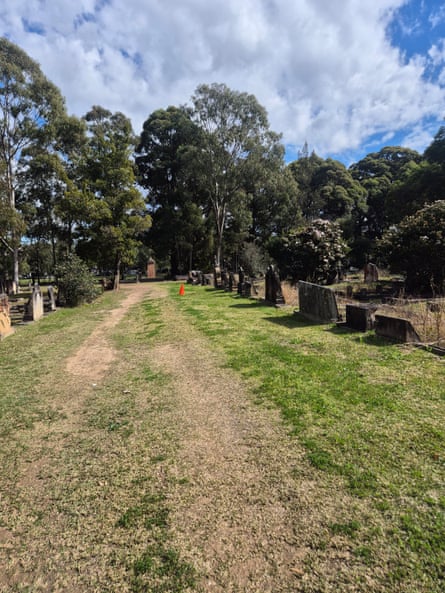
Using evidence from family, friends and the homelessness sector, together with analysis of cemetery registries and aerial imagery, the Guardian has established that the NSW government is using bare stretches of earth between dirt walkways and old headstones at Rookwood cemetery in Sydney to bury the remains of four to six strangers together in communal graves.
Among those being buried together are war veterans, cancer sufferers, people with gambling addictions and severe mental illness, and migrants from developing countries whose families cannot afford exorbitant repatriation costs.
In at least six cases, the Guardian has identified failures by authorities that meant friends, family or support workers were either not contacted or not told of the use of unmarked and common graves. The failures are likely breaches of a NSW policy designed to “avoid causing unnecessary distress to people who may have wished to make other funeral arrangements”.
Shocked family and friends say they have been left feeling robbed.
“It’s unspeakable,” said Chantel Dubsky, whose brother Roger Davies, a rough sleeper, was buried in an unmarked grave with four strangers at Rookwood without her knowledge. “He should have had the opportunity to be laid to rest with his mother, his grandparents and the people he loved, at his home in Adelaide.
“He wasn’t just someone off the street – he was someone’s son, he was someone’s brother. He was my brother.”
By crosschecking names with homelessness services in Sydney, Guardian Australia has also identified a further 18 individuals in the communal graves who had experienced homelessness.
The homelessness sector is outraged by the revelations.
Two leaders in Sydney’s homelessness sector say they were never made aware of the practice of using unmarked communal graves and are not being given the chance to intervene on behalf of their clients to fund a proper burial.
A third service, the Rev Bill Crews Foundation, an inner-city Sydney homelessness charity, says it has repeatedly raised concerns with the state government about the possible use of unmarked and communal graves but has been ignored.
The Rev Bill Crews, who runs the foundation, identified three of his clients as being among those in the communal graves but said he had not been told about their deaths and impending burials.
“It’s outrageous,” Crews said. “We did not know – they would all have had a dignified funeral and a proper cremation, and their ashes would have been scattered in the sea.
The foundation regularly uses its own funds to conduct funeral services for rough sleepers when it becomes aware they have died. It was given no notification in the three cases.
“For us, it’s frustrating. Incredibly frustrating.”
Guardian Australia has also established that two veterans of the Vietnam war, who both served in the Royal Australian Navy, were buried in unmarked communal graves in 2024 and 2025.
The pair were buried despite the availability of a federal funding program run by the Department of Veterans’ Affairs to help pay for the funerals of impoverished veterans. NSW policy recommends state health authorities approach DVA in such cases.
DVA was never asked for funding for the 2024 and 2025 burials. A spokesperson said it has “not been approached to help fund the burials of destitute persons since 2020”.
The Guardian’s investigation has prompted an apology from NSW Health, which has flagged changes to improve the process, and criticism from the health minister, Ryan Park, who described the failings as “unacceptable”.
In the first half of this year alone, a 17-metre stretch of earth adjacent to a dirt pathway at Rookwood has been dug up and used to bury the remains of more than 40 people in unmarked communal graves, including a rough sleeper who was well-known to most major homelessness services.
Nothing has been left to mark the 17-metre stretch of graves. Inspections of the sites of hundreds of other burials at Rookwood since 2010 show only about a dozen are marked by crosses or plaques.
The vast majority have no crosses, plaques or headstones to name the groups of deceased in each plot. There are also no signs to indicate the presence of graves.
Older sites, where the earth has settled, appear simply as long stretches of grass.
Markings are generally not used in Queensland for the smaller number of people buried under its scheme. The use of communal graves is much rarer in that state.
The situation contrasts sharply with the process embraced by Victoria, where each individual is given their own grave and a simple marking, identifying who is interred below.
The NSW government has previously pledged to stop the use of unmarked graves for destitute burials.
That came after lobbying by Barbara Davis, who was never told that her foster daughter Christine Halpin had been buried in Rookwood in 1989.
Davis and Christine’s biological daughter Jayne say they were told by the NSW government in 2013 that the use of unmarked graves would cease. The cemetery erected a “path of remembrance” that allows people to pay more than $800 to put a plaque on a rock, about 1km from some of the gravesites, but this has been used in a few dozen cases since 2020.
Christine’s gravesite remains unmarked. Davis and Jayne are both furious.
“It is a disgrace,” Davis said. “Whether you’re a prince or a pauper, you deserve a decent burial site, even just with a wooden cross with your name on it.”
In another case, a young Fijian who came to Australia to play rugby in Leeton, in NSW’s Riverina region, was buried in a communal unmarked grave after dying of cancer in 2022.
A former Leeton mayor, Paul Maytom, now president of the Leeton Multicultural Support Group, said he had previously helped raise funds from local Solomon Islander and Vietnamese communities to provide repatriation or proper burials.
He was not informed about the Fijian’s death.
“There should be a point of contact when this type of thing happens,” Maytom said. “And you should never have a situation where someone ends up in an unmarked grave, particularly when there are community members who are willing to help pay.”
A NSW Health Pathology spokesperson apologised for the failings, acknowledging they meant the dead and families and friends were not always treated with dignity and respect.
“Families and friends who have lost a loved one face many challenges managing arrangements during a time of grief, and all deceased persons should be treated with dignity and respect, regardless of their financial circumstances,” a spokesperson said.
“It is clear this has not always occurred with respect to the burials or cremations for deceased people without the financial means to pay for a funeral, and NSW Health apologises for the distress this has caused to those who have lost someone they love.”
NSW Health said it had made changes to the process in 2025 and in recent months to improve the way the funerals were handled. That includes giving NSW Health greater control, in place of police, and creating a dedicated six-person team within NSW Health Pathology to provide “alternative funeral arrangements and alternate sources of support for families and friends that may be willing to assist”.
It also flagged improving its relationships with “religious, cultural, charitable, community, and government organisations” to find funding for funerals after deaths.
Two NSW ministers, Park and the homelessness minister, Rose Jackson, said the dead and their families should be treated with respect, regardless of their financial circumstances.
“Previous arrangements have meant that this has not always been the case, and that is unacceptable,” Park said.
“Since early 2025, NSW Health has made significant changes to establish a more comprehensive and person-centred approach to ensure all deceased persons are treated with the respect and compassion they deserve.”
A spokesperson for Metropolitan Memorial Parks, which operates Rookwood general cemetery, said the NSW government did not fund it to provide grave markings for persons without means.
MMP said destitute burials were not the only burial type that used multiple interments in a single plot, and rejected any suggestion that those buried through the process were being placed between individual headstones, under walkways or in trenches.
It also said it had identified no legislation or regulation that had given effect to the government’s 2013 promise to mark graves.
Disclaimer : This story is auto aggregated by a computer programme and has not been created or edited by DOWNTHENEWS. Publisher: theguardian.com