Hundreds of criminals start leaving prison under new early release scheme
-
Published
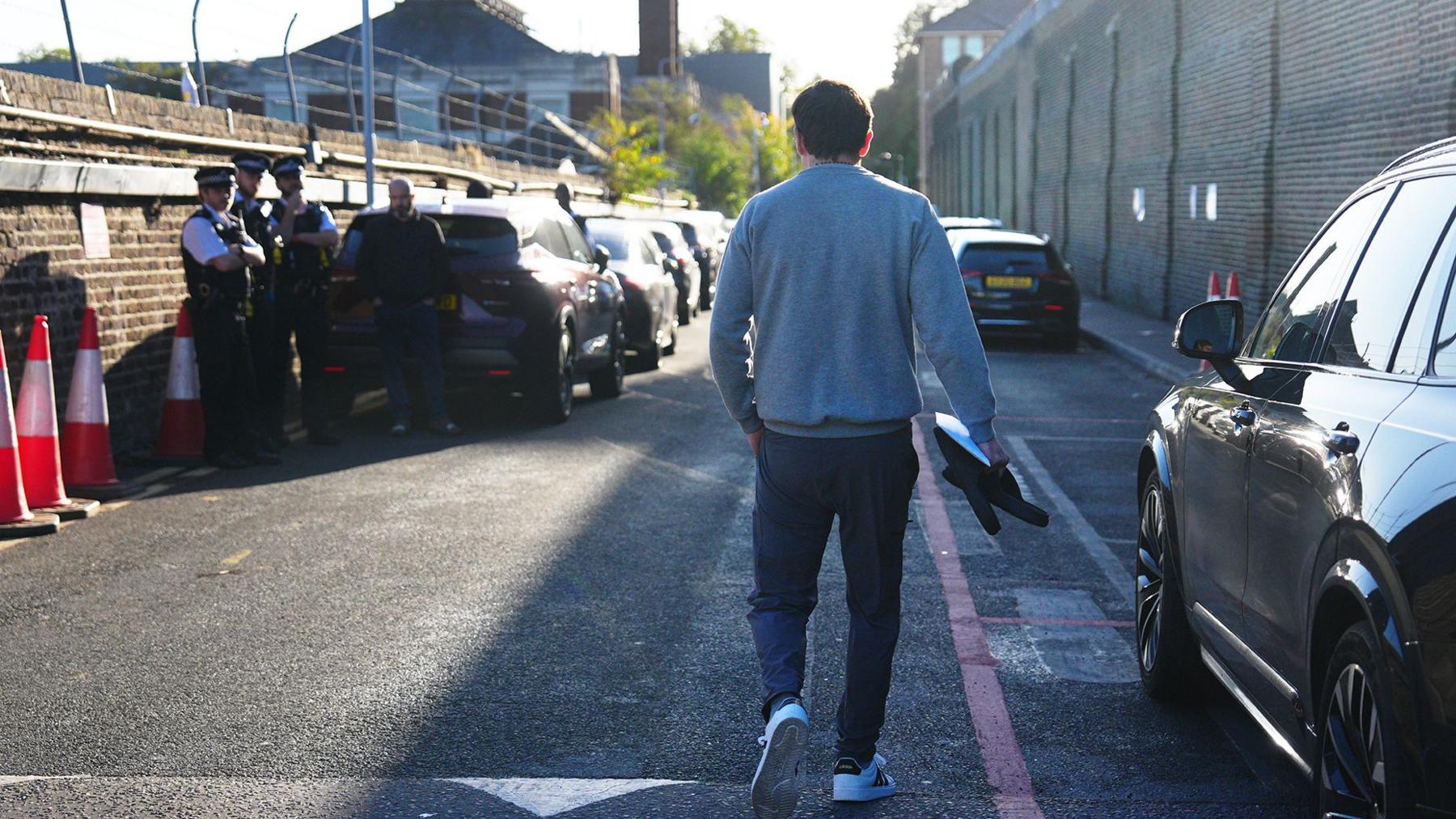
Hundreds of criminals are being released early from prisons in England and Wales under new rules introduced to prevent facilities reaching capacity.
The first 700 of an expected 4,500 inmates eligible under the scheme were due to be let out on Thursday.
The government has stressed they will remain subject to strict monitoring arrangements, including the expanded use of electronic tagging, and has said action was needed to prevent prisons from becoming full.
But the plan has been strongly criticised by victims and questions have been raised over whether the Probation Service has sufficient resources to monitor thousands more criminals in the community.
Prisons in England and Wales are a matter of months away from reaching capacity, with Ministry of Justice data showing as of Monday 87,499 people were incarcerated, taking prison population levels up to 98.2%.
Thursday’s release is the first of 10 scheduled to take place, with the final slated for June 2027.
Prisoners released initially were serving sentences of up to 19 months, with the most serious offenders – serving fixed sentences of more than 12 years – leaving in later waves.
-
We fear for our lives after being told our abusive exes will be freed from jail early
-
Published10 hours ago
-
-
‘Overcrowded’ and ‘set up to fail’: Freed prisoners react to early release scheme
-
Published1 hour ago
-
-
What’s behind having to release some prisoners early?
-
Published5 hours ago
-
Speaking to BBC Breakfast, Treasury minister James Murray said: “I know the level of concern and maybe anger will be intense, and it’s worth me making clear that this is not a situation where there is any good solution – there’s just a series of very difficult choices we’ve got to take.”
He said the government “inherited a prison system on the brink” and without early releases the country would face a situation where “people who are arrested now can’t go behind bars”.
Murray said measures were in place to restrict criminals’ movements in the community, adding: “I can’t guarantee exactly what will happen, but I can tell people we have done everything we can to reduce the amount of people being released as far possible.”
An early release programme introduced by the Conservatives saw more than 10,000 prisoners freed early between October 2023 and September 2024.
Sir Keir Starmer’s government introduced the Sentencing Act to deal with the ongoing capacity crisis, which stipulated that offenders who were due to spend 40% or 50% of their sentences in prison would leave after a third – while prisoners who previously served two thirds would leave after half.
The number of people expected to be released under this scheme was cut from around 6,000 after Prime Minister Andy Burnham intervened to review its terms, removing eligibility for crimes including all forms of manslaughter, grooming offences and causing or allowing the death of a child.
The scheme does not apply to indeterminate sentences, which are handed out for the most serious offences like murder, and require a parole board to deem a prisoner safe to be released.
London Victims’ Commissioner Andrea Simon said the exemptions “have not included some offenders whose imminent release is a genuinely terrifying prospect for their victims”.
She told BBC Radio 4’s Today programme: “[There is] no real reason to believe that an even shorter spell in prison will have dealt with the risk that their offender poses.”
Simon also questioned whether electronic tagging would be an effective safeguard, saying the equipment “will tell you where someone is but it can’t stop them from doing something they shouldn’t be doing”.
Earlier this week, the Chief Inspector of Probation Martin Jones said the electronic monitoring regime had “not kept pace” and could create “a false sense of assurance” unless failing are addressed.
Some newly released prisoners spoke to the BBC as they were freed, including former bus driver Michael Bogle – who described the conditions inside London’s Wandsworth Prison as “awful”.
“Tagging is better than prison,” he told reporters in support of the early release scheme. But others said they were concerned about a lack of support awaiting them on the outside, while one man told the BBC he did not know he was being released until Thursday morning.
To play this video you need to enable JavaScript in your browser.
This video can not be played
Kirsty Pellant is among victims whose perpetrator was expected to be released in the coming months.
A man was convicted of several offences against her, including stalking, and jailed for five years in January 2025 after she discovered her photograph had been used to create a fake identity online and portray her as a sex worker.
She told BBC Radio 4’s Today programme she had received assurances he would not be let out in the first wave of releases but was not told when he would be.
The uncertainty “leaves us in such a dangerous position as victims because we need to be prepared, we need to know what we’re dealing with,” she added.
Prisoners released early can immediately be returned to prison if they breach the terms of their licence, including by committing another crime, contacting a victim or living at an address not approved by authorities.
However, charities have raised concerns that domestic abuse survivors may still be put at risk, despite such provisions.
“We know that license conditions are frequently breached by perpetrators”, the charity Refuge warned, and cautioned that it was “deeply concerned that newly released perpetrators will be able to continue their campaign of abuse” without proper enforcement.
Women’s Aid chief executive Farah Nazeer meanwhile said the scheme could further erode “incredibly low” trust in the criminal justice system, meaning “even greater numbers of women and children may be left without protection”.
Ministers have also introduced restrictions zones, which will allow the Probation Service – which monitors offenders after they leave prison – to stipulate they can only move within a small geographic area, limiting their chance of a victim coming into contact with them.
But the National Association of Probation Officers (Napo) trade union has warned the service is “significantly under-staffed”, adding: “You cannot solve the prisons crisis unless probation is fully functioning and provides a real alternative to custody.”
The union’s general secretary Ian Lawrence questioned government pledges to increase probation staff to deal with the influx of released prisoners, telling the BBC he had “heard it all before”.
Government projections indicate the prison population will still rise to around 100,000 by the end of the decade despite early release schemes.
Minister have pledged to invest £7bn in a prison building programme which will expand capacity by 14,000 cells by 2031.
-
-
Published14 hours ago

-
Disclaimer : This story is auto aggregated by a computer programme and has not been created or edited by DOWNTHENEWS. Publisher: BBC