
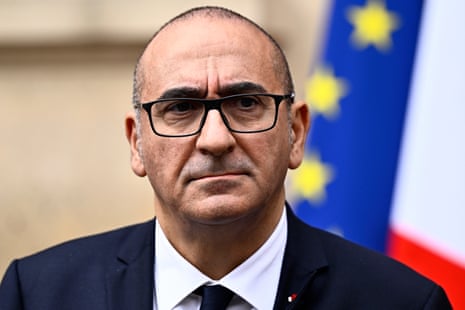
French police arrested almost 1,000 people on Saturday during the protests held across the country, interior minister Laurent Nunez said.
He told reporters that the number “will rise” as more data from police becomes available.
Although marches over the cost of living “passed off well” in cities, officers found themselves later confronted with “an extremely elevated level of violence” from “ultra-left” groups, Nunez said.
-
French police arrested 1,000 people during protests about the cost of living and education, with that number expected to rise, according to the country’s interior minister Laurent Nunez
-
The government estimated that at least 400,000 people had marched across France. Trade unions estimated the number at double that.
-
Two serious injuries were sustained during the protests, Nunez said, including a 20-year-old man who had his fingers blown off.
-
A demonstration on the outskirts of Paris was largely peaceful but was marred by violence at the end, with police using a water cannon and teargas to quell the crowds.
-
More than 70,000 police were on the streets of French cities, with shops boarded up and many museums closed.
-
In Italy, nine were arrested and more than 370 people “briefly detained” by police.
-
Protests also took place in Belgium, Spain, Portugal and Albania over different issues.
A peaceful protest during the day in Paris descended into violent clashes with police by the time night fell.
The sound of pop music blaring and chanted slogans was swapped for the sound of teargas being released and fireworks being released, according to reports.
Eyewitnesses say the mood soured at the end of the march, where rows of police officers and vans awaited the crowd.
Protesters reportedly fired fireworks towards law enforcement officers, who responded with charges and baton strikes.
The AFP news agency quoted David, a protester who gave only his first name. He is said to have appeared shaken and had a gash on his face, which he said was caused by a police officer throwing a baton at him.
“The police started moving towards everyone, telling them to get down and back off. They were just taking people down, you know, beating protesters,” he said.
Mike, a 23-year-old student who also declined to give his surname, said: “Look around, they’re just teenagers. Is it normal for teenagers to be teargassed and beaten with batons?”
For Jessica, a 24-year-old student, said: “I just don’t understand why there’s so much violence. I feel like our right to protest is being trampled on.”
As night fell, police began clearing the streets and protesters started to disperse.
Italian police said nine people were arrested, and 371 briefly detained during protests in eight cities.
In a statement, the police said 110 of those either arrested or detained were minors.
My colleague Angelique Chrisafis has been reporting from the protest in Paris today, which has since dispersed.
She writes about how a largely peaceful demonstration on the outskirts of the French capital was marred at the end by violence.
The mood in Paris on Saturday afternoon was peaceful and lighthearted, with brass bands playing and children and grandchildren present. Some people carried banners critical of the government’s policing, saying: “Oppression breeds rebellion” and “The right to protest”.
But at the end of the Paris demonstration, at Porte de Vincennes on the city’s eastern edge, different groups of masked men dressed in black emerged who had not appeared to have taken part in the peaceful march. Some groups of masked men threw glass bottles and stones at police, who responded with teargas, water cannon and stun grenades. A bin was set alight and fireworks were set off towards police.
A man reportedly had his fingers blown off during trouble in France, a minister has said.
France’s interior minister – equivalent to the home secretary in the UK – Laurent Nunez said two people had been “seriously injured” during what he called “an extremely elevated level of violence” at today’s protests.
A 20-year-old man in Toulouse, in southern France, is said to have had his fingers blown off, and the other serious injury occurred in Clermont-Ferrand in the centre of the country. He did not give details of either case.
In an update, Nunez said “ultra-left” groups had thrown projectiles and aimed fireworks at police to provoke clashes.
He struck a more positive tone than last week when violence erupted across French cities during protests about the level of investment into public services and the cost of living.
Nunez said that, while some shops and businesses had been vandalised and looted today, “the scale was far smaller” than a week earlier. He stressed that shopping centres had been well protected this time.
In Paris, where the main demonstration passed off largely peacefully but clashes broke out with police as the crowd dispersed, Nunez said “several thousand radical activists gathered at the rear of the march, including about 500 individuals identified as rioters”.
Ensuing clashes in the French capital lasted for around two hours, he said.
The minister said that there were first-time clashes in the southern cities of Cannes and Montpellier between far-right activists who sought confrontations with “ultra-left militants” who he said claimed to be there to protect businesses.
The authorities will remain “on high alert” through the night and into Sunday, he said.
Demonstrations were held in the Italian cities of Rome, Turin and elsewhere, with some turning violent.
As we reported earlier, security was heightened in Rome, where authorities locked down luxury shopping streets and stepped up controls around the Circus Maximus and Piazza del Popolo.
A small number of protesters tried to force their way into the Colosseum, but were ushered out by guards.
Elsewhere in the city, several hundred students demonstrated peacefully to stress they were not rioters after unrest last week, particularly in Milan.
Riccardo Ponzio, national president of an Italian far-right student association, said: “I think the images from last week were truly something terrible, especially for the young people, for the students, for the vast majority of the younger generations who want to study … and do not accept being represented by those who use issues and needs to devastate entire cities.”
A separate anti-war march took place in central Rome. Organisers sought to distance themselves from potential unrest, urging participants to keep their faces uncovered and hands visible.
But it was these marchers who briefly clashed with police near the Piazza della Repubblica, even as organisers were trying to hold the crowd back using batons and teargas.
In the end, the protesters pulled back when a water cannon was turned on. They retreated to a location about 500m away.
French police arrested almost 1,000 people on Saturday during the protests held across the country, interior minister Laurent Nunez said.
He told reporters that the number “will rise” as more data from police becomes available.
Although marches over the cost of living “passed off well” in cities, officers found themselves later confronted with “an extremely elevated level of violence” from “ultra-left” groups, Nunez said.
Jean-Luc Mélenchon, the radical-left presidential candidate who marched in the Paris rally today, said in a social media post that the French police “ruined the day” by “shooting indiscriminately” at Paris protesters.
“In Paris, as a way to ruin the day and blow off some steam, the so-called ‘forces of law and order’ are firing tear gas and shooting indiscriminately into the crowd at the tail end of the march, all to secure footage for domestic television channels, which have spent the entire week broadcasting the very images that incited the killer in Trappes,” he wrote. “A non-stop display of shame.”
In addition to the earlier footage of police using tear gas against protesters in Lyon, we are now seeing tear gas being deployed in the cities of Paris, Marseille, Nantes, and Bordeaux.
Though the protests have been relatively contained so far, the use of tear gas has become an increasingly common tactic for police to disperse crowds at the end of organized rallies, even without an immediate threat. And taking past demonstrations into consideration, these situations often become more volatile as the sun begins setting and the organized gatherings are ending.
The Interior Ministry has put today’s nationwide turnout at 410,000 total protesters across France.
Clashes began to erupt late on Saturday, following a pattern of otherwise peaceful protests growing more tempestuous as the day draws to a close.
The Paris march began calmly, but near its endpoint at Porte de Vincennes, some protesters threw projectiles while police fired volleys of tear gas and used water cannons to disperse people.
Authorities had confined the capital’s march to the city’s southeastern edge, keeping protesters away from central neighborhoods hit by last weekend’s destruction.
Police in Paris say that about 110,000 people have marched across France’s capital today, but that the “situation remains calm” according to reporting from AFP. Authorities have now begun dispersing the crowds.
The 110,000 figure is roughly the same amount as the number of protesters in Paris last weekend. Considering the fears many people had that the protests could turn violent, as well as the rainy weather across the area, the number is an impressive showing.
The police also said more than 3,000 checks have been carried out and 65 people were arrested during the demonstrations in Paris.
Meanwhile in Albania, more than 2000 police have been deployed around Tirana on the 12th day of student-led protests amid reports of concerted efforts to stop demonstrators entering the capital.
Protests initially spurred by fury over a planned Trump family-backed resort in Albania have turned increasingly violent as students have joined what growing numbers are now calling a revolution to oust prime minister Edi Rama. Today, rally numbers swelled with demonstrators traveling to Tirana from cities across the Balkan state and as teachers, doctors and labour unions also weighed in.
But police also stand increasingly accused of heavy-handed tactics amid reports of civilians being plucked from the streets by masked officers and riot police increasingly resorting to using rubber bullets, batons, tear gas and water cannons to disperse crowds.
Speaking to the Guardian after spending several hours at Tirana’s National Trauma hospital earlier in the day, Kei Brisku, who heads the Abania Rehabilitation Centre for Trauma and Torture, said there were growing concerns about “the mass and random use” of rubber bullets.
“Nine protestors, five women and four men, were badly wounded by rubber bullets today and are now in hospital,” he said.
“The use of rubber bullets against violent protesters may be justified under applicable regulations … however, their indiscriminate use against crowds is unacceptable, as it risks harming peaceful protesters and bystanders who pose no threat.”
In power for 13 years, Rama has resolutely refused to resign. While he has offered to discuss the “ legitimate concerns” of students, he has ruled out talking with hooligans who resort to violence.
Last week, the socialist leader told the Guardian the “violence in Tirana is very real,” as he dismissed accusations that his government was employing underhand tactics to fast-track the controversial resort championed by Jared Kushner, the US president’s son-in-law.
The NFL (American football league) closed its “NFL House” in Paris as the city braced for street protests with a heavy police presence and storefronts boarded up.
The league announced the closure to fans on Saturday morning through its “OnePass” app, according to the AP, citing “potential accessibility issues.”
Security concerns have overshadowed the NFL’s planned debut in Paris. The New Orleans Saints will play the Pittsburgh Steelers on Sunday at Stade de France in the league’s first-ever regular-season game in France.
Major museums including the Louvre and Orsay Museum are also closed Saturday, though tourists were seen lined up to enter Notre Dame Cathedral.
Spanish authorities say about 25,000 demonstrators have marched through the country’s capital demanding protections to the state pension scheme.
Spain is voting in a snap parliamentary election in a few weeks and this has been a key topic of concern. Spain’s Socalist prime minister Pedro Sanchez, who called the snap election after struggling to get pension reforms through parliament, has accused conservative parties of holding back inflation-linked increases.
Protesters marched from the Atocha train station to the Gran Via shopping avenue in the Spanish capital.
Some expressed concern about portions of their state pensions being privatised in the future. About 6.8 million Spaniards receive a state pension and fiscally conservative, right-wing politicians have raised questions over how sustainable the current system is.
Spain has also seem major protests in recent months over increasingly unaffordable housing and renters’ rights.
Some are, namely in certain cities and low-income suburbs. Videos filmed by students and teachers have shown leaks, scurrying rats, holes in walls and ceilings, broken toilets and not enough chairs or tables, meaning teachers have to carry them from classroom to classroom. Some children said they had to learn in class while leaks were pouring into buckets, or move desks to avoid getting wet. Many school classrooms experienced temperatures over 35C (95F) in the heatwaves of last May and June.
Estimates in recent years have pointed to thousands of French schools at all levels, both primary and secondary, in need of repair. These include many 1960s school buildings. French regions are responsible for upkeep of high school buildings, but have asked for higher budgets from the government. A senate report has advised that billions need to be spent in the coming years to renovate and repair schools, as well as to address the impact of the climate crisis.
Tens of thousands of people have turned out to the heavily policed demonstrations across France and they have been, on the whole, quite contained so far.
Some sections of the crowd could be seen singing and dancing in Paris as they walked along the route, which was pushed to the city’s fringes at the last minute as police sought to move the march away from the fortified city centre.
In Lyon, police used teargas early on in the banned demonstration to disperse some of the crowd but people were still able to walk on.
In the last half hour there’s also a been of bit of rough activity in Marseille between police and a few dozen people. The French broadcaster BFMTV has shown live footage of masked attendees throwing bins, flares going off and spot fires in the street. There are cordons of riot police around.
Overall though, the heavy policing has appeared to be successful so far in staving off the type of looting, ransacking and violent activity we saw on the fringes of the marches last week. The government has added on 20% more officers, for a 70,000 strong force across the country.
Earlier today, the French interior minister had said protest numbers – at about 36,000 in the morning- were about half of what they were last Saturday.
At the Paris march, Nadège, a communications worker, said she was at Place de la République last Saturday when teargas hit. But that hadn’t deterred her.
I’m out again peacefully today to support everyone who is brave enough to demonstrate. It does take courage. People are afraid now.
We have to keep our rights alive. We’ve seen what happens in the US when a bad president is in power. In France, it’s our legal right to protest in the street and I’m here to defend that.
The French president had hosted student representatives for a highly anticipated meeting yesterday afternoon.
Going in, the student leaders had already expressed cynicism over whether the French president would adequately address their concerns.
Pupils in Paris began protests over the quality of their education four weeks ago – and their spirit has since inspired demonstrations elsewhere, across the nation and also into other countries, such as Italy and Greece.
French high schoolers say they’re fed up with the deteriorating state of their school buildings, overworked and underpaid teachers, and packed classrooms.
They’re demanding school renovations and upgrades, better study conditions and the scrapping of the Parcoursup univeristy admissions platform which was introduced in 2018 and has long been criticised for lack of transparency.
Macron held a two-and-a-half hours-long meeting with 20 students.
Nathanael Combary, president of campaign group High School Renewal, said the president had been “attentive” and they would continue talks with Prime Minister Sébastien Lecornu on Monday on proposed changes like reform of Parcoursup.
But he and other student leaders called on their peers to continue protesting this weekend.
The radical-left presidential candidate Jean-Luc Mélenchon, leader of the La France Insoumise party, is also marching in the Parisian procession.
Speaking to the press earlier he said the protests would continue every week until Emmanuel Macron and his government addressed the public’s demands.
He said Macron “is going to understand that this is going to repeat itself every week” and urged the president, “there is still time for him to concede” to the students’ wishes.
Macron met with student leaders on Friday for the first time since the demonstrations began a month ago. More on that meeting next.
Disclaimer : This story is auto aggregated by a computer programme and has not been created or edited by DOWNTHENEWS. Publisher: theguardian.com




