
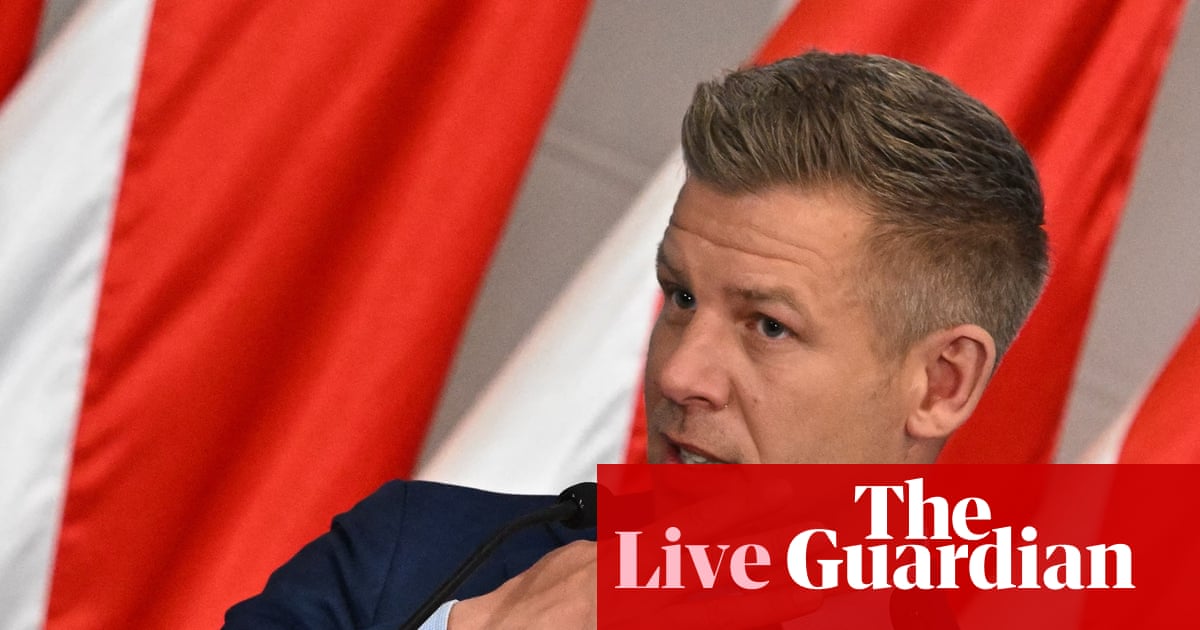
Magyar has also offered a bit more detail on how he wants to negotiate with the EU on releasing the billions of euros in frozen EU funds earmarked for Hungary.
He suggested he could sign a political agreement with the EU in mid-May – suggesting somewhere between 15 and 20 May – which would include a schedule of Hungary’s planned reforms between then and the end of August.
If necessary, further talks would be held daily, he said, as the release of the funds would help rebuild the investors’ confidence in the country.
… and on that note, it’s a wrap for today!
-
Hungarian election winner Péter Magyar has signalled Hungary would seek a political agreement on reforms needed to unfreeze EU funds after Orbán years as the new government faces a August cliff to agree on spending or lose money (16:02).
-
Magyar called the talks with the EU “constructive” and joked that he would urge officials to take short holidays this summer as the new government will have just under three months to get the EU money flowing again (12:16, 16:25, 16:38).
-
The incoming prime minister also confirmed he would drop Hungary’s veto over the €90bn Ukraine loan as soon as oil deliveries through the Druzhba pipeline are restarted, urging Ukraine’s Volodymyr Zelenskyy to do it as quickly as possible (16:22).
-
The issue is expected to formally be discussed at the EU level on Wednesday (17:15), with France’s Emmanuel Macron saying he is “reasonably optimistic” that the loan will finally be paid out (17:12).
-
Magyar also named first ministers in his incoming government (14:55), and repeated his warning to Orbán-era officials, urging them to step down by end of May or face removal by the new parliamentary majority as he seeks a break from the past (15:22).
-
Separately, Poland’s Donald Tusk has confirmed that Magyar asked Poland to help with repairing the relations with the EU (17:01), as we reported over the weekend.
Separately,
-
Spain’s Pedro Sánchez has led the calls for the EU to suspend its association agreement with Israel, as the issue is expected to return to the EU forum on Tuesday (17:45).
-
EU and Nato leaders congratulated Bulgaria’s former president Rumen Radev on winning the country’s parliamentary election on Sunday (12:30, 13:33, 13:41), amid some concerns over his future government’s stance towards Russia and Ukraine after the Kremlin praised his call for “pragmatic” relations with Moscow (11:49).
If you have any tips, comments or suggestions, email me at jakub.krupa@theguardian.com.
I am also on Bluesky at @jakubkrupa.bsky.social and on X at @jakubkrupa.
Some 45 children forcibly removed from Ukraine have been tracked down by Europol in an initiative also involving the International Criminal Court and experts from around the EU and the US.
Over two days, experts from 18 countries including the UK and the US, used open source intelligence including information on military units assisting deportation of children from Russian occupied territory, platforms showing photos of alleged deported children and information on individuals who received children to track them down.
It was the third event of its kind and is aimed at assisting Ukrainian authorities at repatriating the children and building evidence of potential war crimes.
Two years ago the International Criminal Court with the backing of the EU and the US established the International Centre for the Prosecution of the Crime of Aggression (ICPCA) in bid to systemically build evidence for potential trials after the war.
The number of children tracked is a tiny fraction of the 19,500 Ukrainians have estimated have been deported or forcibly removed from occupied territories during the four year war.
Participating countries were: Austria, Belgium, Czechia, Denmark, Finland, France, Germany, Ireland, Italy, Malta, Netherlands (co-organiser), Norway, Portugal, Romania, Spain, Ukraine, United Kingdom, United States.
Organisations involved were the International Criminal Court – Office of the Prosecutor, Mnemonic, Global Rights Compliance, Osint for Ukraine and Truth Hounds.
Sam Jones in Madrid and Jennifer Rankin in Brussels
Meanwhile, Spain’s prime minister, Pedro Sánchez – who has been among the most vocal European critics of Israel’s war in Gaza – has said he will ask the European Union to end its association agreement with Israel on Tuesday.
“The time has come for the EU to break its association agreement with Israel,” Sánchez said on Sunday.
“We have nothing against the people of Israel – quite the contrary. But a government that breaks international law – and thus breaks the values and principles of the EU – cannot be our partner.”
The Israeli government has hit back at Sánchez, accusing him of hypocrisy and double standards.
“We won’t accept a hypocritical lesson from someone who has a relationship with totalitarian regimes that violate human rights, such as Erdoğan’s Turkey and Maduro’s Venezuela,” Israel’s foreign minister, Gideon Sa’ar, posted on X, alongside a photograph that apparently showed a poster of Sánchez’s face and his criticisms of Israel’s war on Iran on an Iranian missile.
In a reference to the poster, Sa’ar said the Spanish government had received thanks “from Iran’s brutal regime and terrorist organisation”, adding that it has “dedicated itself to spreading antisemitism”.
He then threw Sánchez’s words back at him:
“We have nothing against the citizens of Spain – quite the contrary – but we do against the double standard of the government of [Pedro Sánchez].”
More than 390 former EU ministers, ambassadors and top officials have recently urged the EU to wholly or partly suspend the agreement, which created a free trade area and deepened joint work in energy, environment and research agreement.
Signatories included the ex-EU foreign affairs chief and former Spanish foreign minister Josep Borrell, the former Swedish foreign minister and UN weapons inspector Hans Blix, and the former European Commission vice-president Margot Wallström.
Ireland, Spain and Slovenia – among the staunchest supporters of the Palestinian cause in Europe – have called for a discussion of Israel’s human-rights obligations under its association agreement with the EU, when EU foreign ministers meet on Tuesday.
“The European Union can no longer remain on the sidelines,” wrote the foreign ministers of the three countries in a letter to the EU foreign policy chief Kaja Kallas, referencing “unbearable” conditions in Gaza and “escalating violence against Palestinians” in the West Bank.
Diplomatic relations between Spain and Israel have plummeted following Sánchez’s repeated criticisms of Israel’s actions in Gaza and Iran.
In September last year, the Spanish prime minister accused Benjamin Netanyahu’s government of “exterminating a defenceless people” by bombing hospitals and “killing innocent boys and girls with hunger”.
Announcing a raft of measures designed to increase the pressure on Netanyahu to stop the military campaign, Sánchez added:
“What prime minister Netanyahu presented in October 2023 as a military operation in response to the horrific terrorist attacks has ended up becoming a new wave of illegal occupations and an unjustifiable attack against the Palestinian civilian population – an attack that the UN special rapporteur and the majority of experts already describe as a genocide.”
Sánchez’s speech drew an immediate and furious response from the Israeli government, which accused his administration of deploying “wild and hateful rhetoric” and of using a “continuous anti-Israel and antisemitic attack” to distract from corruption allegations.
Sa’ar also announced that two senior leftwing Spanish politicians – the labour minister and deputy prime minister, Yolanda Díaz, and the youth minister, Sira Rego – would be banned from entering Israel because of their criticisms of Israel’s conduct in Gaza.
In fact, it looks like it’s not only Macron who is reasonably optimistic about the next steps.
A spokesperson for Cyprus, which holds the EU’s rotating presidency, said the EU countries will seek to give the final greenlight to release the €90bn for Ukraine on Wednesday, AFP reported.
He said the item will be on the agenda for their meeting on Wednesday, with hopes this could be finally approved after months of delays under Viktor Orbán.
Responding to a question on Hungary, Macron also hails Péter Magyar’s win over Viktor Orbán as a chance for a “new era” in relations with Hungary.
He says he is “reasonably optimistic” that the change of government will unblock the €90bn loan for Ukraine, “which is a good thing both for Ukraine and for ourselves and our credibility.”
In their presser, Tusk and Macron focus primarily on bilateral cooperation, including on nuclear “information sharing,” defence and joint exercises, but Tusk makes a small detour to talk about Hungary, too.
He says Poland and Hungary are “traditionally very close partners,” and repeats how pleased he is about having “a European democrat” as the next prime minister in Budapest.
He also indirectly confirms our reporting from over the weekend as he says that Magyar “requested that Poland help Hungary fully return to every day European life” in politics.
“Of course, we will help our Hungarian friends in this certainly difficult process,” he says.
So, yup, it’s exactly as we reported over the weekend:
Meanwhile, France’s Emmanuel Macron and Poland’s Donald Tusk are speaking at a press conference in Gdańsk, Poland.
The pair are meeting for further talks on bilateral partnership, including on defence, in a bid to build on last year’s cooperation treaty signed in Nancy.
You can follow it live here:
Over in Brussels, the EU’s foreign policy chief, Kaja Kallas, spoke this afternoon at a press conference about Palestine and the EU’s policy towards violent Israel settlers – and she made it clear she hoped for a change of position on this issue from the new Hungarian government.
She said:
“We have 27 countries, and 26 countries want to put the violent settlers sanctions in place. One doesn’t, and because we have the working methods as they are, so far, the one who doesn’t want the sanctions on violent settlers has got the upper hand.
Now this country [has recently] had the elections and will [soon] have a new government.
I will not speak for the new government, but definitely I think we can look into all these policies and see whether they have a new approach.”
Our team of foreign correspondents explained the context in more detail over the weekend, with this – now prescient – quote:
“Hungary’s veto was the only thing preventing the package of sanctions against violent settlers,” said Maya Sion-Tzidkiyahu, the director of the Israel-Europe relations programme at the Mitvim thinktank and a lecturer at the European forum of the Hebrew University of Jerusalem.
“I expect once the [new] Tisza government is in place, that would be one of the first things the EU would like to push, and it should be easy for [Péter] Magyar to say yes. Netanyahu is on the wrong side of history from the perspective of many Europeans, and he is a symbol for Orbán.”
For what it’s worth, Magyar also confirmed during his press conference that the new government would stop the process of Hungary’s withdrawal from the International Criminal Court, prompting new questions over his government’s future relations with Israel under Netanyahu.
And that ends Magyar’s press conference in Budapest, but in the meantime there has been another development in Brussels, so let’s go over there…
Magyar also confirmed parts of the plan that includes moving and shuffling some of the funds, including by allocating them to special purpose vehicles, or SPVs, that would give them more flexibility on how the funds can be deployed and by what deadlines.
Lots of that chimes with our reporting over the weekend that his team has been involved in talks with various senior Polish officials, offering their advice on exactly this sort of solutions. For what it’s worth, Poland’s current government also used SPVs when accessing EU funds frozen under the previous illiberal government.
Magyar said his government saw “several possible solutions” and would proceed with “utmost care” to make sure all proposals are in line with the EU’s expectations and rules.
On the critical issue of EU funds, Magyar added that the first talks with the European Commission were “constructive” as he joked he would ask officials “not to plan too long holidays” as the focus this summer will be on unlocking the EU funds.
He says there is a lot of technical fixes needed to get the funds flowing again, not just at the political, but also at the administrative level.
“We definitely have to implement this by August,” he said, adding that the new government will try to “do in three months what Orbán could not and did not want to do in three year.”
Magyar was also asked about his position on the Druzhba pipeline given earlier suggestions – including from the outgoing prime minister, Viktor Orbán (9:56) – that Ukraine could be about to restore the oil flow after months of disruption.
He said he was aware of suggestions that this could happen in the coming days, and warned Ukraine’s Volodymyr Zelenskyy – with whom he didn’t hold any talks yet – against using the pipeline to pressure Hungary or the EU on related issues, including the €90bn loan for Ukraine.
Magyar said if the pipeline has been repaired and is ready to use, it should be reopened as soon as possible so Russia can resume oil shipments to Hungary.
But he also confirmed that his government would lift the veto on the loan as soon as the pipeline becomes operational (something that Orbán also suggested earlier today, 9:56).
Magyar has also offered a bit more detail on how he wants to negotiate with the EU on releasing the billions of euros in frozen EU funds earmarked for Hungary.
He suggested he could sign a political agreement with the EU in mid-May – suggesting somewhere between 15 and 20 May – which would include a schedule of Hungary’s planned reforms between then and the end of August.
If necessary, further talks would be held daily, he said, as the release of the funds would help rebuild the investors’ confidence in the country.
Disclaimer : This story is auto aggregated by a computer programme and has not been created or edited by DOWNTHENEWS. Publisher: theguardian.com



