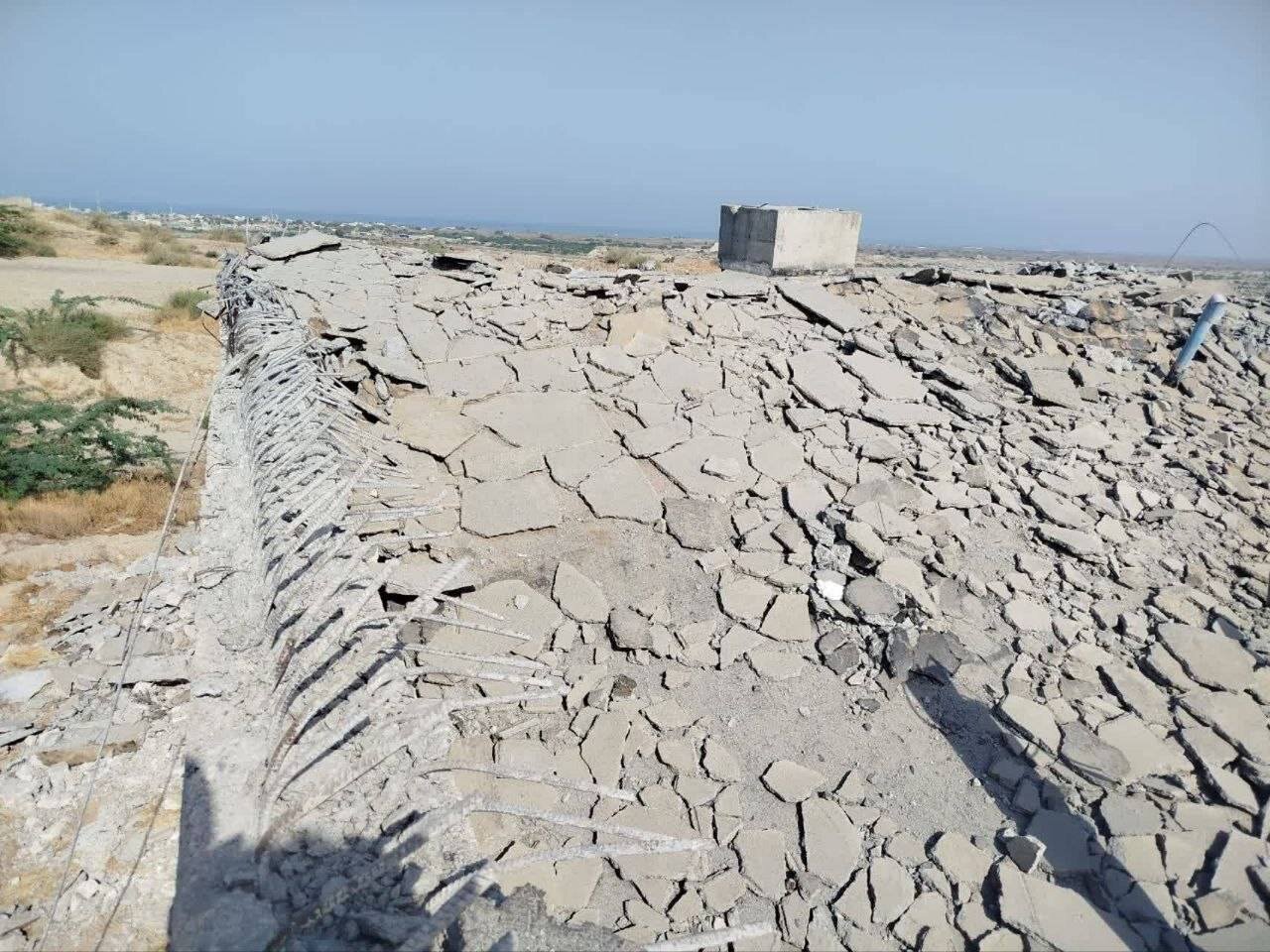
TEHRAN — The ruins of two concrete water tanks in Sirik stand as silent witnesses to American brutality. One held 500 cubic meters, the other 2,000.
Alongside mechanical facilities, they sustained over 20,000 people in southern Iran across Kohestak and ten villages in the Bomani district.
Abdolhamid Hamzehpour, Managing Director of Hormozgan Water and Wastewater Company, said the U.S. destroyed this infrastructure, leaving residents cut off in blistering heat.
This was a deliberate strike on an asset indispensable to human survival, violating Article 54 of Additional Protocol I to the Geneva Conventions.
These tanks served thirsty villagers and the objective is simply using civilian suffering as political leverage.
The infinite regress doctrine
To justify hitting indispensable assets, the Pentagon relies on an elastic legal fiction called “dual-use” targeting.
This introduces an infinite regress where civilian life completely evaporates.
Under this pretext, any facility manufacturing an atom that might brush against a soldier’s uniform becomes a legitimate military target.
This matrix treats civil society as a latent reserve force, legally sanitizing the destruction of hospitals, schools, and water grids.
The water tanks of Sirik, fixed, immobile, exclusively serving civilian households, are twisted by this logic into some phantom “logistics asset.”
This is an infinite regress designed to erase the civilian from existence, transforming every man, woman, and child into a lawful target of war. It is the legal architecture of genocide, dressed in Pentagon jargon.
Pretexts and historical bloodlines
The claim that strikes responded to a downed U.S. Apache helicopter is a technological fantasy.
Washington alleges an Iranian drone struck cleanly between two pilots without exploding.
This fable masks pre-planned infrastructure destruction executed during a “ceasefire.”
In reality, the Apache was enforcing an illegal naval blockade, an explicit act of war.
The follow-up strikes were meant to further degrade Iran’s ability to defend itself, picking apart infrastructure just below the threshold of total war so Washington does not run out of munitions, while preventing regional stability from resuming and energy exports from restarting.
The American record
Sirik continues a decades-long American tradition of weaponizing water to slaughter populations.
In 1991, the U.S. bombed Iraq’s water treatment plants, then enforced sanctions that blocked chlorine imports, contributing to over 500,000 child deaths by 1998.
In this campaign of aggression against Iran, this blueprint is co-authored by Israel under the Dahiya doctrine, which mandates disproportionate force against infrastructure to inflict raw societal trauma.
This axis, after incorporating at least one small fragile Arab country in the Persian Gulf, has utilized shared intelligence and American munitions to hit Iran’s South Pars energy installations, pharmaceutical factories such as Tofigh Daru, steel plants, and the Qeshm Island desalination plant.
It was seen horrifically in the February 28 missile strike on the Shajareh Tayyebeh elementary school in Minab, where a U.S. Tomahawk missile murdered 156 civilians, including 120 children.
The unfinished B1 bridge in Karaj was likewise obliterated on April 13, killing a dozen civilians in what anonymous U.S. officials described as a “symbolic” airstrike to make Iran surrender.
The calculus of hydro-reciprocity
Trump has dropped all pretense, openly telling Fox News on June 10 that he is “close to ordering additional strikes on energy infrastructure and bridges in Iran.”
His eliminationist Truth Social posts, which mockingly use the phrase “Praise be to Allah,” reveal a sadistic glee driving this extortion.
The White House sends mediation teams while pumping noise through anonymous sources, using the threat of civilian dehydration to force political surrender.
While Iran has responded with discipline, launching self-defense strikes against the al-Azraq base in Jordan and Fifth Fleet installations in Bahrain under Article 51 of the UN Charter, its restraint must not be mistaken for weakness.
The foreign bases and host economies in littoral Persian Gulf states exist in absolute ecological vulnerability, relying entirely on centralized coastal desalination networks like Jebel Ali.
If the United States continues to normalize attacks on municipal water supplies, Iran possesses the precise kinetic capability and absolute legal justification to enforce strict hydro-reciprocity.
The aggressors operating from these fragile desert outposts would do well to heed a profound Persian proverb: “Digi ke vase man najooshe, sare sag toush bejoushe,” literally translating to, “If the pot does not boil for me, let a dog’s head boil in it.”
If the U.S.-Israeli axis and their regional enablers insist on weaponizing thirst, Iran will ensure the well runs permanently dry for them.
A region complicit in denying life-sustaining water to the Iranian people will find its own fragile desalination networks shattered, leaving the architects of this state terrorism to choke on the dust of their own making.
Disclaimer : This story is auto aggregated by a computer programme and has not been created or edited by DOWNTHENEWS. Publisher: tehrantimes.com