
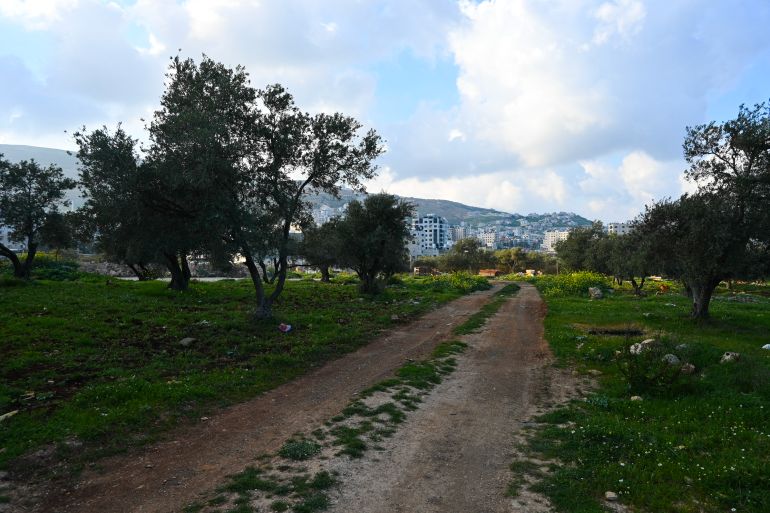
Nablus, occupied West Bank – Islam Madani says families and young people from the Askar refugee camp would once congregate beneath the olive trees on the slopes of Tel Askar, a hilly area in the north of the occupied West Bank which is home to the camp.
“But most won’t go anymore because soldiers shoot so many people there,” the 32-year-old father of two told Al Jazeera.
Recommended Stories
list of 4 itemsend of list
Amjad Refaee, director of the Askar Social Development Centre, says memories of those killed by Israeli soldiers haunt one of the only green spaces in the camp where children can play.
The military has killed three teenagers there, and maimed many more since October 7, 2023, when Hamas led an attack on Israel, and Israel began its genocidal war on Gaza.
The soldiers no longer fire rubber bullets or aim below the waist, “they shoot to kill, or cause disability”, Refaee told Al Jazeera.
“We are animals to them,” he added. “They terrorise us, kill our young people in cold blood, and keep us here in a prison.”
People from the camp say Tel Askar has become the entrance point used by invading Israeli soldiers as they infiltrate the narrow and dilapidated streets of the camp, often via the illegal settlement of Elon Moreh that looms over the east of Nablus.
It was on the hill where soldiers shot 18-year-old Amir Othman last January, leaving him with a disability. The shooting was almost at the exact spot where his childhood friend Mohammed Abu Haneen was killed by the army just over a year before. He was 18.
‘I asked my uncle to shoot me’
Amir was a promising footballer and dancer until Israeli soldiers shot him in the leg last January as a convoy of jeeps drove through Tel Askar.
Advertisement
He had travelled extensively performing Dabke, a traditional Palestinian line dance.
Amir, now an aspiring nurse, was hauling his wounded friend – also shot by soldiers – to safety when he was hit by a bullet.
“My kneecap and my thighbone were shattered,” he told Al Jazeera.
“I couldn’t feel my leg anymore, so I thought I had lost it.
“The blood felt like boiling water spilling out of my leg.”
Soldiers blocked ambulances from reaching Amir as he lay bleeding. Healthcare officials and international organisations say that has happened hundreds of times since October 7, when Israel intensified raids on Palestinian communities in the occupied West Bank, particularly refugee camps.
Amir eventually underwent four operations to help him walk again. He spent four months bed-bound, doctors tell him his mobility will never return to normal.
“When I woke up from the first surgery, I asked my uncle to shoot me, because I thought it’d be better,” he added.
“But I’m learning to accept the situation and keep living.”
Amir said he still dreams of touring, dancing Dabke and running with his friends. “But none of that is possible now,” he said.
The children of refugees
At least 13 Palestinians have been killed in Askar since Israel’s assault on the occupied West Bank intensified after October 7, according to Palestinian monitoring groups. Many others have been shot during the military’s incessant raids.
At least 157 children have been killed by soldiers or Israeli settlers in the West Bank and occupied East Jerusalem since 2024, according to data compiled by Defense for Children International – Palestine.
Israel denies targeting children, saying its military raids are necessary for security reasons, and to clamp down on Palestinian fighters.
Askar is among the most densely populated of the 19 refugee camps in the occupied West Bank. It is home to 24,000 people, packed into an area about the size of 17 football fields.
It is plagued by unemployment, and many residents live in poverty and suffer “cramped living conditions,” according to the United Nations Relief and Works Agency (UNRWA).
Refugee camps originally were makeshift tented communities intended to provide temporary sanctuary to hundreds of thousands of refugees forcibly expelled from historic Palestine in the Nakba of 1948, when the state of Israel was established.
But as the decades passed, and hopes faded for the refugees to return to their homes faded, the camps became overcrowded, built-up areas.
Amir sat in the camp’s newly established emergency health centre with his friend Yamen Habron, aged 17, and Islam Madani, aged 32. They were also shot by the Israeli military in the last three years, leading to disabilities.
Advertisement
The trio were insistent that no one, no matter their age, is safe when the military storms the camps. They noted the case of 14-year-old Iyad Shalakhti, who was shot dead by soldiers on July 9, 2025, in Tel Askar.

‘No safety’
Islam Madani said he forbids his children – as do many other parents – to play outside in the refugee camp. His four-year-old son energetically patrolled the meeting room where Al Jazeera spoke with his father.
The young boy cries uncontrollably every time the military enters the camp because he knows what soldiers did to his father.
He was shot by a sniper at 7:30 am on January 9, 2024 as he rushed to clock in at the factory where he worked.
“I lost so much blood,” he said. “The paramedic did everything he could to keep me conscious, in case I didn’t wake up.”
He recovered from multiple major surgeries. The shot, he says, went in the back of his knee and out the front, leaving gruesome scars.
He said the army now invades at any time of day and doesn’t distinguish between those fighting against the Israeli occupation and peaceful, unarmed residents.
“Anyone can get shot,” he said. “There is no safety. I was just walking to work.”
Islam is no longer employed at the factory, and cannot stand for long before pain overwhelms him.
He’s been seeing a psychologist to help him process what he sees as the shame of not being able to provide for his family since he was shot and left jobless.
“I became more aggressive, angry and impulsive since being shot,” he said. “I pray to God that better is to come.”
Deliberate?
Yamen dropped out of school very young to support his family through hardship.
The timid teenager was shot twice in the side by soldiers who surrounded him as he reached his front door after returning from the gym. One bullet became lodged in his hip, and the other sliced through his side.
He told Al Jazeera that all he could remember was his father and brother desperately trying to keep him conscious while he waited for the ambulance, which was being blocked by army jeeps.
“All I could remember were my mother’s cries,” he said.
He spent 14 days in intensive care, and doctors spent two days removing the bullet shrapnel. He now walks with a limp.
Centre director Amjad Refaee has known Islam, Amir, and Yamen their entire lives. He says none of them has ever been active in Palestinian fighting groups, as many are in refugee camps.
As they discussed their futures, the young men questioned whether the soldiers had intended to kill them, or whether they aimed to deliberately leave them disabled – to deepen the misery of their lives in the camp.
“Kids in Askar wake up to the occupation,” Refaee said. “They don’t have playgrounds. They can only play football in the streets. Many are forced to work from a very early age.”
Refaee said that his purpose is to keep young people alive by giving them hope, because they are “the future of the country”. “Otherwise we will disappear,” he added. “Which is what Israel wants.”
Disclaimer : This story is auto aggregated by a computer programme and has not been created or edited by DOWNTHENEWS. Publisher: aljazeera.com






