

At Page 27 Cafe, down an Alice Springs laneway, ceiling fans cool tables that buzz with friends catching up over coffee and tourists lingering over breakfast, as the morning sun slants between shade sails. It could almost be Melbourne, if Melbourne had this much sun.
It’s definitely not the Alice Springs I’d expected. Crime, alcohol-fuelled violence, trouble involving young people and curfews have dominated headlines in recent years, and contributed to a perception that Alice – Mparntwe to its Arrernte traditional owners – is somewhere travellers should avoid.
Over breakfast, I tell my travel companion, who grew up here, that I’m surprised by how at ease I feel. “I feel safer here than I do in Sydney,” she replies. She acknowledges the town’s challenges, but points to the Strong Grandmothers Group of the Central Desert as an example of community-led solutions. The women have spent years supporting vulnerable children on Alice’s streets and have built trust and respect in areas where police have often struggled.
Around the corner, we duck into Red Kangaroo Books on Todd Mall, its shelves stacked with Indigenous histories and desert writing.
Outside, the mall is undergoing a multimillion-dollar makeover, while galleries including Papunya Tula Artists and 8 Hele Gallery exhibit the town’s extraordinary creative talent. Further afield, Tjanpi Desert Weavers transform native grasses into sculptures, while Bindi Mwerre Anthurre Artists supports Aboriginal artists living with disabilities.
Sign up for the Traveller Deals newsletter
Get exclusive travel deals delivered straight to your inbox. Sign up now.
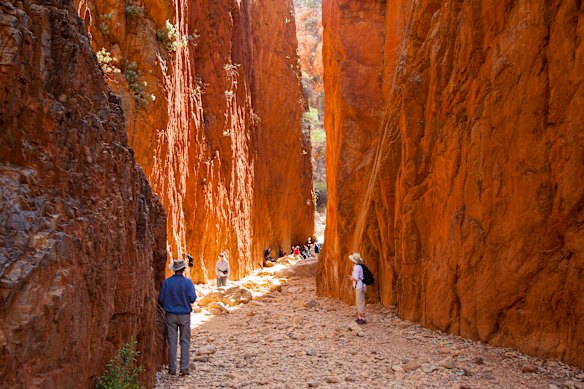
At Angkerle Atwatye (Standley Chasm), Arrernte guide David McCormack introduces us to the landscape his family has cared for over generations. Along a bush track, he points out native hops, bush banana and bush coconut, cracking one open to reveal the tiny edible larvae inside. Entering the chasm, the temperature drops. He tells us how his ancestors found refuge from the desert heat here and that ancestral stories connect this place to four different nations.
“Every time I’m here, the significance behind the place, and what it means to my people and my family, is humbling,” he says.
After sunset, we swap ancient landscapes for Bojangles, an outback saloon heaving with jackaroos and jillaroos fresh from a rodeo, in oversized hats and cowboy boots. With Alice’s strict alcohol controls, ID checks are commonplace. But at 42, it’s been a while since I’ve been carded, so I’ve left mine behind. The bouncer looks me over. “You’ll be right. Just don’t glass anyone, OK?” Inside, everyone seems relaxed, drinking and playing pool. It’s only when I notice barbed wire fringing the courtyard fence that I think again about his joke.
At Simpsons Gap the next morning, British artist Anna Dakin gives us what she calls a “speed course in painting”. Dakin moved to Alice 12 years ago, after hiking the Larapinta Trail with watercolours and glittery Doc Martens. Painting, she says, forces us to pay attention. “The challenge is to override our mind’s natural belief that it knows what it’s looking at, before it’s digested the visual information.”
As we paint gum trees and rock formations, our chat moves to Alice’s reputation. “When I first arrived here, I felt more comfortable than I had anywhere in the world, and safer too,” says Dakin. She still does. “This is a place that holds so much cultural significance, and there are so many more interesting things to talk about here than crime.”
We chat about the irony of how, amid mounting global crises, we pay so little attention to the knowledge systems that have sustained Aboriginal cultures for millennia. “There are ways to interact with ancient knowledge systems that have allowed people here to thrive for a very long time,” Dakin says.
Her words are still with me when, that afternoon at Olive Pink Botanic Garden, I climb through native gardens as black-footed rock-wallabies appear among the boulders. From the top, I look across Alice and the ranges beyond, struggling to reconcile the captivating place I’ve actually seen with the one I’d been conditioned to see by headlines and YouTube.
Later, at Earth Sanctuary Observatory, Saturn hangs in the darkness, its rings impossibly clear through a giant telescope. Beneath the desert stars, our white-bearded guide Andrew, nicknamed “the wizard”, teaches us to find our bearings by the Southern Cross.
On my final morning, I set out alone towards Emily Gap, reluctant to leave and keen to squeeze in one last adventure. For two hours I walk through red ranges and spinifex, with nobody else in sight. Until, that is, I notice a snake trail curling through the red dirt ahead. Of all the things I’d been warned about in Alice Springs, somehow nobody had mentioned those.
DETAILS Qantas flies to Alice Springs from major Australian cities, with connections via its domestic network. See qantas.com; DoubleTree by Hilton is about two kilometres from the centre of Alice Springs with two restaurants, a bar and pool. Rooms from $188 a night. See hilton.com; northernterritory.com
The writer was a guest of Tourism and Events Northern Territory
 Nina Karnikowski is a travel writer focused on sustainability, and the author of two books including Go Lightly: How to Travel Without Hurting the Planet.Connect via X.
From our partners
Disclaimer : This story is auto aggregated by a computer programme and has not been created or edited by DOWNTHENEWS. Publisher: www.smh.com.au





