Flying cars are once again taking over the internet, with Tesla’s plans fuelling conversations about a future where people could travel through the air instead of sitting in traffic. But in Almora, Uttarakhand, an innovator has spent 13 years working towards a similar idea, driven by a problem much closer to home.
Ravi Tamta grew up in the mountains of Kaflikhan village near Jageswar Dham, where reaching a hospital could mean hours on winding roads. He began wondering if there was another way to travel through the hills, one that did not depend on roads or require an airport.
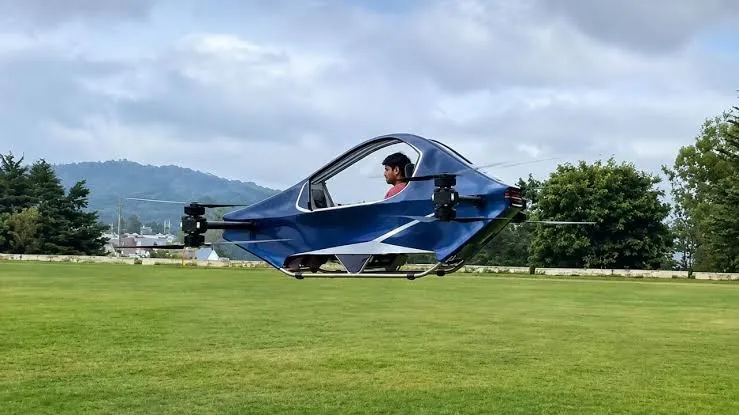
That question led him to build HAPIDA SKYNeX, an electric flying vehicle prototype that can take off and land vertically. After years of experiments, the vehicle completed its maiden test flight in August, taking off from an army helipad in Almora and remaining airborne for nearly a minute.
A mountain problem sparked the idea
For people living in hilly regions, distance is not always measured in kilometres. Winding roads and difficult terrain can turn a relatively short journey into a long trip, particularly when someone needs medical attention.
Tamta began exploring whether a flying vehicle could help people cover such distances faster. His idea was to develop a vehicle that could rise vertically, travel over difficult terrain, and land without needing a runway.
The aim is to make air travel more accessible in hilly regions, particularly during medical emergencies and in areas that are difficult to reach by road.
Developed under his venture, Hapida Sky Private Limited, the HAPIDA SKYNeX combines modified, scaled-up multirotor drone technology with an electric vertical take-off and landing (eVTOL) system. In simple terms, it uses the same basic principle that lets a multirotor drone take off and hover, but applies it to a prototype designed to carry a person.
Unlike conventional aircraft that need a runway to gain enough speed for take-off, an eVTOL vehicle is designed to lift off and land vertically. This could make the technology particularly relevant to mountainous areas, where finding suitable space for runways can be difficult.
How the flying vehicle works
HAPIDA SKYNeX uses multiple electric motors and propellers mounted on external arms to generate lift. Working together, these components are designed to raise the vehicle off the ground, sustain a hover, and help control its movement through the air. This multirotor arrangement is similar in principle to the technology used in drones, although scaling it up to carry a person presents additional engineering and safety challenges.
The prototype also features a lightweight frame, a cockpit designed for a single pilot and a transparent canopy. Its electric propulsion system is battery-powered, eliminating direct exhaust emissions during operation.

However, its practical flight range, battery endurance, and overall efficiency will depend on factors such as the battery capacity, the vehicle’s weight, and the power required to sustain flight.
The intended use is short-distance travel across difficult terrain. According to the reported project details, a journey of around 40 kilometres that takes approximately 90 minutes by mountain road could potentially be completed in 10 to 15 minutes by air. This is an intended travel-time goal, rather than a demonstrated operational capability at this stage.
Thirteen years of learning through experiments
Tamta did not have an engineering degree or access to a fancy laboratory. Instead, he turned to the internet to learn, relying on his parents’ support and repeated experiments to develop his idea.
Over 13 years, the concept gradually took shape under his venture, Hapida Skynex. The maiden flight was an important step in testing whether his idea could work beyond the drawing board.

The prototype is still at an early stage and requires further testing. While the test flight offers a glimpse of what the vehicle might eventually do, it is too soon to know how it will perform in regular use.
Before a vehicle of this kind can be used for routine passenger travel, it would need to demonstrate reliable flight control, sufficient battery performance, structural stability and safe responses to component failures.
Operating in mountainous terrain would bring additional considerations, including changing weather, wind conditions, landing-site availability and emergency procedures.
From everyday inventions to flying vehicles
The flying vehicle is not Tamta’s first attempt at solving practical problems through invention. His earlier creations include shoes that charge mobile phones on the go, a smart walking stick for visually impaired people, a bamboo-splitting machine and firefighting equipment.

Each project began with a practical challenge, leading him to explore how a device could make a task easier.
HAPIDA SKYNeX has a longer journey ahead before it can carry passengers or help people reach hospitals faster. For now, its first flight marks a step forward for an idea shaped by life in the mountains.
As conversations about flying cars continue online, Tamta’s work offers a different way to look at the technology: not just as a futuristic mode of transport, but as a possible answer to the everyday challenges of getting from one place to another.
Sources:
‘Uttarakhand Man Conducts Test Flight Of Drone-Based Flying Vehicle: Watch’ by NDTV, Published on 8 August 2026.
‘This Uttarakhand youth built an electric flying vehicle. Here’s why everyone is talking about Ravi Tamta’ by The Times of India, Published on 7 August 2026.
Disclaimer : This story is auto aggregated by a computer programme and has not been created or edited by DOWNTHENEWS. Publisher: thebetterindia.com