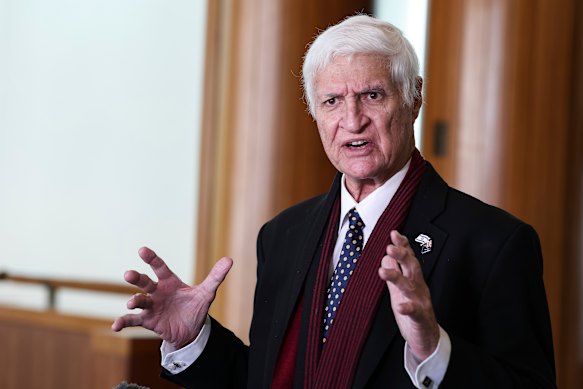
One of the more unexpected moments during my trip to Canberra for last week’s federal budget was when the member for Kennedy, Bob Katter, invited me into his parliamentary office for an interview.
The word “interview” should be used loosely because there was little of the back-and-forth conversation you’d expect from a standard politician. Rather, “the Mad Katter”, as he’s fondly known to his constituents, mostly talked at me.
While I was there to discuss key announcements from the budget handed down the day earlier, Katter was – as he’s well known for – more interested in marching to the beat of his own drum.
No matter how many times I tried to ask questions about basic everyday things that Australians were talking about – such as the cost of groceries or fuel prices – the chat simply went where Katter wanted it to go, even if it was impossible to understand how his answer linked with what I’d just asked.
It was when I raised his interest in expanding the mining sector, however, particularly in his home state of Queensland, that things got especially interesting.
Before I could ask him about his economic interest in that proposal, Katter cut me off to say, “It’s to get you enough money so that you can stay home and have some kids like every other Australian mother has done for the last 200 years. Which you can’t do now, it’s not an option that’s available to you. Whether people want to do it or not, I just want to give them the option.”
One of the things that frustrates me about what Katter said is that it’s broad enough to be both true and false at the same time.
As a woman who was working at that moment, and who had two young children at home being cared for by their dad, it was pretty awkward.
I wondered what his female staff, as well as the female colleagues he works with every day in the House of Representatives, felt about the implication that we are all there doing our jobs because the natural order of things has been disrupted and because it’s currently financially impossible for us not to be working.
One of the things that frustrates me most about the kind of statements Katter made is that even though there’s a lot you may not agree with, certain parts of the argument aren’t entirely wrong, either. It’s broad enough to be both true and false at the same time.
Katter’s assertions that more Australian women are entering the workforce instead of staying at home full-time, for example, is absolutely correct. Our full-time and part-time participation rates are as high as they’ve ever been and unquestionably higher than they were back in 1825.
He’s also correct in suggesting that money is one of the reasons people are having fewer or no children, or are returning to work sooner than they might have liked, and that parents are crying out for more cost-of-living relief. But for a very decent chunk of women, it’s certainly not the only reason.
And I have three main problems with Katter saying that Australian women have been staying at home full-time and raising kids for the past 200 years.
The first is that this implies women have always had a choice when it comes to participating in the workforce, and that we simply used to choose differently, which is obviously categorically untrue.
The second is the assertion that the declining birth rate is a new problem that’s only come about recently rather than something we’ve known about for a long time. In fact, data from the Australian Bureau of Statistics shows that national fertility rates have largely been declining since the 1960s. While the fall in births certainly will have major ramifications, it is neither new nor something that is only affecting this generation of parents or would-be parents.
The third point is that women aged over 55 are among the fastest-growing cohort of people experiencing homelessness in Australia.
This is not some weird phenomenon that demographers and economists can’t explain. It’s because the majority of women who are at such risk dedicated their lives to unpaid domestic labour such as raising children and running a household, meaning they did not earn an income, or earned a reduced income for much of their working lives. Following Katter’s “norm of 200 years” has left them without superannuation or any other substantial financial safety net, and seriously vulnerable.
As we know, the reasons people choose to have fewer children or none are deeply varied and complex. If you were to ask a roomful of women about their decisions, you’d probably find many common themes, but the weight of those factors would vary greatly from person to person.
Considerations in the decision-making process can include (but are rarely limited to): the cost of housing, education, the general cost of living, how many incomes and parents are in the household, job security or insecurity, fertility treatments and general debt levels.
Where one person might say they’ve just always known they didn’t want to have children, another might say they had once wanted four but stopped after two because it was more expensive than they initially thought it would be.
Some women might be working full-time but would prefer to move to part-time, but can’t because their employers don’t offer that kind of flexibility, or because their family can’t afford it at the moment.
Many women, like myself, aren’t only working for financial reasons but also because we find work to be deeply rewarding, mentally stimulating and a core part of our identities. I imagine that for similar reasons that’s why, despite being eligible for retirement, Katter himself still chooses to work at the age of 80.
The point is: the significance of each different factor in each person’s decision is not easy to determine because it’s probably different for every person.
Finally, Katter said he wanted to make it more affordable for women to have the choice. That is a good thing. But I’d argue that the choice shouldn’t just be extended to women.
The number of fathers choosing to stay at home and take parental leave is on the rise – up from 12 per cent in 2022 to 17 per cent in 2025. Studies show – and I know this from my own experience because my husband took parental leave with both of our children – that kids who have a stay-at-home father, even for a short period of time, are likely to have better long-term emotional and social outcomes, and relationships among parents can be strengthened thanks to better domestic labour splits.
If this is about outcomes that are best for the future of the nation, women surely levelling the playing field so that men, women and children all have more freedom of choice should be what this is really about, right? Perhaps I’ll be able to ask Katter the next time I’m in Canberra.
Victoria Devine is an award-winning retired financial adviser, a bestselling author and host of Australia’s No.1 finance podcast, She’s on the Money. She is also founder and director of Zella Money.
- Advice given in this article is general in nature and is not intended to influence readers’ decisions about investing or financial products. They should always seek their own professional advice that takes into account their personal circumstances before making any financial decisions.
Expert tips on how to save, invest and make the most of your money delivered to your inbox every Sunday. Sign up for our Real Money newsletter.
Victoria Devine covered the Federal Budget as part of a group of podcasters and other new media outlets granted access by the government.
 Victoria Devine is an award-winning retired financial adviser, best-selling author, and host of Australia’s number one finance podcast, She’s on the Money. Victoria is also the founder and managing director of Zella Money.
From our partners
Disclaimer : This story is auto aggregated by a computer programme and has not been created or edited by DOWNTHENEWS. Publisher: www.smh.com.au