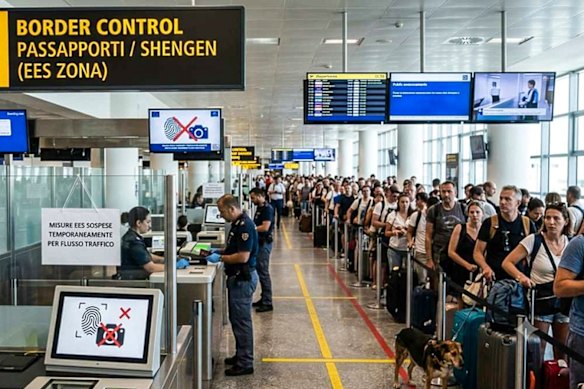
Europe’s elaborate Entry/Exit System (EES) at passport control has been plagued with issues – and they still haven’t been fixed. The system even fails in its primary purpose: to track movements across the borders of the Schengen Area.
It’s a problem that made a British traveller be turned around and deported from Italy because the EES incorrectly stated they’d overstayed their welcome on a previous visit. Just one missing immigration record, through no fault of the traveller, can send a carefully planned trip into chaos.
Imagine the horror when checking my own immigration history and finding that in June, my exit from Italy wasn’t processed correctly. According to EES, I was still there: and had now exceeded the 90-day limit for Australian visitors across any 180-day period.
I only make the discovery out of sheer curiosity, when planning another trip and entering my prospective dates into the European Union’s official website. It suggests that my travel plans are “not OK”… all because somebody in Rome didn’t press the right button before I boarded my Qantas flight to Perth.
Apparently, I can contact the Italian National Police and request a correction, but an update can take 30 days. That’s no use: my next trip is in a week. Sorry Europe, but I’m not changing my plans just because you replaced the trusty passport stamp with a dodgy computer system. I’ve done nothing wrong – I’m coming whether you like it or not.
Sign up for the Traveller newsletter
The latest travel news, tips and inspiration delivered to your inbox. Sign up now.
Expecting a battle at the border, I arrive prepared. I start by collating itineraries from my earlier European travels. Fortunately, I’m a stickler for keeping boarding passes: always handy for travel insurance claims, chasing down missing frequent flyer points, or in this case, proving where I was – and where I wasn’t.
I also gather the same documents from other recent overseas travels and even retrieve my immigration record from the US Customs and Border Protection, showing the dates of a Stateside visit made after that trip to Italy. If Europe tries to turn me around, it won’t be without a fight.
My trip starts with an uneventful visit to London, then a quick 41-minute flight from Heathrow to Brussels. While the destination is pure coincidence, what better place to clear things up than the birthplace of the EES?
I’m expecting my paperwork may take time to peruse, so I pack extra water in anticipation of a slight delay. But stepping off the aircraft in Brussels, I’m greeted by a 2½-hour queue at passport control. Whether it’s your first visit since EES or you’re already in the system (and apparently, still in the country), everybody who doesn’t have a European passport joins the same queue.
It takes almost two hours before the passport desks even come into view. Meanwhile, camaraderie builds in the line. Strangers start sharing lollies and snacks. Some find sources of humour, like measuring how long it would have taken to drive from London instead of standing in line. My role in the troop becomes that of timekeeper, announcing updates as we pass milestones (two hours gets a grumble).
As we get closer, there’s a new source of comedy. The EES kiosks – which travellers would normally visit before the passport desk, to pre-process their arrival – weren’t merely switched off, they were properly broken.
One kiosk displays an error message: the error being that it could not find the correct error message for a second problem. Another kiosk is trying to print to a non-existent fax machine. Every screen brings a new source of laughter and bewilderment.
Those in line are at least in good spirits, and everybody respects the queue. Solo travellers in search of a restroom simply say “excuse me” to the crowd and return to the same spot without any heat. We’re all in this together.
Finally, I reach the counter and tackle the problem head-on. “I don’t know if the EU website matches your system, but it looks like Italy might not have recorded my last exit properly, back in June.”
“Oh yes,” the officer replies. My preparation just saved the day. Soon enough, he’s fixing my record and venting his own frustrations. “This keeps happening. This is why the line is so long, it happens a lot. Sorry about that; welcome.”
Of course, my flight landed in the morning and it’s now the afternoon, so the arrival screens are devoid of the baggage belt number – and staff are no help. That’s a lesson to listen to your airline’s announcement closely on landing (I napped through it). I then roam around and eventually spot my bag on a belt marked “Etihad, Abu Dhabi”. Not even close.
If you can, enter Europe through a quieter airport and check your own Schengen status before you fly. It’s also smart to pack snacks and a drink in case queues are chaotic. If your file has the same problem as mine, the preparation may be a hassle, but it sure beats getting deported because the computer says no.
 Melbourne-based journalist and columnist Chris Chamberlin enjoys maximising his points to travel the world in comfort and, as a points coach, helping others to do the same. From showering on a plane to stretching out in a double bed in the sky, Chris knows all the tips for flying in style without breaking the bank. His adventures have taken him on almost 1000 flights aboard more than 80 airlines, earning lifetime frequent flyer status along the way. Follow him on Instagram @chris_chamberlin.Connect via email.
From our partners
Disclaimer : This story is auto aggregated by a computer programme and has not been created or edited by DOWNTHENEWS. Publisher: www.smh.com.au