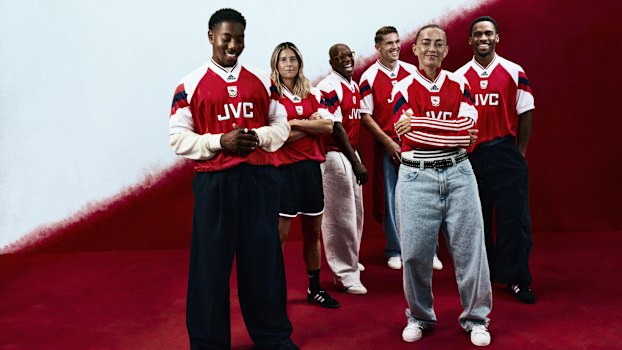
Their boxy, vibrant silhouettes were once the domain of diehard fans fuelled by fond memories of beer-soaked nights in cacophonous suburban stadiums in the 1990s. Today, retro football jerseys are a hot fashion item, highly sought after by both women and men flaunting them in hip bars, on runways, and across social media feeds.
It’s a craze fuelling a boom for Australian shirt dealers, while globally, the trend has attracted private equity dollars, pushing some vintage kit businesses toward $100 million valuations.
Surging demand stems from a broader appetite for nostalgia in fashion and a desire to express belonging, experts say. But this thriving secondhand ecosystem operates distinct from the multi-billion-dollar industry that fuels the shirts’ initial creation.
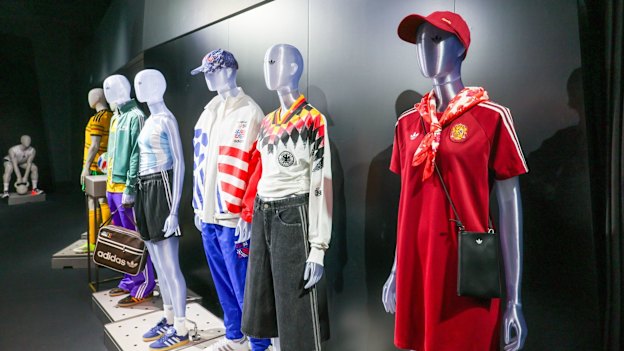
For decades, sportswear giants have paid astronomical licensing fees to produce a team’s merchandise line – Nike, for example, currently pays European giant FC Barcelona FC a reported €127 million ($206 million) per season – with clubs receiving only a slim cut of each new shirt sold to fans.
Modern shirts tend to retail for about $130 each, with extra fees to put a specific player’s name and number on the back.
But while official replicas fund modern football, the second-hand trade has exploded from a niche fan community into a multi-million-dollar global market.
Retro shirts retail anywhere from $100 up to $500 depending on rarity and era, while iconic match-worn jersey can fetch millions at auctions. The shirt that Argentina great Diego Maradona wore when he scored the infamous “hand of God” goal against England in the 1986 world cup set a record when it sold for £7.14 million ($13.5 million) at auction in 2022.
Several factors have driven this sport-fashion crossover, says Emily Brayshaw, a lecturer in fashion and design history at the University of Technology Sydney. She points to a desire for quality over fast fashion, the rise of athleisure, and blurred gender lines.
“They’re incredibly comfortable, breathable, and you can dress them up,” she says. “If [men] don’t want to be seen as too feminine, you can still wear a pink or mint shirt, and because they’re associated with football, there’s a masculine element.”
Brayshaw adds that the oversized, colourful designs of the 1990s offer an edge in a mainstream fashion landscape that has gone beige. Nostalgia for bygone sponsors and old fonts adds aesthetic appeal, tying into the current early-2000s Y2K revival playing out and the marriage of football and style spearheaded by David Beckham.
For football supporters, it can mean connecting with their team’s heritage. For others, retro jerseys can be a way to engage with nostalgia for a bygone era, Brayshaw says. “They’re a window into the past.”
These dynamics are clear online. A recent Pinterest summer trend report finds that “football shirts take the lead as the hero top,” with searches for how to style national team shirts surging by up to 840 per cent.
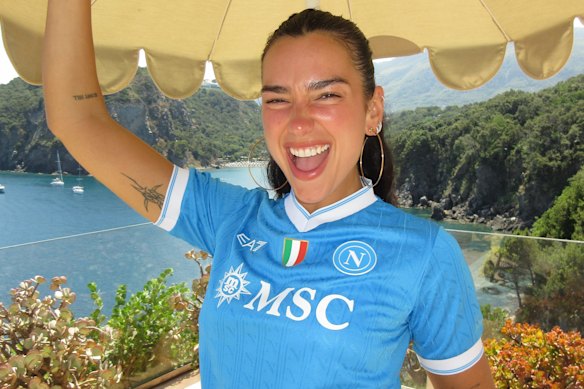
Images of celebrities like Kim Kardashian and Dua Lipa wearing retro jerseys have propelled the shirts into the mainstream.
The jersey phenomenon is so advanced that even band and restaurant merch is now being released in the style of collared football shirts, with logos in place of a club crest.
But there’s nothing like the real thing. Fashion resale apps like Depop have reported a 77 per cent spike in jersey searches between 2024 and 2026, while eBay has recorded a similar jump for vintage Socceroos and AFL gear. “Football brings people together and gives us a chance to proudly support that community,” says Peter Freestone, eBay’s director of categories.
Paul Blake, a self-described football romantic, launched retro shirt retailer PFC Vintage in 2019 and has seen it boom into a physical shop, fuelled partly by the ‘blokecore’ trend.
“I’m not a fashion-forward guy, I got into this because I’m a football fan, but we’ve stumbled into the fashion space now, and we’ve seen that these customers are willing to spend,” he says. Clubs now release a new home, away and third kit every year, which Blake believes can exhaust fans.
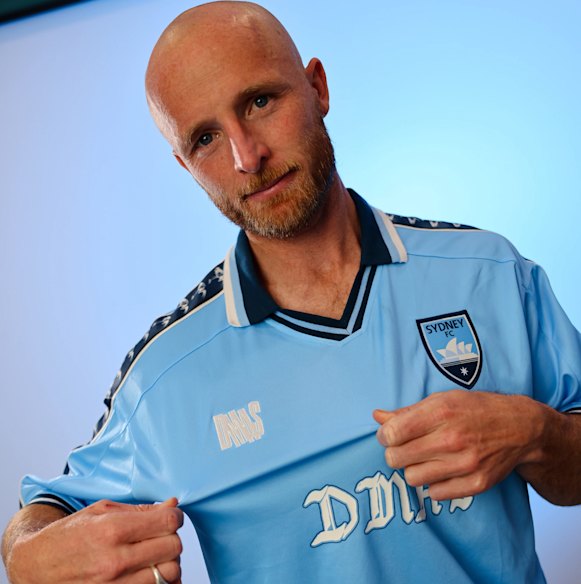
Blake must painstakingly hunt down all of this stock. To manage the risk of ending up with stock that won’t sell, he focuses on kits from the 1980s, 90s, and 2000s – the aesthetic he believes is the current “sweet spot” for both diehard fans and fashion buyers. “It’s supply and demand, and the demand is very much here right now. But supply is limited, there’s no manufacturer to order from,” he says.
To capitalise on this shortfall, clubs and manufacturers such as Nike and Adidas are now re-issuing popular heritage shirts, a trend seen locally with sold-out heritage NRL jerseys and Australian-made vintage AFL wool guernseys.
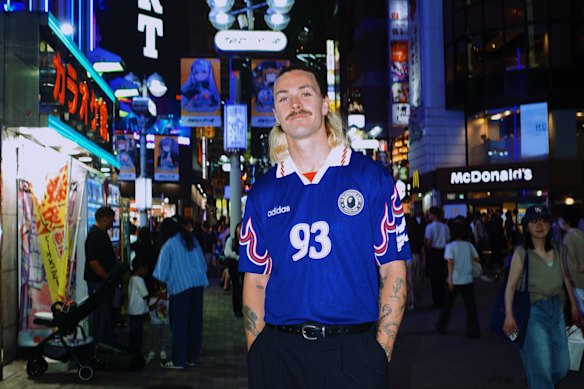
International dealer Classic Football Shirts is perhaps the industry biggest player, growing from a Manchester student dorm online operation in 2006 into a global powerhouse with physical stores in the UK and US.
In May 2024, American the private equity firm Chernin Group took a minority stake in the company with a £30.4 million growth equity investment. Analysts have valued the business at approaching £50 million ($94 million).
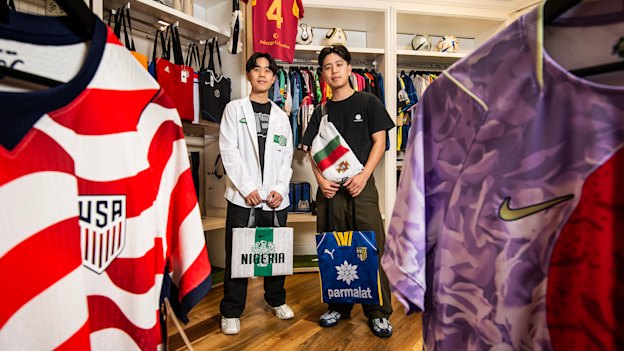
Back home, Brisbane start-up Unwanted FC is turning heads around the globe with its very different approach. While they collect and sell vintage shirts, its founders, twins Kevin and Keith Chan, were inspired to upcycle unused or damaged kits after seeing the football industry’s wastage firsthand as interns at Adidas’s headquarters in Germany.
“Our jobs as interns were to destroy samples, we couldn’t even donate them,” says Kevin. They spoke about the conundrum with their aunt, a retired tailor, who helped them turn an old kit into a tote bag.
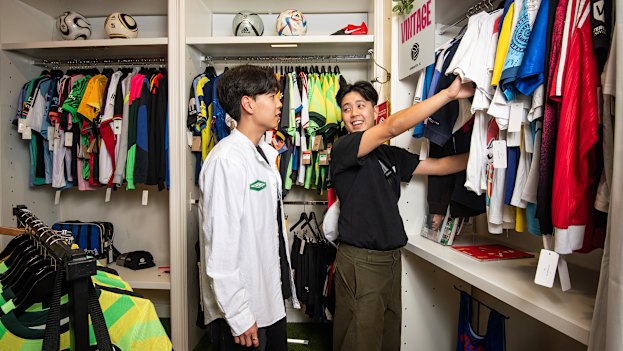
After launching in 2018, their business has grown to upcycle kits into boot bags, toiletry kits, hats, women’s crop tops and shirts with shirring, and now, business shirts and ties. They recently opened a concept store in Sydney. Manipulating the stretchy fabric is tricky, requiring several experienced garment technicians to sew the designs together.
The Matildas’ popularity has generated immense interest from women looking to signal their affection for the game with unique items. Players including Ellie Carpenter modelling their upcycled garments on Instagram has boosted this and about half of Unwanted FC’s customers are now women, the brothers say.
“They think they can get more use out of a side bag or a tote bag than a jersey … it’s a different way to wear, it’s [more] accessible.”
But altering jerseys can come at an emotional cost. At one point, the brothers pleaded with a customer who had sent in a rare 90s Arsenal sweatshirt to reconsider their request for it to be chopped up. “We just couldn’t cut it up, so instead of taking her money, we bought it off her,” says Kevin.
Their work has caught the eye of global football royalty. Kevin recalls the moment he saw Spanish footballer and fashion icon Hector Bellerin photographed holding one of Unwanted FC’s reworked items. “I couldn’t sleep that night, I literally thought I was dreaming,” he says.
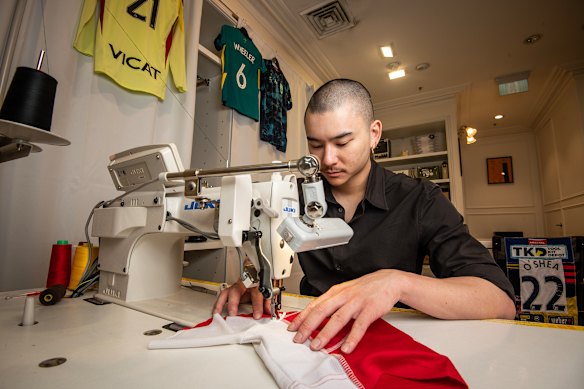
Unwanted FC now collaborates with professional clubs including Tottenham and Chelsea, alongside Australian sporting teams. Few realise that when players are filmed walking off team buses ahead of World Cup matches or Premier League games clutching vibrant boot bags refashioned from their jerseys, those items were hand-sewn in a Brisbane studio.
“It always does hit me with a lot of dopamine when I see [Socceroo Nestory] Irankunda rocking our boot bag,” Kevin says. “It’s crazy. Locally made in our studios and then worn on the global stage at the World Cup.”
The Business Briefing newsletter delivers major stories, exclusive coverage and expert opinion. Sign up to get it every weekday morning.
Disclaimer : This story is auto aggregated by a computer programme and has not been created or edited by DOWNTHENEWS. Publisher: www.smh.com.au