I recently took a trip to Ping’s PLD Fitting Lab at their HQ in Phoenix, Ariz. and quite honestly had my mind blown.
When developing their new Scottsdale TEC putters, Ping utilized studies in ‘Quiet Eye’ theory to help develop their new Eye Q alignment aid. The aid has since gone on to give Tony Finau his first ever-strokes gained putting lead in an event, as well as powering Wyndham Clark to a few wins this season. The question is, what makes the Eye Q alignment aid so intriguing? I found out with Ping’s Erik Henrikson.
As explained in the video, the new Scottsdale TEC Eye Q alignment aid design comes from the team studying ‘Quiet Eye’ theory. The study involves using eye-tracking glasses to examine what a golfer does for the two second duration before they begin their putting stroke. By studying a wide range of putters with a wide range of different alignment aids they settled on their Eye Q alignment design that incorporates a very small front sight dot married to a crown line. (Here’s a great article on Quiet Eye in sports that you can read here.)
Quiet Eye Theory is something that’s vastly used outside of golf and with the help of eye-tracking glasses like the Tobii glasses I wore in the video, it’s easy for engineers and scientists to gather data on humans’ ability to focus on their objective or target. I’ve actually seen this tested when I used to work in the firearms industry and it’s something I’ve always found rather fascinating.
As a competitive handgun shooter, we used to watch video replays of how the best shooters in the world would blaze through stages while wearing eye-tracking technology to see how they approached a multi-target stage. Understanding how people focus, and more importantly what they may be distracted by, can be critical information. In the video you hear Erik tell us that as they started to go through their testing they realized that something as simple as the placement of the shaft band sticker was affecting how players were or weren’t able to focus on their putt.
I went into this test really skeptical, but also recognizing that as an engineering-first company, Ping was probably going to prove me wrong pretty easily. I mean how much can an alignment aid design actually help a golfer focus on what they need to do? Quite a bit as I found out.
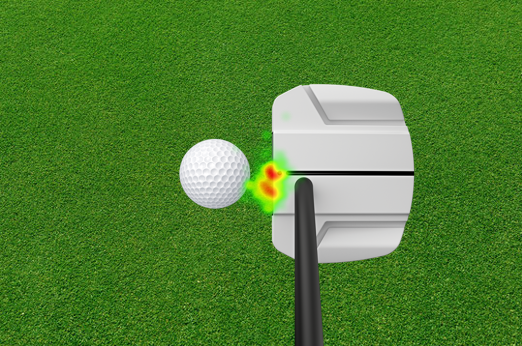
My eye-tracking heat map with the Scottsdale TEC Ally Blue Onset.
Ping Golf
I actually prefer to not have any alignment aids on my putters. If anything I just want a nice clean sight dot. Which it turns out, actually makes a ton of sense. With a mallet putter that has long alignment lines, I just don’t feel comfortable standing over the ball. There’s just too much going on. But with the small sight dot on the Scottsdale TEC I was pleasantly surprised by the comfort it provided, and there was no arguing with the eye-tracking data.
My eyes were all over the place without any alignment. It seemed like I was searching, and ended up sort of focusing on the golf ball itself. With just a standard line, my eyes got a bit more focused to the center, but still searching for a landing spot between the face and the ball. With the Eye Q alignment aid of the Scottsdale TEC, my eyes were dialed on the small sight dot that breaks up the long crown line.
Yet again, Ping delivers on it’s promise of engineering and science. Like I said above, I can’t say I’m surprised. There’s so much going on inside those walls at Ping HQ, and every trip I take I learn answers to questions I didn’t even know I was supposed to ask. Now the question is, which Scottsdale TEC putter could actually end up in the bag for me? Tony Finau is putting better than he ever has, and Wyndham Clark is winning … so there has to be something there!
<figure class="youtube-facade" data-content="
“>
Disclaimer : This story is auto aggregated by a computer programme and has not been created or edited by DOWNTHENEWS. Publisher: golf.com