‘I was angry at my husband – I didn’t know he had dementia’
-
Published
Helen Beaumont spent years arguing with her husband before realising he had a terminal illness.
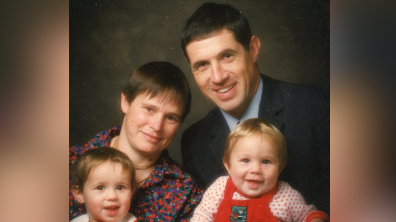
Helen, who lives in Manchester, married Clive when she was 21 and the couple had their two children two decades later.
While she expected parenthood to change things – when elements of Clive’s personality appeared to shift she spent years frustrated.
She wondered why he had stopped listening, had become unreliable, was unable to get a job and had been diagnosed with depression.
About five years later, when Clive was 46, he was diagnosed with young onset dementia. He died aged 51.
Helen, now 75, said if Clive had received an earlier diagnosis they could have had “at least two years when we weren’t fighting all the time”.
 Image source, Helen Beaumont
Since Clive’s death in 1999, Helen has been working as a dementia researcher, raising awareness of his condition and continuing his legacy through her charity, The Clive Project.
She continues to tell her story because there is still “more to be done” to help dementia patients and their families, she said.
Helen described her late-husband as a calm, level-headed and “very active guy” who used to run marathons, even “before it was popular”.
“Clive was unflappable,” she said.
“He reckoned he failed if he lost his temper.”
But as Clive approached his 40s things began to change.
“You can’t really tell at what stage somebody’s behaviour changes,” she said.
“Younger people in particular are always going to be difficult to diagnose.
“And he covered up some things. He never admitted to me that he was having problems with reading and writing.”
While Helen had never before heard of dementia in younger people, she said she “knew there was something wrong”.
“I would make plans and he would forget he was looking after the children,” she said.
“We had very many arguments about it.
“He said, ‘I’m just growing old’ – and he was early forties then.”
 Image source, Helen Beaumont
Clive was made redundant when he was 44 and after taking on odd jobs, he struggled to get another permanent role.
“I had to fill in his job application forms,” Helen recalled. “He couldn’t do it.”
Helen said Clive’s symptoms began to lead to tensions between them.
“He went shopping, he bought things like cream and chocolates instead of fish fingers and bread,” she said.
“And I just couldn’t understand it.
“I was cross with him – really cross with him for quite a lot of the time.
“We could have a conversation and then it was like it had never happened.”
“I didn’t know it was dementia.
“With hindsight you think, ‘How could I have been so silly?’.
“But I talked to a medic friend and I said, ‘I think there’s something wrong. He might have something like dementia’.
“And she said he couldn’t possibly – not at his age.”
 Image source, Helen Beaumont
Finally, when Clive was 46, he was sent for neurological tests.
“Clive was never depressed,” Helen said. “The symptoms had been confused.
“For a long time they refused to admit that a healthy man in his early 40s could have dementia.
“Eventually he got to see a neurologist and six months later I was told over a telephone call that he was very sorry to say my husband had pre-senile dementia, [as it was then referred to].
“There was no treatment and very little support.”
Young Onset Dementia
-
Dementia is associated with an ongoing decline of brain functioning
-
Symptoms can include memory loss, slower thinking speed, and lower levels of understanding, judgement and mood, according to the NHS, external
-
The condition is often associated with old age, but according to Dementia UK, external, 7.5% of people with dementia in the UK have young onset dementia, meaning their symptoms began below the age of 65
-
Young onset dementia often develops in people between the ages of 45 and 65 but can affect people of any age
 Image source, Helen Beaumont
For about a year Helen balanced her job with raising her then three and four-year-old children – while also caring for Clive.
“I just had three children,” she said. “Two of them I could pick up when I wanted them somewhere where they weren’t. And Clive, I had to cajole along.”
Helen said the family were able to do normal activities like going to the park or the cinema for some time – but then Clive became more difficult to care for.
“There was a time where we were on the M14 and he tried to get out of the car,” she said.
“And in he last couple of years he could be quite aggressive.”
She said when he left the house and went missing she knew he would need full-time care in a residential home.
“Fortunately, somebody noticed how uncomfortable he was walking and asked him in for a cup of tea and then got in touch with the police,” she said.
 Image source, Helen Beaumont
Helen said she felt “fortunate” that the NHS had covered the costs of social care for Clive.
Nonetheless, finding care for Clive was not easy.
“He was moved three times,” Helen said. “And as he got worse, it got more difficult for them to manage him.
“Looking after somebody like Clive counts as social care – not medical care.”
Five years after his initial diagnosis, Clive died in a residential home in 1999, aged 51.
After Clive died, Helen said: “I was very depressed.
“I kept going. It took me a long time to get back to having some joy in my life”
‘Years of anguish’
In 2008, at the age of 58, Helen made a big change.
“My daughter and son had left home to go to university and I moved from Oxford to Manchester to pursue a new career as a dementia researcher,” she said.
She did a PhD in 2015 and specialised in using magnetic resonance imaging to investigate brain changes in people with dementia with the aim of improving diagnosis.
“What brings me to the university every day is a determination to ensure other families don’t have to go through the years of anguish I went through with my husband Clive,” she said.
According to Dementia UK, external, the average waiting time for a diagnosis of young onset dementia in the UK is just under four years and five months – as opposed to an average of just under two years and two months for a diagnosis of dementia in over 65s.
Helen said she felt “very sad” that she had spent so many years being angry at Clive for something which had been out of his control.
“I was trying to get him to do things that he was no longer capable of doing.
“It makes me feel very sad.
“And that’s why I go out and talk to people now so that people can understand.”
Helen said awareness of young onset dementia had grown since the 90s – but diagnoses still took too long.
“It still takes four or five years to get a diagnosis and I’m absolutely certain it’s no easier now than it was back then to find suitable care, she said.
“There are treatments becoming available.
“But you will not treat it if you can’t diagnose it.
“There is more to be done.”
Get in touch
Tell us which stories we should cover in Greater Manchester
Listen to the best of BBC Radio Manchester on Sounds and follow BBC Manchester on Facebook, external, X, external, and Instagram, external. You can also send story ideas via Whatsapp to 0808 100 2230.
More like this
-
-
Published7 September

-
-
-
Published2 July

-
-
-
Published30 March
-
Disclaimer : This story is auto aggregated by a computer programme and has not been created or edited by DOWNTHENEWS. Publisher: BBC