The terror is palpable. Sydney mother Eloise* and her three children were “under a daily regime of coercive control, intimidation and punishment to enforce compliance” at the hands of her now ex-husband.
What she didn’t know then was that disentangling her family from their abuser would leave her financially crippled. The four-year court fight cost her $500,000 in legal fees.
Like many parents, Eloise fell through a legal assistance gap: she did not meet the means test for legal aid, but she could ill afford to pay for legal representation.
Legal Aid NSW has warned of a crisis in government funding, leading to cuts in its services.
From July 1, it will provide assistance in family law proceedings only to victims of domestic violence and Aboriginal people – but many parents still do not qualify for help because of means tests.
By the time of the final Federal Circuit and Family Court hearing in her case, the financial strain on Eloise was so severe she had to access her superannuation on compassionate grounds to prevent the forced sale of her home to cover legal bills.
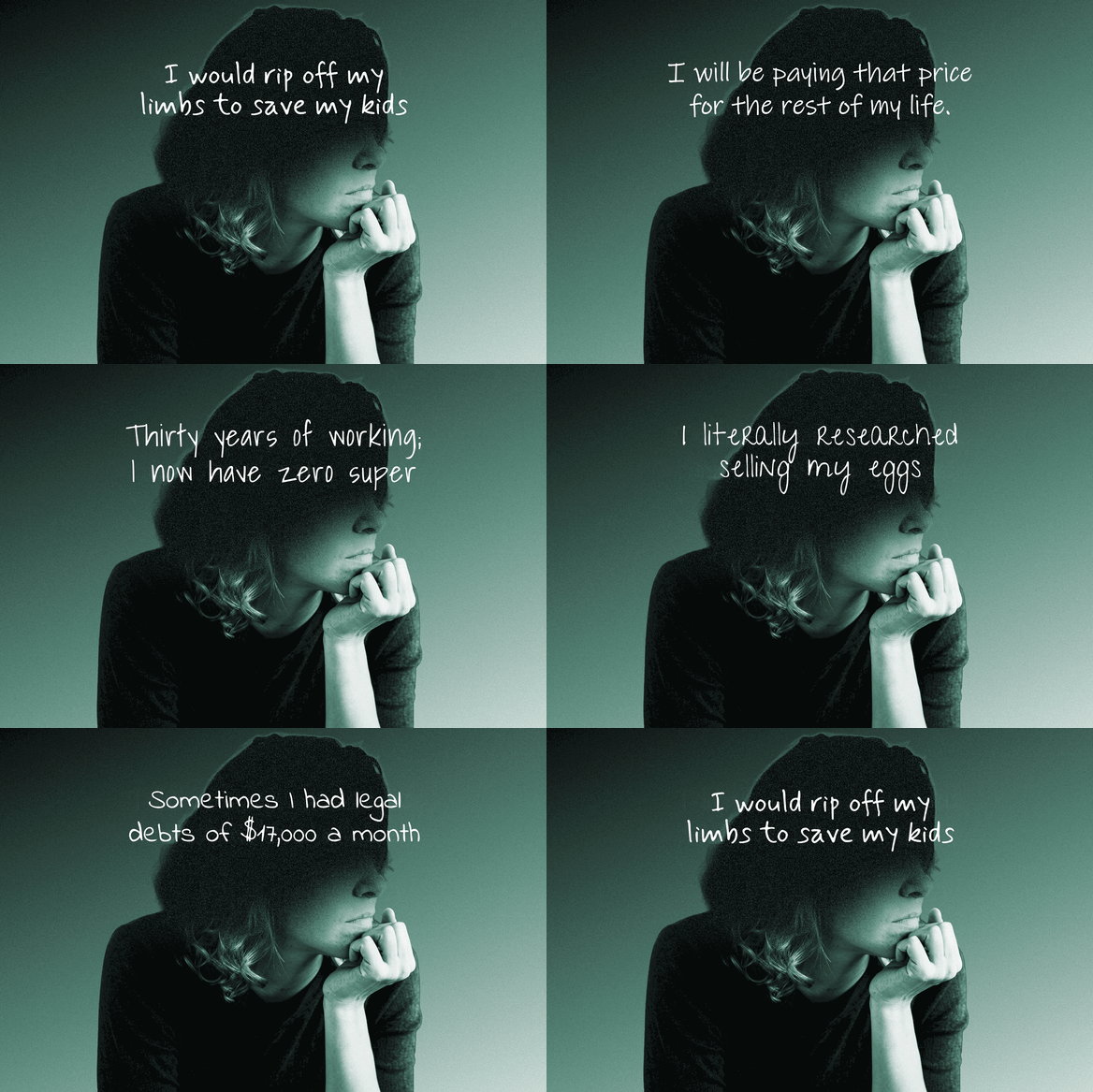
“Thirty years of working; I now have zero super,” Eloise said. “This is what happens to so many women my age that have gone through this.
“I don’t regret spending half a million dollars protecting my children … but I will be paying that price for the rest of my life. I will probably work until the day I die.”
Eloise said the system was “absolutely not workable, but there isn’t any other choice”.
“It is exhausting to have to keep proving abuse over and over again. The secondary trauma of family court proceedings takes a huge emotional and financial toll.”
Eloise’s lawyer, whom the Herald has chosen not to name to avoid indirectly identifying her client, said there was a massive gap between people who don’t qualify for legal aid and people who can actually afford legal fees.
“The system is really broken,” she said.
‘Normal people’ priced out
Steve Frost, founder of the not-for-profit Horizons Family Law Centre in Sydney, estimated that “about 70 to 80 per cent of the population … couldn’t afford a private lawyer to run a full family law case”.
“Under current funding arrangements, most people in paid employment wouldn’t qualify for legal aid,” he said. Nor would those with “any form of savings, even if they’re modest”. Home-owners, even with a mortgage, were also mostly ruled out.
“It’s normal people,” Frost said. “When we first set up [in 2005], we used to talk about our service being for ‘ladies and tradies’.
“These days … huge numbers of the people contacting us are in white-collar jobs earning objectively good incomes but without the capacity to pay $330 an hour and upwards for a private solicitor.”
Who qualifies for legal aid?
- A means test applies to all legal aid applicants in family law proceedings.
- Many people in full or part-time work will not meet the means test because the income and asset thresholds are set at a low level.
- Even if they don’t satisfy the means test, some victims of domestic violence may be eligible for a grant of aid if their personal circumstances meet certain criteria.
- This might include living in a refuge or having experienced significant trauma that affects their ability to earn income.
Frost’s centre, a registered charity, does not receive government grants and is funded by donations. Its service is not means tested, but it provides higher levels of help to people who don’t qualify for legal aid and who can’t afford a private lawyer, he said.
He was not sure if there was a magic bullet to plug gaps in legal assistance, but he said private lawyers had become “more innovative about offering what they call unbundled legal services … to provide best bang for buck”.
This involved lawyers acting in key moments, such as preparing court documents.
Frost believed that if prospective family law litigants had access to some form of government-funded legal advice about the merits of the court case they’re about to run, it might relieve pressure on the system and prompt earlier resolution of some cases.
Litigation funding by private lenders is available in some family law cases involving property, rather than purely parenting matters. The loan is repaid from the eventual payout. But the interest rates are high.
In the case of amicable splits, Frost said the government-funded AI tool Amica, developed by National Legal Aid, provided guidance about likely court outcomes and generated legal documents for a relatively low cost.
Rise in family violence cases
The proportion of parenting cases in the Federal Circuit and Family Court alleging family violence increased from 80 per cent to 86 per cent over the past four years, according to its 2024-25 annual report.
Statistically, it is more common for women and their children to be the victims of family violence by a male partner, heightening the need for lawyers in parenting and property disputes.
But most litigants, regardless of gender, face significant financial pressures in obtaining legal representation in family law cases.
‘Legal warfare’ post-separation
Eloise said it got “a thousand times harder” when she did leave her ex-husband.
What followed was legal warfare, she said, or “years of legal proceedings that I had no choice but to respond to”.

“Every single cent of my income goes towards raising my children,” the full-time worker said. “I don’t have spare money.” On some measures, she was well below the poverty line, Eloise said.
“You can’t just self-serve [in navigating family law],” she said. “It’s incredibly difficult to understand the process and the procedure.”
Crucially, her lawyer acted as a shield because her ex-husband could communicate with her only via the lawyer.
A property settlement helped her cover some legal bills, but the money ran out. Eloise said her lawyer “would try really hard to minimise costs for me, but she can only do so much”.
Her ex-husband went through a series of lawyers before self-representing “as a way to just drag things out even further”. She said it appeared to be a tactic to drive up her legal bills.
“It seems to be a playbook that all of these kinds of men all seem to have,” Eloise said.
“They’ll turn up self-represented, waste time, spend hours and hours on small things … while you’re paying $600 to $800 an hour for a lawyer, and then $12,000 a day for counsel.”
Her lawyer said the violence in this case was “some of the worst … I’ve seen in my career”, and it was quite common for an abusive former partner not to obtain legal representation to perpetrate further abuse in court.
The Family Court rarely made cost orders against parties, she said, but if a party was deliberately ramping up costs, there needed to be costs ramifications to act as a deterrent.
Ultimately, the court made orders that kept Eloise’s children safe. But it was a long and expensive road.
‘Weaponisation’ of the system
National Legal Aid executive director Yvette D’Ath, a former Queensland attorney-general and justice minister, said it was clear the family law system was weaponised in some cases to further traumatise victims of domestic and family violence.
“To add additional financial strain in those circumstances is just heartbreaking,” she said.
D’Ath said the proportion of the population below the poverty line had grown, but funding had not grown at that same rate.
Previous estimates suggested only 8 per cent of Australian households would be able to access a legal aid grant. D’Ath said there was no doubt that figure had gone down further.
“It is really concerning,” D’Ath said. “We are a statutory authority; we have an obligation to deliver services to those most vulnerable in the community, but we’re not being funded to meet that demand.”
Cost of living pressures
Jacqueline Minors, principal of Minors Family Law in Sydney, said she had seen an increase in the number of clients trying to act for themselves in court to reduce costs.
Legal fees could increase very rapidly in family law cases, she said, particularly if a dispute went all the way to a final hearing.
“The number of people who can afford that is so slim,” Minors said. “Even somebody who earns $200,000 a year, which seems like a good salary … by the time you pay your living expenses, that is just not sufficient for legal fees.”
Ultimately, the cost of proceedings affected how parents could support their children financially in the future, she said.
While costs were a longstanding issue, Minors said the rising cost of living was making things a lot worse.
Minors said she had helped support many clients “along the way of self-representation”.
“They come to me for the initial advice about their entitlement … and some strategy, and then from there they’ll check in with me,” she said.
“I can give them ongoing advice on the processes. But that’s all they can afford.”
There were obvious risks with self-representation, including the difficulty of making submissions in person in the courtroom.
“They’re very serious matters. You’re talking about children; often children at risk or matters that have family violence,” Minors said.
“You’re talking about what arrangements are going to be in place for the rest of their childhood. We’re not talking about … a neighbourhood dispute.”
‘Researched selling my eggs’
Lucy* tells a similarly confronting story. She was forced to leave a volatile, toxic and abusive home with her three children.
It was the most terrifying decision of her life, the Sydneysider said. When she left, she was not even a shell of a person, she said, but a shadow of her former vibrant, spontaneous self.
“I ended up exceeding $300,000 in debt,” she said. “I really felt like I had no choice because of the safety risks to my children.
“Sometimes I had legal debts of $17,000 a month. Who can pay that? I literally researched selling my eggs.”
Owning her own home was now beyond her reach, Lucy said.
“I have to live with my mum as I can’t afford to live elsewhere on a part-time wage and with no child support with three dependants.”
Lucy’s part-time job would not cover rent, but she did not qualify for legal aid. She recalled being told that her assets – chiefly an inexpensive car she needed to drive her children around Sydney – could be sold to cover her legal bills.
Her salary was “not great, but not minimum wage, either”.
“I was in the middle somewhere,” Lucy said. “I think a lot of us in that situation are that middle worker.”
An initial estimate suggested the court process would cost her up to $180,000 in legal fees, Lucy said, but her ex-husband’s behaviour caused multiple delays. It was an ongoing nightmare, she said.
She became ill from years of severe psychological and physical distress, and she said the five-year court process “broke me in ways I’ll never recover from”.
Lucy said she tried to do things to keep the costs down, including having her lawyer vet some correspondence she had written herself.
But she could understand that for many women the cost would be too substantial, and the trauma so overwhelming, that giving in to their former partner’s demands would seem the only option.
“I don’t even know what the answer is. It’s so broken, the system,” Lucy said. “I’m not alone. I have met … so many other women in this situation.”
The court process was trauma after trauma, Lucy said, but she wouldn’t change anything because her children were now safe.
“I would rip off my limbs to save my kids,” she said.
*Names changed to protect their identity, in line with legal restrictions.
Support is available from the National Sexual Assault, Domestic Family Violence Counselling Service at 1800RESPECT (1800 737 732)
The Morning Edition newsletter is our guide to the day’s most important and interesting stories, analysis and insights. Sign up here.
Disclaimer : This story is auto aggregated by a computer programme and has not been created or edited by DOWNTHENEWS. Publisher: www.smh.com.au