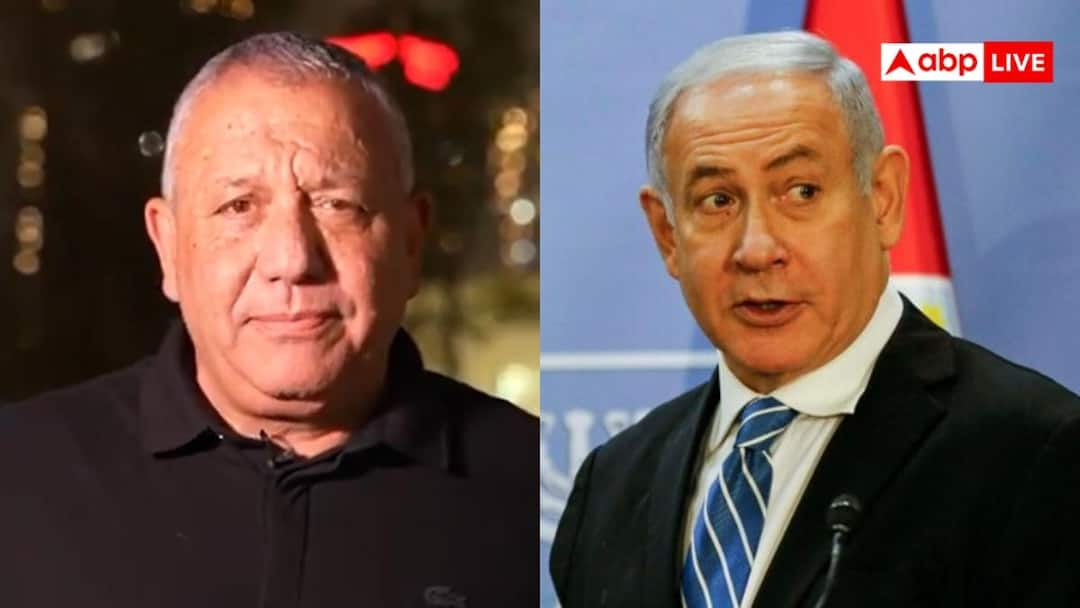
- Netanyahu offered Eisenkot premiership; Eisenkot invited immediate unity talks.
- Eisenkot noted no response; opposition called offer a trick.
- Election deadlock persists; Netanyahu cited security, trial issues.
Israel’s political deadlock continued on Saturday as Yashar party leader Gadi Eisenkot invited caretaker Prime Minister Benjamin Netanyahu and his team for immediate talks on forming a national unity government. Eisenkot gave Netanyahu’s Likud party 24 hours to demonstrate its willingness to negotiate, hours after the prime minister offered him the top post under a rotation arrangement.
In a post on X, Eisenkot invited Netanyahu and his negotiating team to the Dan Accadia Hotel in Herzliya, where he is staying with his own team, for discussions on the proposed government’s basic guidelines and policy issues.
“If Likud is ready for genuine unity, I am ready to assess the seriousness of its intentions over the next 24 hours, and I invite Netanyahu and his team, tonight, to the Dan Accadia Hotel in Herzliya, where I am staying with my negotiating team, to conduct genuine and accelerated negotiations on basic guidelines and policy issues–based on the detailed proposal to which Netanyahu has yet to respond,” Eisenkot said.
He added that his commitment was to forming a government representing all Israeli citizens, including those who did not vote for him or his political partners.
“The unity Israel needs, which I am committed to and for which I am prepared to pay political prices, is unity among Israel’s citizens based on values; unity around a new and different path that will honour and celebrate the Israeli solidarity I see as a fundamental component of Israel’s national security,” he said.
Eisenkot Says Netanyahu Has Not Responded To Policy Proposal
Eisenkot said a detailed proposal had been sent to Netanyahu on Sunday through a secret channel established at the prime minister’s request. The proposal covered substantive policy matters and included significant compromises in certain areas, he said.
“To this very moment, we have received no response on these issues,” Eisenkot said, adding that his team had been seeking genuine negotiations for around three weeks but had encountered “refusal and evasion”.
He also said the basic guidelines for the government he intended to swear in over the coming days had already been drawn up and would form the basis of any future government led by him.
Netanyahu Offers Eisenkot Prime Minister’s Post Under Rotation Deal
Eisenkot’s remarks came after Netanyahu renewed his appeal for a national unity government on Saturday evening, offering for the first time to serve as alternate prime minister while Eisenkot takes office as prime minister at the beginning of the government’s term.
In a post on X, Netanyahu said the scale of the security threat facing Israel required him to set aside the principle that the largest party should lead the government.
“Given the magnitude of the existential threat and the possibility that a government could be formed that lacks the ability to confront it, my responsibility as a leader requires me to set everything aside, including the principle that the largest party should lead, and agree that Gadi Eisenkot will serve first as prime minister, while I serve as alternate prime minister at the beginning of the term,” Netanyahu said.
Addressing Eisenkot directly, he called for immediate negotiations and urged both sides to show a willingness to compromise to establish a government capable of safeguarding Israel’s security and future.
The proposal followed speculation in recent days that Netanyahu could offer to take the second position in a rotation arrangement. However, Yisrael Beytenu leader Avigdor Liberman had earlier cautioned that such an announcement would be “nothing more than a political manoeuvre”.
Opposition leaders also criticised Netanyahu’s offer. Democratic leader Yair Golan said, “Enough with the tricks and games. Netanyahu lost. It is our duty to respect the will of the voters and establish a government of change and recovery.”
Yair Lapid, second-in-command in Naftali Bennett’s Beyachad faction, also questioned the proposal, calling it “another transparent con by a serial fraudster who has deceived every partner and violated every agreement”.
“The only way to test this proposal is to swear in a government headed by Eisenkot, and only then can negotiations begin on the possibility of expanding it,” Lapid added.
Netanyahu Raises Court Trial, Knesset Disputes In Unity Appeal
In his address, Netanyahu also referred to developments in his ongoing criminal trial, claiming that recent court proceedings had brought “truth and justice” to light. He cited comments by Judge Rivka Friedman-Feldman concerning Cases 4000 and 2000, as well as the possibility of an agreement in Case 1000.
Netanyahu also criticised recent scenes in the Knesset, alleging that lawmakers had shown disrespect towards national symbols, veterans suffering from combat trauma and bereaved families.
Referring to a legislative vote earlier in the week, he said demands by Ra’am and the Joint List had led to the defeat of a bill intended to prevent the return of terrorists’ bodies to their families.
He further alleged that Arab political parties could enable policies affecting Israel’s security, including changes concerning citizenship, security zones and the establishment of a Palestinian state.
Arguing that the need for national unity had grown, Netanyahu said, “The overwhelming majority of Israeli citizens are not falling for this transparent manoeuvre. Since the dramatic revelations in court and the disgraceful events in the Knesset, many people have approached me expressing a desire for unity.”
He added, “We must confront immediate threats to our very existence. The only way to do so is by bringing together all parties that recognise Israel as the nation-state of the Jewish people.”
Netanyahu also said a unity government would need to address issues including military conscription and Torah study, with understandings to be reached with ultra-Orthodox partners.
Israel Election Results Leave Both Blocs Short Of Majority
The political deadlock follows Israel’s October 27 general election, in which no bloc secured the 61 seats needed for a majority in the 120-member Knesset.
Netanyahu’s right-wing and religious bloc won 53 seats, leaving it eight short of the majority mark. Likud secured 27 seats, while United Torah Judaism and Otzma Yehudit won seven each. Shas and Religious Zionism secured six seats apiece.
Eisenkot’s Zionist opposition bloc secured 48 seats. It comprises Yashar with 21 seats, Naftali Bennett and Yair Lapid’s Beyachad with 12, The Democrats with eight, and Yisrael Beytenu with seven.
The bloc remains 13 seats short of a majority without either bringing Likud into the government or relying on outside support from Arab-led parties. The Joint List won 11 seats, while Ra’am secured eight, taking the combined tally of the two parties to 19.
The results have left the formation of the next government dependent on negotiations between the political blocs and the possibility of support or participation from parties outside them.
Disclaimer : This story is auto aggregated by a computer programme and has not been created or edited by DOWNTHENEWS. Publisher: abplive.com