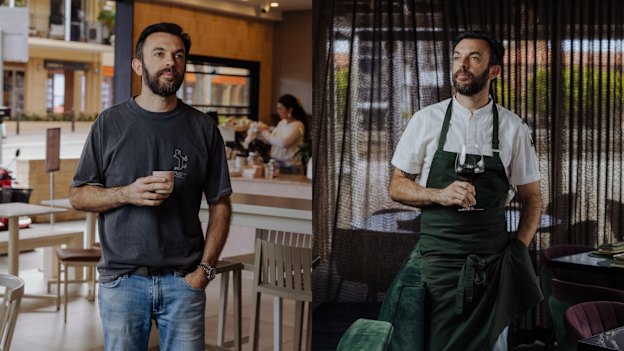
One acclaimed chef reckons high-end restaurants have an expiry date, another says the maths doesn’t add up, but they all agree evolution is the answer.
When two of Australia’s most celebrated restaurants closed this year, they became the loudest canaries in the coal mine of haute cuisine. Something wasn’t right, and fine dining would have to evolve to survive.
Quay, which was the only restaurant to have ever held three hats, the highest Good Food Guide ranking, for 24 consecutive years, shut its Circular Quay venue first, hosting its final service on Valentine’s Day. The owner of the harbourside restaurant, Leon Fink, pointed to rising operational costs, lagging tourism, and the suburbanisation of the hospitality sector.
Oncore by Clare Smyth’s closure followed two weeks later when the UK-based chef’s contract concluded with Crown Sydney.
As Melbourne chef Peter Gunn prepared to farewell his two-hatted Collingwood restaurant Ides in March, he wondered what it meant for the future of fine dining: “When you see a temple of gastronomy like Quay close, you sort of think if they can’t do it, when they’ve got their legacy, their hospitality group behind them, and their chef [Peter Gilmore] who is more-than-well-established, what makes it viable for anyone else?”

After 10 years of pushing Ides to become the best restaurant it could be, Gunn was done. The pursuit of excellence that once lured him into the world of aspirational dining had become all-consuming. He was tired of the set menu format and so were diners, if the decline in bookings was any indication.
Restaurant reviews, news and the hottest openings served to your inbox.
“It’s one of those unspoken things that we all know: chefs can only work in fine dining for so long,” said Gunn. “Then they get f—ing fed up with it, and they crash.”
Gunn tried shifting gears by introducing an a la carte menu, but there was no disguising those beautiful solid brass tables, or the long marble bar: Ides was a fine dining restaurant, and it had run its course. After the farewells ended, the doors closed, and the tears stopped, Gunn said the clean-up felt “like a slow, painful death”.
‘Fine dining will never die, we cannot let it. It will evolve.’Federico Zanellato
“Fine dining restaurants are delicate, difficult to run, and they have an expiry date,” said Federico Zanellato, the chef-restaurateur behind two-hatted Pyrmont restaurant LuMi.
The concept, he said, is fatally flawed: its success hinges on a single visionary chef, only human and subject to mounting pressures.
“What would happen if you took Peter Gilmore from Quay? These chefs created that vision, that concept, and when they are no longer there, there’s no longer a business,” Zanellato said.
“I know that LuMi must follow a life cycle,” he said. “Eventually, I am going to run out of creativity, energy and time.”

Fine dining is a necessarily challenging endeavour. That’s the appeal, said Rob Cockerill, Quay alumnus and head chef of Bennelong at the Sydney Opera House. In what other profession do you become the caretaker of a 20-year-old lobster, fetching buckets of water from Sydney Harbour for its tank, only to deconstruct every part of its body into mousselines, consommes, tapioca pearls and dumplings, as he once did at Quay?
“It’s the pinnacle of dining,” Cockerill said. “We put all of this effort and energy, over months, to develop something special, art that will be put on a plate and consumed within a matter of seconds.”
Each year, it costs more to produce. In April, the Australian Bureau of Statistics reported the price of dining out inflated by 3.9 per cent over the past 12 months, outpacing CPI due to the elevated cost of wages and ingredients.

At three-hatted restaurant Sixpenny, in Sydney’s inner west, chef-owner Dan Puskas said suppliers added an extra charge after Iran closed the Strait of Hormuz, to cover the rising cost of fuel.
“Costs have blown out to a point that’s beyond rational,” said chef-restaurateur Aaron Turner, who closed renowned Geelong restaurant Igni in 2023. “At a certain point, it stops being about creation and becomes about survival.”

Labour is one of fine dining’s greatest financial challenges – a full kitchen brigade employs 20 people, and Gunn did the maths: if it cost around $13,000 to pay 11 employees at Ides, a large format restaurant requiring a week of training would mean a $20,000 wage bill “and that’s before you even served your first customer”.
The world inside a fine dining kitchen has always felt “magical” to Melbourne chef Hugh Allen. He was nine years old when he read about Michelin-starred restaurants like The French Laundry in California, and by the time he turned 30, his first solo restaurant, Yiaga, received a score of three hats from The Age chief restaurant critic Besha Rodell.
External investment was necessary to make the magic happen, said Allen.

“The cost of entry is considerable, and if you’re opening at the higher end, the expectations are high from day one,” he said.
“There’s very little opportunity to open quietly and build gradually — from the moment you open, everything is on social media, Google reviews, and in the media.
“There’s very little room for error.”
Australia’s cost of living crisis has compounded the pressure: “The challenge has [always] been matching [the cost of operation] with what you can reasonably charge,” Allen said. “That tension has only grown.”
It’s worth the investment, said Victor Liong, the chef-restaurateur behind Lee Ho Fook in Melbourne and Sydney: “If there are no fine dining restaurants in Australia, the next hungry, passionate chef is just going to go overseas, and we might lose them.”

Zanellato said restaurant profit margins have diminished to around 5 per cent in Australia, where restaurants aren’t able to command the high prices of their European counterparts. He points to one restaurant which charged him €350, not including drinks – the equivalent of around $700: “You’d never be charged that here, even though the rent and labour costs more.”
“We’ve got to start charging what it costs to deliver a fine dining experience.”
That is the future of fine dining during a cost of living crisis, Gunn said: a contracted selection of the most elite culinary experiences, and little else.
“I think people are more cautious with their money. If they’re going to spend $200 on a set course menu they might as well spend another $100 on what is perceived as the better option,” he said. “And if they’re not doing that, they’re getting a beer and a burger.”
The OpenTable 2026 Dining Trends Report found 67 per cent of Australians considered dining out a “special treat” rather than a regular habit, while 60 per cent said casual, affordable meals were the most appealing
dining experience.
“Fine dining will never die, we cannot let it,” said Zanellato. “It will evolve.”
For Zanellato, that meant diversifying to capture the casual dollar. In 2021, he opened his first bakery, Lode Pies. Now, he operates five locations across Sydney, as well as Freo, a burgeoning chain of upmarket frozen yoghurt shops.

Prefecture 48, a conceptual six-venue dining experience in Sydney, offers a fine dining omakase restaurant and two-hatted kaiseki restaurant Garaku, alongside a casual diner and patisserie.
“You can see it in the market, there’s a trend of blending casual and fine dining, and less of a boundary between them,” said brand director Cindy Tseng.
“Fine dining is no longer about putting out the white tablecloth, it’s about finding creative concepts, sensory experiences … and telling a story that diners can connect with.”

For independent restaurants, the solution is to evolve slowly, and keep it small. Sixpenny in Sydney’s inner west has 13 tables, and “touch wood, we’re full most nights,” said Puskas.
“A small team, a good average spend per head, and the numbers seem to work,” he said. “The important thing is to keep moving forward, looking at what the rest of the world is doing and evolving in a way that makes sense to us.”
Disclaimer : This story is auto aggregated by a computer programme and has not been created or edited by DOWNTHENEWS. Publisher: www.smh.com.au