
Doomscrolling. Bedrotting. Extinction. Dislocation. Isolation. In the internet age, these topics are discussed with unflinching irony.
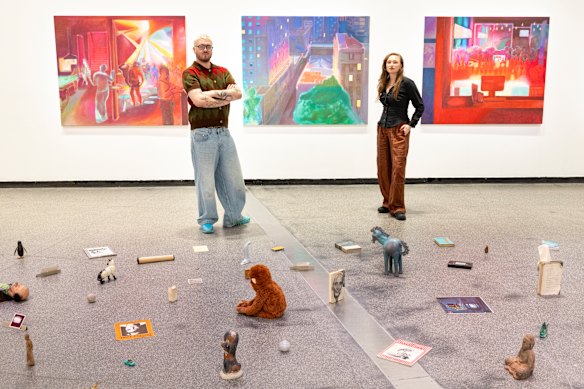
This week, the Australian Centre for Contemporary Art launches Are you lonely tonight? I’m so lonesome I could cry, a new exhibition that presents a scattering of responses to loneliness in 2026, part of a new series of exhibitions exploring art and emotion.
“The premise was that it seems so simple, but it’s an entry point to break into the nuances,” says co-curator Sophie Prince. “The world moves quickly. Looking through one lens like this could be totally different depending on when you do it.”
Questions abound: are we ever really alone when we’re constantly online? Is loneliness, and the capacity for solitude, unfairly maligned? Prince and her colleague Myles Russell-Cook, ACCA’s artistic director and chief executive, have drawn together 11 artists from Australia and the world to provide oblique answers.
Visitors are welcomed by Russell-Cook’s goldfish, alone in a small tank, leading us in to Kelly Yu’s short film Endling (2024), a speculative mockumentary about the carer of the world’s last goldfish, drawing on very real species extinctions.
Animals and anthropomorphism as triggers for empathy recur throughout the show. On the floor beyond, among Patrick Pound’s esoteric found materials is an orangutan plushie from IKEA. The toy was immortalised by Punch, a Japanese macaque and resident of the Ichikawa City Zoo who became attached to the toy when he was rejected by his macaque peers.
Pound’s collection, Museum of Loneliness (2026), is ephemeral but loaded with meaning. A VHS tape hand-labelled “Gulf War” sits alongside a statue of Christ on the cross, a Lonely Planet guide to Israel and the Palestinian Territories, and a photograph of an anonymous woman, her face cut out. All are scattered across the floor, in search of context.
LA-based weaver Kayla Mattes contributes Lonely Planet, a vast, seven-metre tapestry of internet moments and ephemera: memes, error messages, notifications, step counts and search results were lovingly hand-stitched over more than a year. Punch the monkey turns up here, too.
Mattes’ and Pound’s works exist in tandem, exploring ephemera in two dimensions and three – something they will surely discuss in an artist talk on Saturday.
The doomscroll continues with Seth Brown’s Frank (2024), one of the earliest works picked for the show. It’s a hot dog attached to a mustard bottle, repeatedly slapping against a phone screen, triggering an endless scroll through AI-generated images of bread. Like much in the show, it’s a grotesquely funny, but full of yearning.
Several series of paintings explore more serious territory: Melissa Nguyen’s enigmatic works, made with rabbit skin glue on canvas, blur personal histories with historical ones, responding to the life her mother led before her birth, of which very few photographs remain. Ghanian artist Gideon Appah, in video and painting, teases out the distinction between being alone and being lonely.
In a double-take moment, the name Lucy Liu appears – yes, that one. A multi-hyphenate artist, Liu has been painting for as long as she’s been a film star, though often under her Chinese name, Yu Ling.
These starkly explicit paintings explore private lives and sexuality, drawing on Japanese Shunga erotica with broad swaths of paint. The works themselves, the separation of her artistic output, and the notion of being “lonely at the top” all fuel the show’s theme.
Russell-Cook travelled to New York to meet Liu and discuss her inclusion in the show. “Her art is primarily for her,” says Prince. “She’s very careful about how it’s put out into the world, and interpreted with the proper intentions.”
This intentionality is a through line in the show. “We never wanted to shove 50 artists in here,” says Prince. “There’s genuine care in the process. We want space for communication, to be creative together.”
Natasha Matila-Smith’s If I die, please delete my Soundcloud (2019), an unmade bed with a laptop on it, incorporates endless scrolling and defensively ironic internet-speak. In the opposite corner are Polly Borland’s sculptures of warped human-textile hybrids that speak to Matila-Smith’s work, and the idea of “bedrotting”. They’re feminine, fleshy and subsumed by lumpen unsightliness.
With only 11 artists, the show is spacious, leaving room for connections between the works. The cute sits alongside the erotic, and loneliness emerges in a crowd. There’s a sense of play throughout.
Are you lonely tonight? I’m so lonesome I could cry is conceived as the first in a series of shows on art and emotion at ACCA, to be followed in 2027 and 2029 by shows about rage (All day long I felt like smashing my face in a clear glass window) and joy (This joy that I have, the world didn’t give it to me, the world can’t take it away).
Prince says the intention in these shows isn’t to be definitive, but to open up connections.
“There’s a legacy of shame and privacy that loneliness kind of instils,” says Prince. “People turn to art to process their loneliness privately. But here we’re doing it together.”
Are you lonely tonight? I’m so lonesome I could cry is at ACCA until August 30, 2026.
The Booklist is a weekly newsletter for book lovers from Jason Steger. Get it delivered every Friday.
 Will Cox writes fiction and arts criticism. He’s based in Merri-bek.
From our partners
Disclaimer : This story is auto aggregated by a computer programme and has not been created or edited by DOWNTHENEWS. Publisher: www.smh.com.au