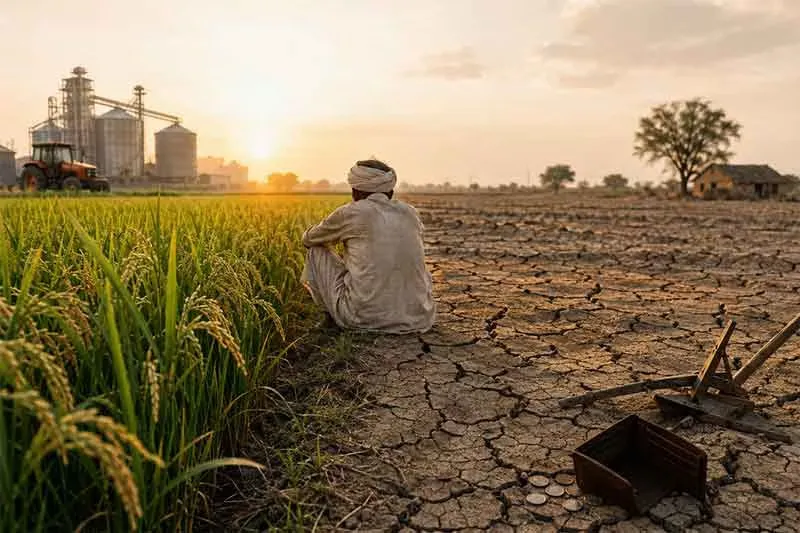
A farmer can prepare the land, choose the right seeds and spend months tending to a crop. But there is one thing no amount of hard work can guarantee: rain arriving when it is needed most.
A dry spell at the wrong time can leave the soil parched, crops struggling and an entire season’s earnings hanging in the balance. And by the time the damage becomes visible, the chance to do something about it may already be slipping away.
What if farmers could see that risk coming, even before the first signs appeared in their fields? What difference could four weeks of advance warning make?
That is the possibility researchers at IIT Bombay are exploring with KrishiDrought, an AI-powered portal that uses satellite observations and climate data to forecast agricultural drought conditions up to a month in advance.
Launched on 28 October 2026, the platform provides weekly forecasts across India, helping users identify areas where soil moisture could deteriorate in the coming weeks.
How an early warning could protect a harvest
Drought is often associated with a prolonged absence of rainfall. However, for agriculture, the problem goes beyond how much rain a region receives.
Agricultural drought occurs when the moisture available in the soil is insufficient to meet the water requirements of crops. Even when a region receives some rainfall, prolonged dry spells, changing weather patterns and high water loss from the soil can leave crops struggling.
This makes it important to understand not just how much rain has fallen, but also how much moisture the soil retains.

Traditionally, drought assessments have largely focused on identifying conditions that have already developed. KrishiDrought takes a more forward-looking approach by attempting to predict how soil moisture conditions could change over the next few weeks.
The idea is to give farmers, government agencies and other stakeholders more time to consider measures such as irrigation planning, crop management and drought preparedness.
Can satellites predict when soil will run dry?
Developed by the Ecohydrology Research Group, led by Professor Karthikeyan Lanka, in collaboration with IIT Bombay’s Centre of Studies in Resources Engineering (CSRE) and Centre for Climate Studies, the platform brings together multiple sources of environmental information.
These include satellite observations, hydroclimatic datasets, dynamical forecasts and advanced deep-learning models.

In simple terms, satellite data helps researchers monitor changing conditions across large areas, including variations in soil moisture. Hydroclimatic information provides additional insights into the relationship between water, rainfall and climate, while dynamical forecasts help estimate how environmental conditions may evolve.
The AI-based deep-learning models bring these different inputs together to identify patterns and generate forecasts of future soil moisture conditions.
The resulting forecasts are available at an approximate spatial resolution of 9 km and are presented at the district level.
A map that shows where drought could develop
One of the platform’s useful features is its map-based interface, which allows users to explore drought conditions across different parts of India.
The map uses a colour-coded system to make the information easier to interpret. Shades towards red indicate drier-than-normal soil moisture conditions, while green represents wetter-than-normal conditions.
Users can select individual states and districts and examine forecasts across four different time windows: one, two, three and four weeks ahead.

This means that instead of looking only at the current situation, users can explore how soil moisture conditions might develop over the coming month.
For instance, if a district is forecast to experience increasingly dry soil conditions, farmers and agricultural authorities could use this information to assess whether irrigation arrangements or other crop-management measures need attention.
The forecasts are intended as an additional decision-making resource, rather than a replacement for local agricultural advice.
What four extra weeks could mean for farmers
The larger thought behind KrishiDrought is to make agricultural planning less dependent on reacting to a crisis after it has begun.
With rainfall patterns becoming increasingly difficult to predict, access to timely environmental information can help farmers and authorities make better-informed decisions. Even a few weeks of advance notice could provide additional time to assess water availability, plan irrigation and consider steps to reduce potential crop losses.
The portal is publicly accessible at KrishiDrought.in, making its forecasts available to farmers, government agencies and other stakeholders.

For a farmer, a few extra weeks can make a meaningful difference. It could mean having time to arrange water for a thirsty crop, rethink an irrigation schedule or seek advice before a dry spell takes a toll on the harvest.
KrishiDrought is an attempt to put that time back into farmers’ hands. By combining satellite data, climate science and AI, IIT Bombay’s researchers hope to make drought preparedness more proactive, helping farmers look ahead, make informed decisions and face an uncertain growing season with better information and a little more confidence.
Sources:
‘How IIT Bombay is fusing satellite data, AI to forecast droughts 4 weeks in advance’ by India Today, Published on 2 November 2026.
‘IIT Bombay launches KrishiDrought portal to warn Indian farmers of agricultural droughts a month in advance’ by Ishita Ganguly for Startup Pedia, Published on 2 November 2026.
Disclaimer : This story is auto aggregated by a computer programme and has not been created or edited by DOWNTHENEWS. Publisher: thebetterindia.com