
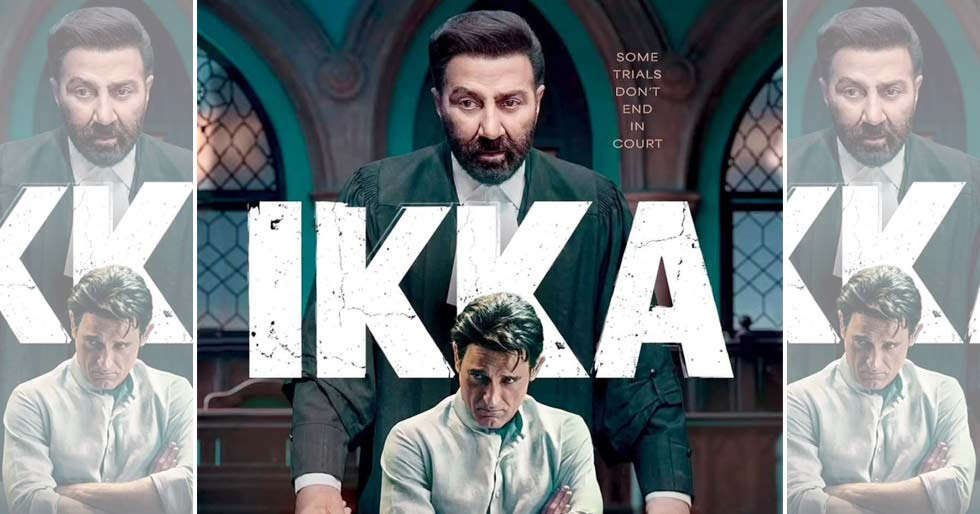
What would you do if life forced you to defend the very man you loathe from the bottom of your heart?
That’s the ethical knot at the centre of Ikka. Sunny Deol plays Arjun Mehra, a celebrated criminal lawyer whose reputation rests on integrity, impeccable legal acumen and an unwavering belief in justice. His carefully ordered life is thrown into disarray when personal circumstances compel him to represent Shauryamann Gaur (Akshaye Khanna), a man Arjun firmly believes is guilty and someone with whom he has had beef in the past. As the trial unfolds, Arjun finds himself torn between his conscience, his family and his professional duty. Is justice always the same as legality? Can a lawyer separate personal conviction from constitutional obligation? Rather than relying on dramatic objections and table-thumping theatrics, Ikka attempts to explore these morally grey questions through psychological sparring and legal manoeuvring.
The biggest strength of Ikka lies in its central premise. It’s deliciously uncomfortable. An upright lawyer defending someone he despises isn’t merely a legal dilemma; it’s a deeply human one. The film constantly nudges us to ask whether the law exists to protect truth or procedure, and whether those two things always walk hand in hand. These moral ambiguities lend the narrative a welcome maturity, resisting the temptation to reduce every conflict into black and white.
Malhotra also deserves credit for resisting the urge to turn every courtroom exchange into a whistle-worthy monologue. There are no gravity-defying speeches designed purely for social media reels. The tension comes through strategy, cross-examinations and the psychological battle between opposing sides.
The biggest issue with Ikka is that it spends far too much time telling us who its characters are instead of allowing us to discover them ourselves. Cinema, after all, is a visual medium. Here, almost every important emotional beat arrives wrapped inside exposition.
We’re repeatedly told that Arjun Mehra is a legendary lawyer who has spent his career fighting for the underdog. Yet beyond dialogue, we scarcely see evidence of this reputation. He heads what appears to be a high-powered corporate law firm while simultaneously championing the common man in criminal courts. How exactly does he balance these two vastly different careers? Does he take pro bono cases? Has he built his reputation through landmark criminal trials? A few flashbacks, old newspaper clippings or even brief visual glimpses of his earlier victories would have made his legend feel earned rather than merely announced.
The same problem extends to almost every important relationship in the film.
Arjun, Shauryamann and Dia Mirza’s characters clearly share a complicated history. That history is, we’re informed, central to the motivations driving the present-day conflict. Yet instead of allowing audiences to witness fragments of those shared experiences, the screenplay simply has characters recount them. Emotional investment inevitably suffers because we’re constantly being briefed instead of being immersed.
Akshaye Khanna’s enigmatic Shauryamann Gaur also ends up being more intriguing in theory than execution. The screenplay insists he’s dangerous, manipulative and morally corrupt, yet rarely gives us enough glimpses of his past to independently arrive at those conclusions. Much of his screen time consists of quietly observing proceedings from the courtroom, leaving one wishing the film had exploited his immense ability to convey menace through subtle expressions. Khanna remains magnetic almost by default, but the writing never fully cashes in on his presence.
Sanjeeda Sheikh’s character, meanwhile, steadfastly supports her husband through situations that increasingly stretch credibility. Her motivations remain frustratingly underdeveloped. Likewise, Dia Mirza is introduced as a lawyer, but is largely relegated to being wife and mother. Why she abandoned her legal career is never adequately explored. These aren’t gaping plot holes, but they’re noticeable omissions in a film otherwise so invested in character motivations.
Fortunately, what the screenplay occasionally lacks, the performances frequently compensate for.
Sunny Deol delivers one of the most understated performances of his career. Fans expecting flying hand pumps and flying villains may need to recalibrate expectations. His famous dhai kilo ka haath makes only one mandatory appearance—and yes, it’s entirely deserved—but for most of the film, Arjun Mehra fights with intellect rather than intimidation. It’s a refreshing reinvention for an actor so often associated with righteous fury. Watching him quietly calculate his next legal move proves just as satisfying as watching him demolish villains.
That said, a tiny part of you still secretly wishes he’d lose his temper just once more.
Akshaye Khanna remains effortlessly watchable, even within the limitations imposed on his character. Few actors communicate ambiguity quite as effectively as he does. Whether Shauryamann is calculating every move or genuinely cornered remains intriguingly difficult to decipher for much of the runtime. One only wishes the screenplay had given him more opportunities to dominate proceedings instead of confining him to the defendant’s chair.
The film’s scene-stealer, however, is Tillotama Shome as the government-appointed public prosecutor. She receives some of the sharpest dialogue, but it’s the little details she brings, the pauses, glances and understated confidence, that elevate the character. Good actors often make roles appear larger than they are on paper, and Tillotama does exactly that. Dia Mirza lends warmth and quiet dignity to an underwritten role, while Sanjeeda Shaikh does what she can with limited material.
Despite its narrative shortcomings, Ikka remains an intelligent courtroom drama that values moral complexity over easy applause moments. It asks interesting questions, even if it doesn’t always dramatise them as effectively as it should. Better visual storytelling and richer character backstories could easily have elevated it from good to genuinely memorable.
The ending leaves the door tantalisingly open for a sequel. If that happens, here’s hoping the filmmakers trust images as much as they trust dialogue. The film is currently streaming on Netflix.
Also Read: Ikka Trailer: Sunny Deol’s Principles Are Put to Test As He Defends Akshaye Khanna
Disclaimer : This story is auto aggregated by a computer programme and has not been created or edited by DOWNTHENEWS. Publisher: filmfare.com





