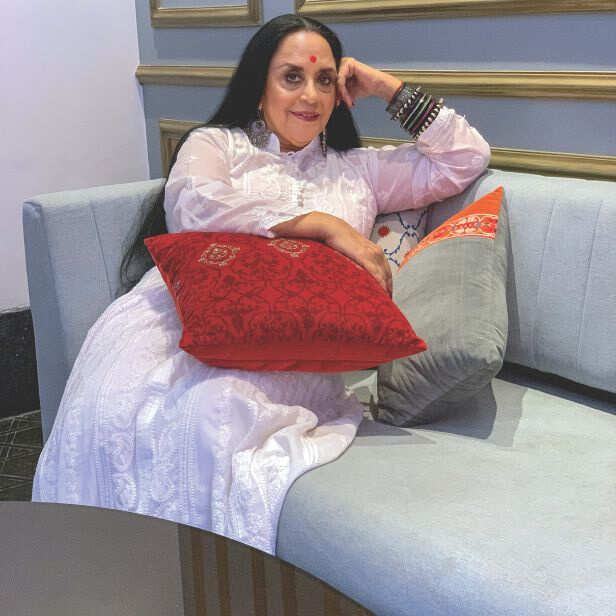
Under a star-kissed night against the sand hills, Ila Arun’s lament, Mhare hivde ne beh gayi re qataar re, moriya chhore bolyo re dhalti raat ma (a dagger seems to have poked my heart when the peacock sang in the middle of the night)… ripped through the deserts of Jaisalmer even as Sridevi danced to Morni baagha ma bole in Yash Chopra’s Lamhe (1991). The folk song remains a tribute to the soul and sensibilities of Ila’s birthplace Rajasthan, which though arid, is culturally lush. Close on heels came her robust and raunchy Choli ke peeche kya hai for Neena Gupta’s banjaran in Subhash Ghai’s Khal-Nayak along with Alka Yagnik’s peppy rejoinder sung for Madhuri Dixit. “All music has its roots in folk. I made it my art,” says Ila who also has a hefty catalogue of private albums to her credit. “People may think you’re a ‘bhenji’ type but you beat them with your grasp of the roots,” smiles the folk-fusion artiste who recently shared her eclectic journey in her memoir Parde ke Peechhey.
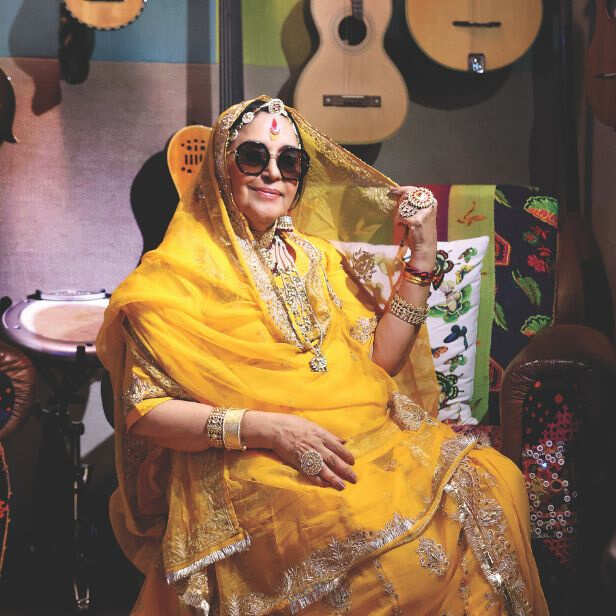
Her appearance is as vibrant as her voice. “Given my ethnic jewellery, I’m often told I am a brand ambassador for both, silver and Rajasthan. I love tradition and I live it. I don’t feel the weight of my heavy silver accessories. I’ve always worn them. In fact, even when I go for a medical check-up, I’m asked about my exotic bindis,” laughs the 70-plus singer, who was also the empowering voice of the Rajasthan Royals anthem, Halla Bol, for the inaugural IPL T20 Cricket League. Over the decades, multi-talented Ila has built her repertoire in radio, theatre, television, films and music as a writer-singer-composer. Be it in Shyam Benegal’s Mandi, Nandita Das’ Manto, Ashutoh Gowariker’s Jodhaa Akbar, Srijit Mukherji’s Begum Jaan, the British film West Is West or Ram Madhvani’s digital series Arya 3… Ila is as ageless as her art. Her story in her own words:
Jodhpur connection
I was blessed to be born in Jodhpur, Rajasthan. Folk music has seeped into my consciousness since childhood. I recall the beautiful winters, where my mother (Bhagwati Pandey) would be roasting sweet potatoes on charcoal and I’d be singing. I had seven sisters and two brothers. Ours being a joint family, the women and the helpers would sing folk songs while sieving the grains. The music of tribal communities inspired me. Women working on construction sites would keep humming to lighten the weight of work. My domestic staff, Raghunath, dropped me to school every day. He wore a dhoti and shirt with colourful buttons, which matched his vibrant turbans. I’d be sitting in front of him listening to him sing as he cycled me to school. Unknowingly, he became my teacher.
I studied in a government school, Maharaja Multipurpose High School. We were taught all art forms including painting, classical music and dance. I developed an interest in music and drama. As a college student, I got more exposure. Rajasthan is full of celebrations, music festivals, literary festivals, theatre. Concerts would be held in the colleges of Jaipur where maestros including Bhimsen Joshi regaled audiences. They’d begin in the evening and end with the morning ragas.
Love of theatre
I began doing theatre under the guidance of actor Pinchoo Kapoorji and playwright/director Mohan Maharishiji at Jaipur’s Ravindra Manch. I was part of Mohanji’s adaptations of classic plays, including Bernard Shaw’s Pygmalion. In the ’70s, I received a scholarship from the Sangeet Academy for a six-month acting course at Delhi’s National School of Drama (NSD). Theatre doyen Ebrahim Alkazi was its director. I was fortunate to have Alkaziji as my teacher too. I worked with him in King Oedipus. I owe it all to him.
In Mumbai, I gravitated towards Prithvi Theatre. In 1983, I co-founded Surnai Theatre And Folk Arts Foundation with theatre veteran K K Raina. To honour the works of Norwegian playwright Henrik Ibsen, we initiated the Ibsen Festival in Mumbai in 2014. We began with the adaptation of Ibsen’s Peer Gynt into Peer Ghani. The story set in terror-afflicted Kashmir of the ’80s follows young Peer, who loves to dream to survive the times. We also adapted other Ibsen’s plays including Ghosts (Peechha Karti Parchhaiyaan), The Lady From The Sea (Mareechika), Hedda Gabler (Hardit Kaur Gill)…
Among the many plays I wrote, Riyaz, explores the relationship between a man and a woman, using music as a metaphor. Recently, I scripted and performed in the play Shabd Leela, which presents extracts from the works of writer Dr Dharamvir Bharti along with letters written by him to his wife, Pushpa Bharti, exploring themes of love and spirituality.
Lure of screen
Television peaked between the 1980s-1990s. I was happy to be part of Govind Nihalani’s telefilm Party (1984), Tamas (1988), his films Ardh Satya (1983), Droh-Kaal (1994), and Rukmavati Ki Haveli (1991). I call Shyam Babu (Benegal) my godfather. I first worked with him in television beginning from Yatra (1986), Bharat Ek Khoj (1988) and Samvidhan (2014). Taking a detour, I sang for Smita Patil’s Giddh (1984). B V Karanth saab, who was a faculty teacher at the NSD, composed the music for the film. I sang Yellamma meri Yellamma and Yellamma tera uday ho in praise of the Goddess. His music was theatrical. He’d say, “Speak like you sing and sing like you speak.”
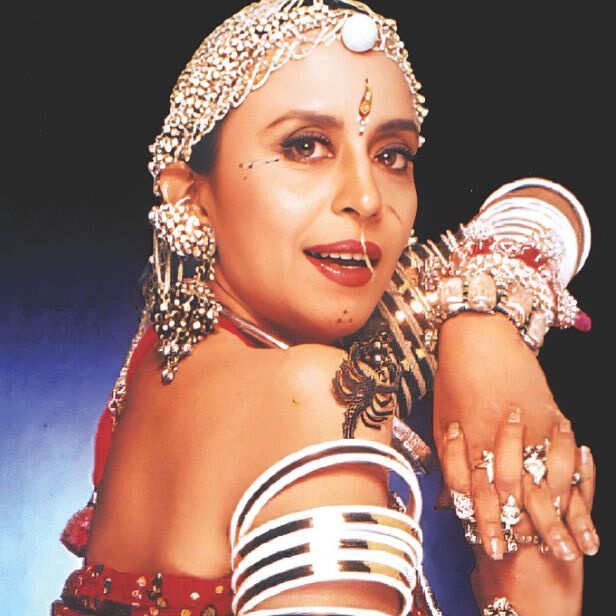
Coming back to Shyam Babu, my first notable screen outing was his Mandi (1983). A satire, it examines how the lives of sex workers in Hyderabad are affected by politics and fake morality. I play a prostitute Kamli, who’s pregnant with her third child and hence not in business. Incidentally, I sang five songs while playing Kamli though officially I wasn’t given any songs. What I liked about Shyam Babu was that he recognised my talent. Because I understood music and metre, he asked me to write the lyrics for Trikal (1985), even as I played a cook in the film. I wrote the lyrics of the songs Mando & Dulpod, Jao jao Anna, Teri ankhon ke chhote darwazon se for composer Remo Fernandes. He blended Western orchestral music with a Goan flavour. Shyam Babu’s 1987 film Susman explores the plight of Indian handloom weavers due to industrialisation. Working with the weavers up close gave me human insights. For Well Done Abba (2009), where I acted as Salma, Shyam Babu asked me to write a wedding song. I wrote the rap number O meri banno hoshiyaar cycle pe sawaar sitting at the airport. Shyam Babu had empathy for women and the marginalised. You can see it right from Ankur (1974). He was a vocal supporter of LGBTQ+ rights as well. You just had to keep listening to him on the set… even from afar and you’d be enriched. His students have been the legendary Shabana Azmi and Smita Patil. You learnt even by talking to them.
Risque factor
I was hosting a music show on TV, where I also sang folk songs. That’s how I caught the attention of filmmakers Subhash Ghai and Umesh Mehra. I was asked to sing Morni baaga ma bole for Yash Chopra’s Lamhe (1991). The song, featuring Sridevi and me, was shot in the desert of Jaisalmer. The first sitting was done at Yashji’s house with maestros Shiv Kumarji and Hari Prasadji. I got a chance to sing with Lata Mangeshkar, which is a moment to cherish forever. My familiarity with Rajasthani folk helped in my rendition. I also sang the folk lines, Phondar khada wo/ Jyo baayro kaako/ Kaako maaryo laat ri/ Main bheegi barsaat ma in the beginning of Megha re megha from Lamhe.
Subhash Ghai’s Khal-Nayak (1993) was the turning point. When I first heard the line Choli ke peeche kya hai it caught my attention. The reply, Choli me dil hai mera, sounded even more beautiful. I sang the traditional part filmed on Neena Gupta while Alka Yagnik sang for Madhuri Dixit. The song, composed by Laxmikant-Pyarelal, became a sensation with my unusually heavy voice being noticed. Good or bad, I got more acknowledgements because the question, ‘Choli ke peeche kya hai?’ was raised by me. Alka and I won the Filmfare Award for it. However my mother remarked, “What was the desperation to sing such a song?” I replied, “What’s wrong with it?” I reminded her that folk songs have always been teasing. Choli brought me so much fame. My stage plays also began running houseful.
In the same year, Chadh gaya upar re written by Maya Govind from Dalaal (1993) was a huge hit too. I’ve done so many live shows because of my songs. This is an answer to my school music teacher, who believed I could never sing. Coming to A R Rahman, we collaborated on several songs, including Muthu muthu mazhai (Mr. Romeo, 1995) and Ringa ringa (Slumdog Millionaire, 2008). Rahman was in London when Ringa ringa was to be recorded. He asked me to go to a studio in the South and record it. I sang it with Alka, whom I call my better half. I have sung maximum songs with her.
Going indie
I have around 10 private albums including Banjaran Gypsy, Chappan Churi, Bichhuda, Mela, Khichdi, The Very Best Of Ila Arun to my name. My niece from Bhopal shared that construction labourers there listen to my albums. One of them even said, “No one has sung about our life like Ilaji.” The common man can relate to my music and that’s my biggest achievement. But the song that comes closest to my heart is Vote for ghaghra (1995), included in my album of the same name. Written and sung by me, the Rajasthani rap, has become an anthem for women empowerment. It begins with the lines “Dehli sehar mai mahro ghaghro jo ghumyo” and goes on to say, “Mardaan ke aage niklegi janaani.” The number implies that a woman in a ghaghra is powerful and to be celebrated. Vote for ghaghra is a call to action. It advocates for an equal society. It cautions you not to underestimate the girl. She’s about dignity and strength.
No to remixes
Remixing old folk songs is like killing classic melody. I urge young composers to create their own music. Voyage 2 (2024) is a collaboration with my son-in-law Dhruv Ghanekar. The album includes songs Nacho, Jadoo and Charkha… which fuses Rajasthani folk music with other genres, including Balkan horns and African guitars. Last year, Voyage 2 garnered 62 million views. Two of my songs, Ghaghra and Choli ke peeche, were recreated for the Kareena Kapoor starrer Crew. I have a good relationship with Tips Films. They asked for my blessings so I gave it. But I believe I could have sung my own songs. Nevertheless, after Diljit Dosanjh’s Choli ke peechhe, I too got a lot of royalty.
I am now enjoying my run on OTT. I played Nawazuddin Siddiqui’s mother in Honey Trehan’s Raat Akeli Hai (2020). While in Akshat Ajay Sharma’s Haddi (2023), I play transgender Amma. Playing Nalini Sahiba, rival to Sushmita Sen’s character in Aarya 3, is going back to my Rajasthani roots but with a ‘royal’ touch. An artiste never ages. In every era, you just have to get better and better.
ALSO READ: Ila Arun: Rekha ji can be bubbly but she draws a line, one you can’t cross
Disclaimer : This story is auto aggregated by a computer programme and has not been created or edited by DOWNTHENEWS. Publisher: filmfare.com